UNCRC Report 2026 to 2029

Commitment Statement

We are pleased to introduce our first UNCRC Report and action plan, which sets out the actions we will take during the 2026 to 2029 reporting period.

This document provides information about ILF Scotland and the work we do. It focuses on how we support, engage with and listen to young people. It sets out our commitment to the UNCRC (Incorporation) (Scotland) Act 2024, the work that we have already done to promote children’s rights prior to 2026 and what we are doing now.

We aim to review our progress and planning relating to the UNCRC regularly and will formally appraise our progress in achieving our objectives on an annual basis and publish this on our website.

Human rights and equality are at the heart of what we do as an organisation and they run through all our everyday activities, thoughts, behaviours and plans. Our core principle is that disabled people have the same rights, freedoms, and abilities to lead the fullest lives they can, free from discrimination and on an equal basis as others. We strive to continuously improve on our commitment to human rights and children’s rights across the organisation.

We developed this report using the national UNCRC Implementation Framework to guide our self-evaluation. We have also published a child friendly version of the report on our website that is appropriate to the age range and accessibility requirements of the Recipients of ILF Scotland.

Our Board members and our staff are committed to ensuring the policies we work to, the services we provide, the decisions we make and the way in which we communicate with young people are as appropriate as they possibly can be. We will review this on an ongoing basis and include  the young people we are involved with in this process.

Anne Marie Monaghan
ILF Scotland Chair of Board

Peter Scott OBE
ILF Scotland CEO

Introduction to ILF Scotland

ILF Scotland is a Non-Departmental Public Body (NDPB), governed by a Board of Directors appointed by, and accountable to, Scottish Ministers. We provide discretionary funding to disabled people in Scotland and Northern Ireland to help them live independently with choice, control and dignity in their own homes and communities.

Our Strategy 2025 to 2028: Realising Ambition - Re-Opening and Beyond is focused on enabling more disabled people to access our funds, supporting cultural change and capability across the sector, and delivering a high-quality, inclusive and sustainable service. ILF Scotland is aligned with Article 19 of the UN Convention on the Rights of Persons with Disabilities and operates in line with the PANEL principles of Participation, Accountability, Non-Discrimination, Empowerment and Legality. We also seek to embed the principles of Co-operation, Dignity, Informed Choice, Involvement and Participation in the delivery of our services.

ILF Scotland is also a Corporate Parent. You can find more information on our website. Corporate Parenting Plan - 2024 to 2027.

UNCRC - Children's Rights

ILF Scotland became a listed authority under the UNCRC (Incorporation) (Scotland) Act 2024 in June 2024. We have been working with the Scottish Government and other colleagues since then to understand our commitments under the Act and prepare for the development of our first active plan from 2026 to 2029.

ILF Scotland must consider how its policies, decisions and services affect children and young people's rights. This includes gathering evidence on impact, involving children and young people in a meaningful and inclusive way, publishing a Children's Rights Report and a child-friendly version of that report, and ensuring that Board members, senior leaders and staff understand and fulfil their responsibilities in relation to children's rights.

For ILF Scotland, this means considering the rights and experiences of disabled children and young people wherever they may be affected by our funding, policies, services, communications and decision-making, and reporting on the actions we have taken and plan to take to advance children's rights.

UNCRC

The United Nations Convention on the Rights of the Child (UNCRC) is an international human rights treaty that sets out the rights of all children and young people and explains how governments and adults should work together to ensure children can enjoy those rights.

The Convention, signed by 196 countries, is the most widely ratified international human rights treaty in history. It contains 54 articles that cover all aspects of a child’s life and set out their civil, political, economic, social and cultural rights. The convention is universal – these rights apply to every child, and the convention entitles every child to claim them. It also explains how adults and governments must work together to make sure all children can enjoy all their rights.

The UNCRC (Incorporation) (Scotland) Bill was passed unanimously by the Scottish Parliament in December 2023 and came into effect on 16 July 2024. The Scottish Government affirmed that the UNCRC is at the heart of the Scottish Government’s commitment to ensuring that all children and young people have the best possible start in life, regardless of their circumstances.

Under the UNCRC, a child means “every human being below the age of 18”. A child has all the rights in the UNCRC until they are 18 years old.

The UNCRC Act followed over a decade of legislation and policy that protects and promotes children’s rights, including the Human Rights Act 1998, Getting It Right for Every Child (GIRFEC), the Children and Young People (Scotland) Act 2014, and the Children (Scotland) Act 2020. Children’s rights, within the broader context of human rights, are also embedded in Scotland’s National Performance Framework (NPF).

ILF Scotland’s Duties under UNCRC

As a listed authority under section 18 of Part 3 of the Act, ILF Scotland must report on actions we have taken and intend to take for the purpose of ensuring compliance with the UNCRC requirements under section 6(1) of the Act.

We must also report on actions we take and intend to take to secure better or further effect of the rights of children – referred to as Children’s Right’s Reports.

We have used a Children’s Rights Based approach to develop our implementation plan. This approach, developed by the Children’s Commissioner for Wales, provides a practical framework for working with children, grounded in the UNCRC. It ensures that children’s human rights are at the core of every aspect of decision making, policy and practice. It breaks this down into five key areas:

Each of the rights enshrined within the Convention is interlinked and no right is more important than another. Notwithstanding this, those UNCRC requirements most relevant to our work and where we can make the most impact include:

Article 2:   Non-Discrimination

Article 3:   Best Interests of the Child

Article 23: Children with Disabilities

ILF Scotland and Young People

Transition Fund

The Transition Fund was opened in December 2017 to provide one-off grants to young disabled people in Scotland aged 16 to 21 to help them increase their independence and participate in their communities. The upper age limit was increased to 25 in November 2019.

The primary aims of the Fund are to help young people:

Since the Transition Fund opened, we have provided grants of over £29 million to over 14,500 young disabled people. Of these Recipients, 6,425 were aged 18 and under.

Find out more about the Transition Fund on our website.

Independent Living Fund

The Independent Living Fund re-opened in April 2024 to new applications in Scotland. This Fund enables disabled people in Scotland with the most complex needs to access the support they need and deserve. Awards are paid on an ongoing, long-term basis.

Since re-opening, we have received over 1,500 applications and provided funding of around £16 million enabling many more disabled people to live independent lives within their chosen communities.

The re-opened Fund is available to people aged 16 and over and since April 2024, we have received more than 50 applications on behalf of Recipients aged under 18.

Find out more about the Independent Living Fund on our website.

Career Ready

As well as our Fund Recipients, ILF Scotland has supported young people through the Career Ready Scotland intern programme. Over the past three years, a number of interns aged 16 to 17 from local high schools have spent 4 weeks immersed within ILF Scotland, working with their allocated mentors in a variety of departments to experience the workplace, before delivering a presentation of their experiences to ILF Scotland staff, Career Ready representatives, teachers and their family members.

As well as being a learning opportunity for the interns, ILF Scotland members of staff have found the experience to be valuable and have received positive and helpful feedback from the young people.

We are delighted that one of the previous interns is now a full-time employee at ILF Scotland as a Modern Apprentice, having been successful after applying for an externally advertised post.

“I did my Career Ready internship at ILF Scotland when I was still at school. A year later, when I saw a Modern Apprentice position advertised, I immediately applied and was delighted to get the job, they are a really supportive employer and I am looking forward to progressing my career here.”                                               Mark

ILF Scotland’s Work and Children’s Rights

ILF Scotland is committed to equality, as outlined in our Mainstreaming and Equality Outcomes Report - 2026 to 2028.

“Equality is at the heart of what we do as an organisation and runs through all our everyday activities, thoughts, behaviours and plans. We strive to continuously improve on our commitment to mainstreaming equality across the organisation.”

As well as embedding equality within our culture, ILF Scotland must comply with the Equality Act 2010 (Specific Duties) (Scotland) Regulations 2012 and the specific duties designed to help Scottish public authorities meet the general duty. Regulation 4 of the specific equality duties requires that we base our Equality Outcomes on evidence and involvement of equality groups.

Our Board and staff group are diverse with regards to their own lived experience, and they are also well-informed about equality, diversity and inclusion more broadly. More specifically, we ensure that a programme of training and awareness is in place so that our staff have a high level of knowledge about the needs of young disabled people. Our employees are well qualified in health and social care and we regularly provide updated training.

Since July 2024, our work in this area has included:

How We Ensure Participation with Young People

Engagement and Young Ambassadors

ILF Scotland has a programme of engagement activity, with a focus on increasing awareness of the Transition Fund among priority groups. This helps in strengthening relationships with partner organisations, and providing direct support to young people, their families and professionals involved in supporting young people through transition from children’s to adult services.

In our engagement activity, we have tried to place particular focus on:

Through this engagement we have provided practical application support to increase access to funding.

Activity has included attendance at:

ILF Scotland has a group of young Transition Fund Recipients who are Young Ambassadors. These young Recipients aged 16 to 25 meet a few times each year to discuss common issues and provide feedback on their experiences with the Transition Fund.

The Young Ambassadors have previously discussed and provided feedback on publications and initiatives relevant to young people including:

The Young Ambassadors have had opportunities to attend events and engagement activities. This included a presentation by one of our Young Ambassadors at the ILF Scotland 10th Anniversary Celebration in June 2025, to an audience of over 100 guests, where they shared their experience of the Transition Fund and what it had enabled them to achieve.

As previously mentioned, ILF Scotland is a Corporate Parent and our plan can be found on our website. Corporate Parenting Plan - 2024 to 2027.

As part our Corporate Parenting role, ILF Scotland works collaboratively with partner agencies including the Centre for Excellence for Looked after Children in Scotland (CELCIS), the Office of the Children’s Commissioner for Scotland and Who Cares? Scotland.

A key area of our Corporate Parenting plan is to ensure that all ILF Scotland staff receive training in adult and child protection. All ILF Scotland staff are considered to have a safeguarding role with a duty to report any concerns of harm. We will continue to provide regular training on an ongoing basis.

What We’ve Done

Since July 2024, we have:

Action Plan for 2026 to 2029

Monitoring and Reporting

In addition to our action plan, we anticipate there will be additional areas identified through our ongoing improvement work and policy reviews that we will add to our UNCRC planning process.

We will monitor the progress of this plan and action points on a regular basis and report to our Senior Leadership Team. We will also provide updates to our Board and our Advisory and Ambassador Groups to provide members with assurance on our approach to meeting our UNCRC duties.

In addition, we will publish a report on progress on our website on an annual basis.
FOI-250826 - Transition Fund Applications Supported by Skills and Learning 33

Freedom of Information (FOI) Request

Reference Number:

FOI-250826

Fulfilment Date:

25/08/2026

Topic:

Awards Made to Transition Fund and Technology Grant Applicants where a Member of Staff at Skills and Learning 33 Had Been Cited as Having Provided Support in the Application Process.

Request:

Following on from ILF Scotland’s response to FOI-070826, please provide details of the amounts of money that were awarded to Transition Fund and Technology Grant applicants who had cited a member of staff at Skills and Learning 33 as a person who had provided support in the application process.

Response:

Awards made to Transition Fund and Technology Grant applicants who had cited a member of staff at Skills and Learning 33 as a person who had provided support in the application process are as follows:

Date Application Submitted, Application Type, Amount Awarded

16/06/2021, Transition Fund, £1849.00

14/12/2021, Transition Fund, £1479.00

05/04/2022, Transition Fund, £1843.00

27/06/2022, Transition Fund, £1605.00

23/01/2023, Transition Fund, £1909.00

15/06/2023, Transition Fund, £2109.00

19/07/2023, Transition Fund, £1709.00

15/09/2023, Transition Fund, £1909.00

02/10/2023, Transition Fund, £2029.00

08/11/2023, Transition Fund, £2395.00

15/11/2023, Transition Fund, £56.00

22/12/2023, Transition Fund, £2109.00

09/05/2024, Transition Fund, £300.00

23/05/2024, Transition Fund, £1400.00

29/05/2024, Transition Fund, £2101.00

26/06/2024, Transition Fund, £800.00

11/07/2024, Transition Fund, £2946.88

21/08/2024, Transition Fund, NULL

28/08/2024, Transition Fund, £2585.00

23/12/2024, Transition Fund, £2585.00

22/01/2025, Transition Fund, £1941.05

22/01/2025, Transition Fund, £2319.00

22/01/2025, Transition Fund, £2013.00

26/03/2025, Transition Fund, £1685.00

15/04/2025, Transition Fund, £2579.00

23/07/2025, Transition Fund, £2535.00

29/04/2025, Transition Fund, £1719.00

27/05/2025, Technology Grant, £676.79

16/06/2025, Transition Fund, £2799.00

30/06/2025, Transition Fund, £2285.00

25/07/2025, Technology Grant, £475.63

25/08/2025, Transition Fund, £3483.00

18/09/2025, Transition Fund, £3263.00

07/01/2026, Transition Fund, £3423.00

15/01/2026, Transition Fund, £4443.00

22/01/2026, Transition Fund, £2669.00

09/03/2026, Transition Fund, NULL

13/04/2026, Transition Fund, NULL

05/05/2026, Transition Fund, £2478.00

05/05/2026, Transition Fund, £2514.00

08/06/2026, Transition Fund, NULL

12/06/2026, Transition Fund, NULL

29/06/2026, Transition Fund, NULL

01/07/2026, Transition Fund, NULL

21/07/2026, Transition Fund, NULL

04/08/2026, Transition Fund, NULL

11/08/2026, Transition Fund, NULL

11/08/2026, Transition Fund, NULL

15/10/2025, Transition Fund, £3285.00

19/11/2025, Technology Grant, £574.03

19/02/2026, Transition Fund, £3035.00

16/02/2026, Technology Grant, £569.64

19/02/2026, Technology Grant, £569.64

20/02/2026, Technology Grant, NULL

15/05/2026, Transition Fund, NULL

14/04/2026, Technology Grant, £569.64

17/04/2026, Transition Fund, £1820.00

28/04/2026, Transition Fund, £3520.00

FOI-070826 - Transition Fund and Technology Grant Applications Submitted by Skills and Learning 33

Freedom of Information (FOI) Request

Reference Number:

FOI-070826

Fulfilment Date:

18/08/2026

Topic:

Transition Fund and Technology Grant Applications Submitted by Skills and Learning 33

Request:

1/ How many Transition Fund and Technology Grant applications have been submitted by Skills and Learning 33?

2/ On what dates did Skills and Learning 33 submit applications to the Transition Fund and Technology Grant?

Response:

1/ Applications for the Transition Fund and Technology Grant are submitted to ILF Scotland directly from applicants. No Transition Fund / Technology Grant applications have therefore been submitted directly to ILF Scotland by Skills and Learning 33.

As at 17/08/2026, however, fifty-one Transition Fund applicants and seven Technology Grant applicants had cited a member of staff at Skills and Learning 33 as someone who had provided them with support in the submission of their application.

2/ Of the fifty-one applications that were made to the Transition Fund in which an applicant cited a member of staff at Skills and Learning 33 as someone who had provided them with support in the submission of their application:

Of the seven applications that were made to the Technology Grant in which an applicant cited a member of staff at Skills and Learning 33 as someone who had provided them with support in the submission of their application:

FOI-040826 - Payments in Excess of £25,000

Freedom of Information (FOI) Request

Reference Number:

FOI-040826

Fulfilment Date:

05/08/2026

Topic:

Payments in Excess of £25,000 Made Between April and June 2026

Request:

Please provide details of all transactions exceeding £25,000 that were made between April and June 2026.

Response:

ILF Scotland made the following transactions exceeding £25,000 between April and June 2026:

Computacenter UK Ltd, 21/05/2026, £36,538.36

Green Lemon Company Limited, 02/04/2026, £42,375.96

Green Lemon Company Limited, 02/04/2026, £45,883.60

Green Lemon Company Limited, 05/05/2026, £26,684.64

Green Lemon Company Limited, 05/05/2026, £44,098.56

Scottish Government, 13/04/2026, £33,026.21

Computacenter UK Ltd, 21/05/2026, £36,538.36

Scottish Government, 18/06/2026, £36,864.74

Green Lemon Company Limited, 01/06/2026, £63,266.40

Green Lemon Company Limited, 02/06/2026, £29,284.20

Business Plan 2026 to 2028

Contents

Introduction
Executive Summary
Strategic Priority 1
Strategic Priority 2
Strategic Priority 3
Business Plan 2026 to 2028
Key Activities 2026 to 2028
Financial Plan
Human Resources Plan
Risk Analysis
Conclusion
Contact Us

Introduction

We are pleased to share with you our high-level business plan for the period 2026 to 2028. This plan drives our activity to help us achieve our corporate strategy objectives (ILF Scotland Strategy 2025 to 2028).

Our primary objective and action over the next two years is to maximise the number of people accessing our funds and the diagrams below show where we want to be by 2028.

We hope to have gained at least 2,000 new Independent Living Fund Recipients and to help with this, we are trying out a new way of applying for ILF Scotland funding where a Disabled People’s Organisation (DPO) could make applications directly to ILF Scotland on behalf of disabled people with the agreement of local authority social work departments.

We also aim to carry out an independent evaluation of our Transition Fund to show how much this funding impacts young disabled people. We will use peer research to inform our findings and a Social Return on Investment approach to assess the wider impact on health and social care expenditure in Scotland.

Our primary strategic outcome for the period 2026 to 2028 is that more people can access our funds. We operate within the budget we receive from the Scottish Government and within that we maximise and distribute these funds to as many disabled people as we can. We re-opened our main fund in 2024 and we hope that by the end of 2028 we will be successful in funding at least another 2,000 new people to this fund. The independent evaluation of our Transition Fund should help us make sure the fund remains sustainable.

We are delighted to play a role in delivering the new Coming Home project involving an additional £20 million of Scottish Government funding to bring home people with learning disabilities and complex support needs who are in hospital or inappropriate out of area placements so that they can live closer to family and friends in the community of their choice. The ILF Scotland Coming Home Fund will also help support those currently living at home where their support is at risk of breaking down to avoid unnecessary admission to hospital or other care settings.

Back to contents

Executive Summary

We are in the first year of our current Strategic Plan that takes us to 2028. We co-produced the plan with disabled people, their organisations and wider professional colleagues during 2024 and 2025.

The re-opening of our Independent Living Fund, which was closed to new applicants in 2010, is significant for us and our priority is that as many new disabled people as possible can benefit from this Fund. We would like this number to be at least 2,000 by 2028 and so far, we are on track to achieve this along with the following key three strategic priorities.

Back to contents

Strategic Priority 1

Enable more people to access our funds. Our key outcome is that by 2028 the number of disabled people accessing our funds grows year on year.

To support this, we will:

Back to contents

Strategic Priority 2

Support cultural change and capability across the sector through leadership and knowledge sharing. Our key outcome is to be a major enabler of independent living across the social care landscape and to help increase the support available to disabled people, their families and their carers.

To enable this, we will aim to:

Back to contents

Strategic Priority 3

Deliver a high quality, inclusive and sustainable service. We will have done this by 2028 if we are a fully sustainable and digitally enabled public service that is inclusive and accessible by all and offers a high quality of working life for all our staff.

To support this, we will:

Back to contents

Business Plan 2026 to 2028

Following the successful re-opening of our main fund in 2024, our funding to provide support to disabled people has increased to £75 million, of which £5 million is allocated to the Transition Fund and a further £4 million to deliver our operation, including our staffing structure, premises and digital arrangements. At April 2026, we have just over 80 staff members supporting over 4,000 disabled people in our Independent Living Fund and approximately 3,000 young people each year in our Transition Fund.

At the time of preparing this Business Plan, we are excited about the prospect of having a key role in the Scottish Government’s Coming Home project. This is designed to bring disabled people with learning disabilities back into their communities, many who have been in hospital or living in an inappropriate area away from home, sometimes for many years away from their families and friends. The project will focus on bringing home people who already have support plans developed. We will be working closely with Integrated Health and Social Care Partnerships to help settle people back into their communities with the appropriate support in place. We will also help disabled people remain in their own homes where their current support services are at risk of breaking down.

Our business model and putting disabled people at the heart of what we do, follows a simple process of Apply, Assess, Award and Review. In developing our Business Plan, we are aiming to ensure that we make each of these stages as inclusive and accessible as possible for those that use our services. The review stage happens every two years, or sooner if requested. We visit those we support, discuss any changes to their circumstances and support needs and, along with our local authority colleagues, make sure the person has a sustainable package of support in place.

As a public body, we are very mindful of efficient and effective service delivery and our business approach fully aligns to the principles of Best Value and Public Sector Reform.

Back to contents

Key Activities 2026 to 2028

Over the next two years we aim to continue to grow the number of people accessing the re-opened fund and further develop evidence to show the impact our Transition Fund is making for young people. By the end of 2028, we hope to be able to expand our role by providing additional funds to make independent living a reality for more disabled people across Scotland. We also aim to support capacity building across the social care sector through knowledge sharing and trialling new routes to apply to our funds.

2026

The activity below is in addition to our day-to-day activities of keeping the business going. It shows that 2026 looks like it is going to be a very busy year for us!

We will / aim to:

2027

Some of our key activities that we plan to carry out in 2027 are highlighted below. In addition, we hope to be making a strong contribution to the Coming Home project in collaboration with our local authority and NHS colleagues and other partner providers.

The planned activity that we currently know about for 2027 is:

2028

We are already making plans for what we need to do in 2028 to get ready for our next strategic plan.

While it is a long way ahead, there are some key activities that we know about and are starting to get ready for now:

Back to contents

Financial Plan

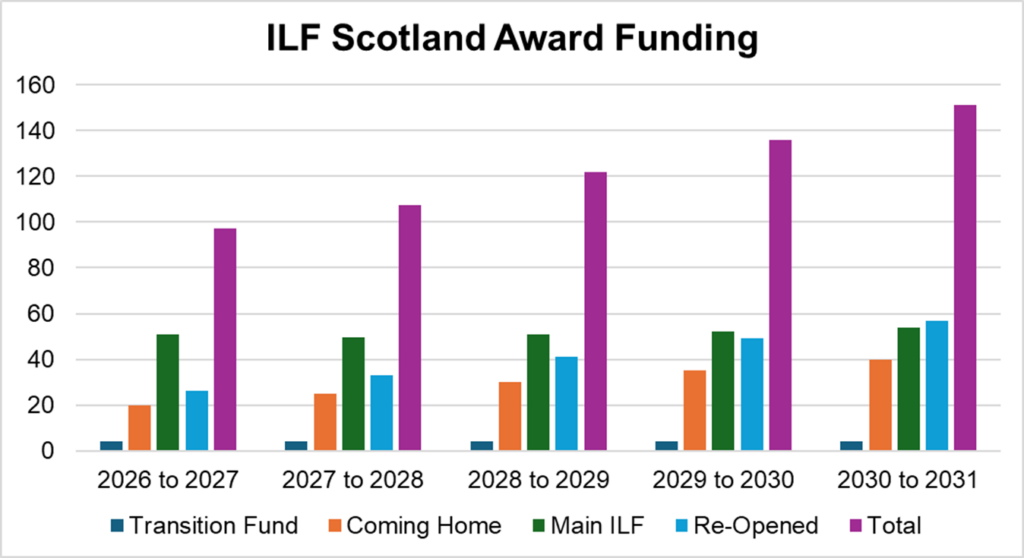
Our Strategic Plan and this Business Plan, helps us to plan and forecast the money we will need in the coming years to deliver our service. We review and update our 5- yearly Medium Term Financial Plan every year to make sure we have enough financial resources to deliver our strategic objectives.

A bar chart showing the amount of funding for each funding stream from the years 2026 to 2027 through to 2030 to 2031.

We are projecting a steady and sustainable rise in our funding over the next 2 years. In addition, we may be provided with a significant portion of the Scottish Government’s £20 million budget to support the Coming Home Project. We manage finances carefully and have strong governance arrangements in place and before we commit to any future awards and projects, we assess them to make sure they are affordable and can be sustained. As well as having an award-winning financial team, we have had clean sets of Annual Reports approved by external auditors for 11 years in a row.

Our internal auditors also report that proper arrangements are in place to represent value for money in the services we deliver. We can confidently say that we are managing our funds to the best of our abilities and making sure that as much of these as possible go directly to our Recipients.

Back to contents

Human Resources Plan

We continue to evolve our People Strategy, which sets out our approach to support and develop our employees. We recognise that projects and change programmes are valuable opportunities for our colleagues to build new skills and gain more experience. By making the most of these opportunities, we can create an even more adaptable and confident workforce that can work across different teams. This will support better collaboration and teamwork, help people learn and build a workforce ready and able for the future.

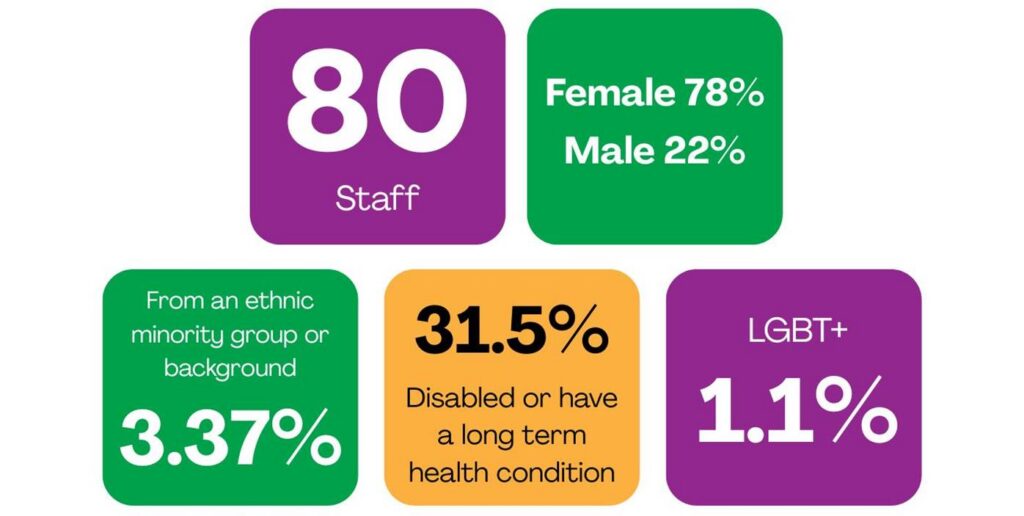
5 coloured boxes. Top line reads: 80 staff. Female 78%. Male 22%. Second line boxes read: From an ethnic minority group or background 3.37%. 31.5% disabled or have a long term health condition. LGBT+ 1.1%.

We employ around 80 members of staff who work across a broad range of working patterns. Over half of our workforce operate in frontline roles, directly supporting applicants and Recipients and with our local authority colleagues to develop sustainable support plans for our Recipients. The remainder provide essential support across Finance, People and Culture, Governance, Digital and Information Services, Policy Development and Communications.

Our workforce reflects our commitment to diversity, inclusion and representation. At the start of the 2026 to 2027 financial year, 78% of our employees were female and 22% were male. 31.5% of staff self-identified as disabled or having a long-term health condition, 3.37% are from an ethnic minority background and 1.11% are LGBT+.

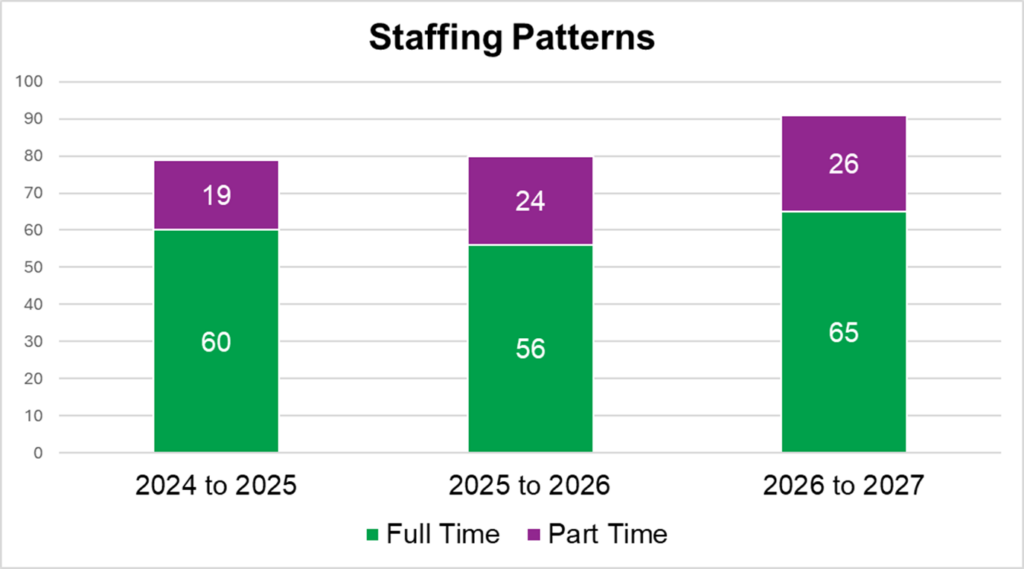
While we grow and develop over the next two years, we also aim to make sure we have a stable and capable workforce who have opportunities to be involved in projects across the organisation and who can learn and develop including into future managers and leaders. We indicate below what we think our workforce numbers will look like by the end of 2026 to 2027.

A bar chart called Staffing Patterns. In 2024 to 2025 there were 19 part time staff (in purple) and 60 full time staff (in green). In 2025 to 2026 there were 24 part time staff (in purple) and 56 full time staff (in green). In 2026 to 2027 there were 26 part time staff (in purple) and 65 full time staff (in green).

Our strategy confirms that we expect applicant and Recipient numbers to grow over the next few years and there will be a small increase in staff because of this. Our staff are most definitely our greatest asset and through them we strive to deliver our services in the best possible way for those we support and to our professional colleagues.

Back to contents

Risk Analysis

Nothing in the world of business or public service delivery is risk free and there is always a fine balance between delivering a service and the cost of doing this.

At ILF Scotland, we operate a detailed risk management system. We make sure we understand what risks we might face and manage these appropriately. We also have strong operational resilience and business continuity plans in place. These plans make sure we can act quickly and effectively if things go wrong or there is a crisis we need to respond to.

This year, our principal risks and uncertainties were mainly in connection with:

The Scottish Government elections, the pressures on public finances and the challenges facing health and social care all featured highly on our risk management radar. As a public body, we are directed by Scottish Ministers and funded solely through Scottish Government and may not always be free to operate or deliver the range of services people tell us they want to have. Our policy framework, approved by Scottish Government, sets out who might access our funds and what items and services we can fund.

The Scottish Government has, however, demonstrated a commitment to disabled people in Scotland and confidence in ILF Scotland to deliver services efficiently and effectively, as evidenced by year-on-year increase in funds resulting in growth in the number of people who can access our funds.

During the period of this Business Plan, there will continue to be increasing pressures on health and education, a recruitment crisis in social care and advances in technology that are changing how services are delivered almost daily. However, we are in a strong financial position and we have a good reputation at the highest levels of government for our ability to confidently manager our resources. This is due in part to the now 11 years of unqualified annual accounts and highly accurate financial forecasting. We are fully able to manage effectively with the funding we are allocated on a yearly basis and the confidence in us is reflected in our year-on-year growth in funding.

Back to contents

Conclusion

The period of this Business Plan is going to be a very exciting time for ILF Scotland and for the disabled people we support and who can access our funds. We are in a time of growth with an additional 600 new Recipients to our re-opened Independent Living Fund planned for 2026, at the same time as trialling new routes to applications via our DPO supported application project. Our Transition Fund demand is growing and by undertaking an independent evaluation of it we hope to evidence the life changing difference this grant funding can make to young people and use the findings from the report to inform thinking about the future of the fund.

Internally, we are excited to bring on board new technology to assist with our case management and customer services. In future we will look at potential new routes to applications and a citizen portal so that Recipients and Award Managers might manage their own award or elements of this online if they wish to do so.

At the time of preparing this, we already deliver approximately one quarter of all Direct Payments in Scotland and this is increasing as we complete the third year of the re-opened fund applications. We have a very bright future ahead of us and our business plan for the next two years is to expand our services and support to as many new people as possible!

Back to contents

Contact Us

ILF Scotland
Ground Floor, Denholm House
Almondvale Business Park
Almondvale Way
Livingston
EH54 6GA

Telephone: 0300 200 2022
Email: enquiries@ilf.scot

If you need this document in an alternative format, please contact us.

Follow us:

Facebook: @IndependentLivingFundScotland
X: @ILFScotland
Instagram: @ILFScotland

ILF Scotland Limited is a company limited by guarantee registered in Scotland. Company Number SC5000075. Registered Office Ground Floor, Denholm House, Almondvale Business Park, Almondvale Way, Livingston, EH54 6GA.

Back to contents

202607 - Newsletter - July 2026

Contents

Celebrating two years since the Independent Living Fund reopened in Scotland

Welcoming new funding to support independent living

Working Families Best Practice Award Winner

Letter changes

Consumer Duty - What this means for ILF Scotland

Guidance for Award Managers

United Nations Convention on the Rights of the Child (UNCRC)

Charter for Involvement

Mainstreaming and Equality Outcome Report

Corporate Parenting Plan

PVG Update

Feedback Strategy

Scotland

Scottish Living Wage Increase

Become a Young Ambassador!

Have you joined the Personal Assistants Network Scotland?

How are your digital skills?

Northern Ireland

Join our Northern Ireland Advisory Group

National Minimum Wage Increase

Self-directed support network in NI

Transition Fund

We’re changing the way we fund Driving Lessons and Theory Tests

Transition Fund Evaluation

Complaints

We want to hear from you!

Welcome

A warm welcome to our summer 2026 edition of the ILF Scotland newsletter. This year is an important one for us.

As we mark two years since our main Fund reopened to new applications in Scotland, it is encouraging to reflect on the difference it is making in people’s lives. We continue to hear powerful feedback from Recipients and their families about the positive impact on independence, confidence, and connection to their communities. We are, however, disappointed not to secure re-opening of the Fund in Northern Ireland. We remain in close dialogue with colleagues at the Department of Health and are exploring options alongside our Advisory Group.

We also look forward to the outcome of the independent evaluation of our Transition Fund, which is now underway. We expect it will highlight the positive impact this Fund is having for young disabled people in Scotland, supporting them to build confidence, develop skills, and take greater control over their lives as they move into adulthood. This learning will help to inform the future development and sustainability of the Fund and should also help us to improve access to independent living opportunities across all of our work.

Alongside this, the launch of the joint Scottish Government and COSLA Coming Home Action Plan represents a significant step forward in supporting people to leave long-stay hospital and inappropriate out of area settings, and to live closer to home. ILF Scotland is proud to play a key role in this work, administering a new £20 million Coming Home Fund to help ensure people have the right support to live independently, and with dignity, in their own communities.

As always, our focus remains on working in partnership with disabled people, families, and other partners to remove barriers to independent living and to improve access to the support and assistance people need to have a good life. I would like to thank everyone who contributes to this work, from our Recipients and advisory groups to our board, staff, partners, and government colleagues.

We know there is so much more to do, but together we are continuing to make meaningful progress towards a society where independent living is a reality for all.

Peter Scott OBE
Chief Executive Officer
ILF Scotland

ILF Scotland News

Celebrating two years since the Independent Living Fund reopened in Scotland

This year marks two years since the Independent Living Fund (ILF) re-opened in Scotland, and we want to take a moment to reflect on what that has meant for those who receive support through the Fund.

Over the past two years, we have received more than 1,600 applications from disabled people seeking the additional support they need to live independent lives - and the impact this has had is clear.

What Recipients told us

When we spoke to Recipients and their families about their experiences, the feedback was overwhelmingly positive.

One Recipient told us:

“It’s been brilliant. I am living my best life. It has really helped me out a lot. It has allowed me to do the things I want to do. It has helped make me even more independent.”

Another Recipient’s father shared:

“My son is thriving on being active and outdoors. After years of regression and anxiety, he is now responding really well to the extra ILF support.

“He is now enjoying activities like cycling, walking, swimming, driving, and exploring new interests, such as his passion for music, which helps him relax.”

Looking ahead

Peter Scott OBE, ILF Scotland CEO, said: “This feedback, provided by Recipients and families, demonstrates the transformative nature of ILF. It has been described as ‘truly life changing’, and families have emphasised the substantial difference it has made to independence, wellbeing, and overall quality of life.

“This evidence reinforces the central purpose of ILF Scotland: to enable some of our most disabled citizens to live with dignity, autonomy, and meaningful connection to their communities. As we move forward in what are challenging times, I extend my sincere thanks to our Recipients, their families, our key partners including Scottish Government and Local Authorities, our Board of Directors, the Co-production Working Group and our dedicated staff team.”

As we celebrate two years since reopening and reflect on the feedback we have received, we remain focused on the future and our vision of independent living being a reality for all disabled people living in Scotland and Northern Ireland.

Back to Contents

Welcoming new funding to support independent living

We are pleased to share that the Scottish Government and COSLA have announced the ‘Coming Home Action Plan’, which will support almost 400 people with learning disabilities and complex support needs to move out of long-stay hospital settings and into housing closer to home, family and friends.

For many people and families, the opportunity to live nearer to loved ones can make a life-changing difference to independence and wellbeing. This funding will provide bespoke support, along with home adaptations, equipment and technology, to help people return to their communities.

ILF Scotland will play a key role in delivering a significant portion of this funding. Working collaboratively with national and local partners, we will help remove barriers and ensure people can return home, or remain at home, with the right support in place. This will help people spend less time in hospital or supported accommodation far from home.

We believe everyone has the right to live in their own home, connected to the people and communities that matter to them. This initiative is an important step towards making that vision a reality.

Back to Contents

Working Families Best Practice Award Winner

We are delighted to share that ILF Scotland has been named Best for All-Round Flexibility at the Working Families Best Practice Awards 2026.

The judges said our approach to flexible working stands out because flexibility is built into everything we do, at every level of the organisation. Our approach is built on trust, dignity and inclusion, and is continuously shaped by the real experiences and needs of our colleagues, including carers, disabled staff and neurodivergent team members.

The panel described ILF Scotland as a truly deserving all-rounder, recognising our ongoing commitment to creating a supportive and adaptable workplace for everyone.

We are incredibly proud of this achievement. Our sincere thanks go to the Working Families Awards, and congratulations to all the other winners.

Back to Contents

Letter changes

We would like to let you know about an upcoming change to how we send letters. From 31 July, most of our letters will be issued through our new mailing provider, Gov Notify.

Only letters that require a document to be returned will continue to be sent directly by our office staff. As a result, most of the letters you receive from us after this date will no longer have the ILF logo on them.

Back to Contents

Consumer Duty - What this means for ILF Scotland

The Consumer Scotland Act 2020 regulations 2024 introduced a duty on relevant public authorities in Scotland from 1 April 2025. A consumer is anyone who uses public services, including people who apply to ILF Scotland and those who receive funding from us. The Consumer Duty helps make sure that people who use ILF Scotland services are considered in all key decisions. It requires us to understand potential impacts, avoid harm where possible, and put the interests of applicants and Fund Recipients at the heart of our work. We are required to publish information about the actions we take to meet our responsibilities under the Consumer Duty and this information will be available on our website. For more information, please visit: The consumer duty | Consumer Scotland

Back to Contents

Guidance for Award Managers

We are currently reviewing both our Your Responsibilities Guide and Employer Support Information Note with the help of our Advisory Group members. We will publish updated versions on our website and highlight these in our next newsletter.

The revised information will also consider recent legislative changes in the Employers Act 2025, which aims to strengthen worker protections while clarifying employer responsibilities, including for individuals who directly employ Personal Assistants (PAs).

The Act highlights the importance of fair contracts, transparent pay, and safe working conditions.

Employers' Liability Insurance: A reminder for Employers

In the meantime, we would like to highlight Employers’ Liability Insurance. If you employ a PA, you must have Employers’ Liability Insurance in place from day one. Failure to do so may result in daily fines and significant legal and compensation costs.

ILF Scotland strongly advises that PA employers choose enhanced insurance, sometimes referred to as ‘Gold’ or ‘Plus’ level. This often includes additional support for redundancy, employment law advice, and health and safety guidance, which employers must follow. Failure to follow advice provided by insurance companies can lead to financial penalties.

Where a PA is directly employed using ILF Scotland funding, we can meet the cost of Employers Liability Insurance. We can also contribute to insurance costs where the PA is jointly funded by ILF Scotland and a Health & Social Care Partnership or Trust. We will not cover insurance costs for a self-employed PA or for staff employed by a care or support provider.

If you already have a policy in place, we encourage you to contact your insurer to check that you have sufficient cover.

For more information about Employer's Liability Insurance, visit www.gov.uk/employers-liability-insurance

For advice on employment law changes, you can contact the ACAS Helpline on 0300 123 1100.

Back to Contents

United Nations Convention on the Rights of the Child (UNCRC)

UNCRC sets out the fundamental rights of every child and young person. It is the most widely adopted human rights treaty in the world, and covers all aspects of a child’s life, including their civil, political, economic, social and cultural rights.

Scotland is the first devolved government in the world to directly incorporate UNCRC, after the UNCRC (Incorporation) (Scotland) Act 2024 came into effect in July 2024. For ILF Scotland, incorporation means ensuring we are engaging with our applicants and Recipients who are under 18, so that they are empowered to have a voice in decisions that may affect them.

Since opening, the Transition Fund has supported over 6,000 Recipients under the age of 18, and there are over 40 Recipients of this age within the re-opened Independent Living Fund.

We are keen to strengthen our commitment to children’s rights by rolling out training on UNCRC and children’s rights across our workforce.

We are also expanding our Young Ambassadors Group – find out more later in the newsletter.

Our first UNCRC report will be published in August 2026, including a child friendly version of the report to ensure it is accessible to young people.

Back to Contents

Charter for Involvement

The Charter for Involvement helps make sure disabled people who use support services have a say in the services they receive, the organisations that provide them, and their wider communities.

We have continued to make significant progress against our Charter Action Plan during 2025 to 2026, through collaborating with the Advisory Groups to make further progress towards delivering Charter priorities. Their ongoing feedback and involvement play an important role in helping us make positive changes. We’re pleased to share an update on the progress against our Charter for Involvement Action Plan for 2024 to 2025 on our website: https://ilf.scot/go/charter-for-involvement.

Back to Contents

Mainstreaming and Equality Outcome Report

In April, we were pleased to publish our fourth Mainstreaming and Equality Outcomes Report, outlining the progress made against our 2024 to 2026 equality outcomes and setting our priorities for 2026 to 2028.

Equality is at the heart of what we do, shaping our everyday activities, thoughts, behaviours and plans. We are committed to continuously improving how we mainstream equality across the organisation.

While our key focus is on addressing inequalities experienced by people with protected characteristics, we are also considerate of broader diversity issues. Over the past year, we have strengthened our focus on areas including neurodiversity, cognitive diversity, social mobility and socio-economic diversity, while recognising how intersecting characteristics can create additional barriers to inclusion. Read the full report on our website to learn more about our progress and ambitions for the next two years: https://ilf.scot/go/mainstreaming-and-equality-outcomes-report.

Back to Contents

Corporate Parenting Plan

In April 2024, we introduced our second corporate parenting plan for 2024 to 2027. The plan aims to empower disabled people to live independently through our funds and we’re pleased to share our latest progress report.

Corporate Parenting means organisations and services working together to make sure young people get the right support and opportunities to succeed and become independent. We continue to work with other corporate parents and care experienced young people to improve our plans, services, and processes.

The Transition Fund specifically supports young disabled people aged 16 to 25 as they move on from school or children’s services, helping them build independence and take part in their communities. We’ve made good progress against our five commitments and published a progress report in April this year. You can read the full report on our website: https://ilf.scot/go/corporate-parenting-plan.

Back to Contents

PVG Update

Changes to the Protecting Vulnerable Groups (PVG) Membership Scheme came into effect from 1 April 2025, making it a legal requirement for anyone in a regulated role, such as a PA, to be a member of the PVG Scheme.

It is the PA’s legal responsibility to be a PVG member, not the employer. Carrying out regulated work without PVG membership is a criminal offence.

We highly recommend that if you employ a PA, you request confirmation of their membership by viewing their membership certificate or online confirmation. During ILF Scotland Recipient reviews, we will ask if your PA is a PVG member and record this, however we will not record individual details.

A further change has taken effect from 1 April 2026, where the PVG Scheme has moved from lifetime membership to a new five-year period. Anyone joining the scheme from that date will receive a five-year membership.

If your PA is already a PVG member in the lifetime scheme, no action is needed at this stage, but Disclosure Scotland will contact them at some point as part of a phased transition of moving members from the lifetime scheme to the five year membership scheme. Disclosure Scotland is contacting lifetime members to check their details before making the transfer. For more details visit Disclosure Scotland or our website: https://ilf.scot/go/pvg-changes

Back to Contents

Feedback Strategy

We published our Feedback Strategy in December last year. This sets out the framework for feedback opportunities from Recipients and applicants who interact with our services. During the financial year 2025 to 2026, we sought feedback for a number of projects including from Recipients of the re-opened ILF from April 2024, feedback from complaints and compliments we received and feedback from our 10 year celebration events last year in Scotland and Northern Ireland. The majority of the feedback was very positive - you can read more about this on our website

The next stage of our Feedback Strategy is to consider and co-produce feedback mechanisms for the next financial year 2026 to 2027. We have set up a staff working group to discuss those next steps and will continue to co-produce any plans with representatives of our Advisory Groups.

Back to Contents

Scotland

Scottish Living Wage Increase

We are pleased to share that the Scottish Government has agreed a pay uplift for adult social care workers.

The minimum hourly rate for PAs will rise from £12.60 to £13.45 per hour from 1 April 2026. This means an increase of 6.75%.

The uplift will allow you to increase your PA’s hourly rate of pay to a minimum of £13.45 per hour for every hour they work including overnight hours of support. You must pass this increase on to your staff and should not use it for any other purpose.

We have automatically increased all relevant awards with effect from this date and have written to all our Recipients to let them know what this means for their award.

If you use a Payroll Agency – please advise the agency topay your PA the increased rate of pay from 1 April 2026.

If you use a Care Provider Organisation - we will not automatically apply an uplift for services purchased by Recipients from Care Provider Organisations. If your provider notifies you of an increase, please send the letter to your ILF Caseworker.

If you have any questions about the pay uplift, or if your individual circumstances have changed, please contact your Specialist Caseworker on 0300 200 2022 or email enquiries@ilf.scot.

Back to Contents

Become a Young Ambassador!

Are you aged 16 to 25? Have you received funding from ILF Scotland?

Would you like to have a voice about our services, give feedback, share ideas, and help shape what we do? If the answer is yes, we’d love to hear from you.

We have a group of amazing young people who are currently Young Ambassadors, and we’re excited to expand the group. We’ll work with members to update its remit with the aim of a relaunch during 2026.

You’ll have the opportunity to get involved with events, blogs, articles and podcasts. We want to hear what matters most to you - what topics you’d like to discuss, how best to communicate and how we can make it easy and enjoyable for you to take part.

Being a Young Ambassador is a great chance to try something new, build your confidence, develop your communication and presentation skills, and add something impressive to your CV.

More information is available on our website and if you think you’d like to get involved, please contact us at communications@ilf.scot to arrange an informal chat.

Back to Contents

Have you joined the Personal Assistants Network Scotland?

Personal Assistants Network Scotland (PANS) is a membership organisation committed to providing meaningful benefits and support tailored to the needs of PAs across Scotland.

They advocate on the behalf of PAs, and work to strengthen recognition, opportunities and the value of the profession.

Why get involved?

Membership is completely free and gives PA access to a wide range of benefits including training opportunities, practical resources, professional development, and discounts on shopping, cinemas tickets, holidays and more.

By joining PANS, you’ll become part of a supportive network that promotes independent living, shares best practice, and champions the vital role PAs play across Scotland.

Visit their website to find out more or become a member: www.panetworkscotland.org.uk

Back to Contents

How are your digital skills?

The Scottish Council for Voluntary Organisations (SCVO) offers two checkups to assess your digital skills.

The checkups take no more than 10 minutes to complete. You can choose to have your results emailed to you, along with additional resources if you request more information on specific topics.

Why not take the checkup today and see if you have any gaps in your digital skills

Check your digital skills on their website: https://skills.checkup.scot/

Back to Contents

Northern Ireland

Join our Northern Ireland Advisory Group

Help Shape ILF Scotland Services in Northern Ireland.

The Northern Ireland Advisory Group is looking for new members. The group is open to ILF Scotland Recipients and their representatives, and we would love to hear from disabled Recipients who want to share their experiences.

Members can help influence how ILF Scotland services are delivered and developed by providing feedback and ideas for improvement. No specialist knowledge is required, and support will be provided to make participation accessible.

To find out more or express an interest, please contact Linda Scott, Director for Policy, Improvement and Engagement, at Linda.Scott@ILF.scot

Back to Contents

National Minimum Wage Increase

We are delighted to share that the Department of Health in Northern Ireland has agreed a pay uplift for PAs.

The minimum hourly rate for PAs will rise from at least £12.21 to £12.71 per hour from 1 April 2026, an increase of 4.1%.

This means that Recipients who employ PAs can increase their hourly rate of pay to a minimum of £12.71 per hour.

The uplift will allow you to increase your PA’s hourly rate of pay to a minimum of £12.71 per hour. You must pass this increase on to your staff and should not use it for any other purpose.

We have automatically increased all relevant awards with effect from this date and have written to all our Recipients to let them know what this means for their award.

If you use a Payroll Agency – please advise the agency topay your PA the increased rate of pay from 1 April 2026.

If you use a Care Provider Organisation - we will not automatically apply an uplift for services purchased by Recipients from Care Provider Organisations. If your provider notifies you of an increase, please send the letter to your ILF Caseworker.

If you have any questions about the pay uplift, or if your individual circumstances have changed, please contact your Specialist Caseworker on 0300 200 2022 or email enquiries@ilf.scot.

Back to Contents

Self-directed support network in NI

The Self-Directed Support (SDS) Network NI was launched in March with an online event bringing together people with lived experience, health and social care staff and other key stakeholders.

Speakers talked honestly about the powerful impact of SDS when people have real choice and control, and the frustrations when flexibility is limited. Trust staff shared their perspective too, showing strong commitment to improve consistency, clarity and shared problem solving as the network moves forward.

To learn more about the SDS Network NI and upcoming events visit www.selfdirectedsupport.org/hubs/northernireland

Back to Contents

Transition Fund

We’re changing the way we fund Driving Lessons and Theory Tests

The Transition Fund is introducing an important change to the way funding is provided for Theory Tests and Driving Lessons.

What’s changing?

As of 1 April, applicants must now pass their Theory Test and provide their certificate before we fund practical driving lessons.

For applicants requesting support with both their Theory Test and Driving Lessons, funding will initially cover:

Once the Theory Test has been successfully passed, funding for practical driving lessons can then be awarded.

Why are we making this change?

This decision has been made following feedback from both applicants and driving instructors.

We want to give applicants every chance of succeeding in passing their Theory and practical Driving Tests so this change should help to ensure an uninterrupted practical learning experience.

Our current processing time for applications is 12 weeks. If you would like to discuss your application further, please get in touch by emailing enquiries@ilf.scot.

Back to Contents

Transition Fund Evaluation

We are carrying out an evaluation of our Transition Fund between now and October this year. The purpose of the evaluation is to consider how best to ensure a sustainable future for the Fund. The evaluation is being conducted by an independent external company, Social Value Lab, who are currently recruiting for a team of Peer Researchers who have lived experience of disability.

Their work will involve designing and administering a survey to Transition Fund Recipients to better understand the demand for the Fund and what impact it has had in the lives of Recipients. The evaluation will also involve a Social Return on Investment analyses (SROI) to determine the social value generated by the funding.

We will update the evaluation findings on our website in due course and include an update in our December newsletter.

Back to Contents

Complaints

The team at ILF Scotland are committed to providing a high-quality service. However, we understand that sometimes things might not go as planned. If our service does not meet your expectations, please let us know so we can work to resolve the issue.

We value all feedback, including complaints, as it helps us improve the way we do things. For more
information, please see our Complaints Handling Procedure at https://ilf.scot/go/complaints-handling

You can also view how to make a complaint and our current complaint statistics at https://ilf.scot/how-to-make-a-complaint

To make it easer for you to share any concerns, we've created a dedicated email address: complaints@ilf.scot

Please contact us directly so we can address your concerns as quickly as possible.

Back to Contents

We want to hear from you!

We’d love to hear your feedback on our newsletters so we can make sure we’re sharing the news you want to hear about. We’d really appreciate it if you could take our quick survey – it shouldn’t take more than a few minutes.

To take the survey, visit: https://forms.gle/p6NbCE1VQPSiAFwS8

Back to Contents

Complaints Handling Procedure

ILF Scotland is committed to providing high-quality customer services.

We value complaints and use information from them to help us improve our services

If something goes wrong or you are dissatisfied with our services, please tell us.  This leaflet describes our complaints procedure and how to make a complaint.  It also tells you about how we will handle your complaint and what you can expect from us.

What is a complaint?

We regard a complaint as any expression of dissatisfaction about our action or lack of action, or about the standard of service provided by us or on our behalf.

What can I complain about?

You can complain about things like:

Your complaint may involve more than one ILF Scotland service or be about someone working on our behalf.

What can’t I complain about?

There are some things we can’t deal with through our complaints handling procedure.  These include:

If other procedures or rights of appeal can help you resolve your concerns, we will give information and advice to help you.

Who can complain?

Anyone who receives, requests or is directly affected by our services can make a complaint to us. This includes the representative of someone who is dissatisfied with our service (for example, a relative, friend, advocate or adviser). If you are making a complaint on someone else’s behalf, you will normally need their written consent. Please also read the section on Getting help to make your complaint below.

Child Friendly Complaints

As outlined in Who can complain? above, anyone who receives, requests or is directly affected by our services can make a complaint.

On occasion this may refer to a young person who is aged under 18 and therefore defined as a child.

If ILF Scotland receives a complaint from a person aged under 18, or a person complaining on their behalf, we will ensure that we handle any such complaint affecting any child in a way that meets all of their rights under UNCRC (United Nations Convention on the Rights of the Child).

ILF will keep the best interests of the child as a top priority in all decisions and actions that affect them (UNCRC Article 3).

The SPSO has created guidance for Child Friendly Complaints that ILF Scotland will refer to when handling complaints from any individual under 18 years. Further information on this guidance can be found at:

Watch the Scottish Public Services Ombudsman’s Child Friendly Complaints Handling Principles in British Sign Language (BSL).

Or read more about Child Friendly Complaints on the Scottish Public Services Ombudsman’s Website

How do I complain?

You can complain in person at our offices, by phone, in writing or by email using the contact details below.

It is easier for us to address complaints if you make them quickly and directly to the service concerned. So please talk to a member of our staff at the service you are complaining about. Then they can try to resolve the issue.

When complaining, please tell us:

Our contact details

Our contact details are:

Email: complaints@ILF.scot

Phone: 0300 200 2022

Address: ILF Scotland, Ground Floor, Denholm House, Almondvale Business Park, Almondvale Way, Livingston, EH54 6GA

Website: www.ilf.scot

How long do I have to make a complaint?

Normally, you must make your complaint within six months of the event you want to complain about or finding out that you have a reason to complain.

In exceptional circumstances, we may be able to accept a complaint after the time limit.  If you feel that the time limit should not apply to your complaint, please tell us why.

What happens when I have complained?

We will always tell you who is dealing with your complaint. Our complaints procedure has two stages.

Stage one: Frontline response

We aim to respond to complaints quickly (where possible, when you first tell us about the issue). This could mean an on-the-spot apology and explanation if something has clearly gone wrong, or immediate action to resolve the problem.

We will give you our decision at stage one in five working days or less, unless there are exceptional circumstances.

If you are not satisfied with the response we give at this stage, we will tell you what you can do next. If you choose to, you can take your complaint to stage two. You must normally ask us to consider your complaint at stage two either:

In exceptional circumstances, we may be able to accept a stage two complaint after the time limit. If you feel that the time limit should not apply to your complaint, please tell us why.

Stage two: investigation

Stage two deals with two types of complaint: where the customer remains dissatisfied after stage one and those that clearly require investigation, and so are handled directly at this stage. If you do not wish your complaint to be handled at stage one, you can ask us to handle it at stage two instead.

When using stage two:

If our investigation will take longer than 20 working days, we will tell you.  We will tell you our revised time limits and keep you updated on progress.

What if I’m still dissatisfied?

After we have given you our final decision, if you are still dissatisfied with our decision or the way we dealt with your complaint, you can ask the Scottish Public Services Ombudsman (SPSO) / Northern Ireland Public Services Ombudsman (NIPSO) to look at it.

The SPSO / NIPSO are independent organisations that investigate complaints. You can ask the SPSO / NIPSO to look at your complaint if:

The SPSO / NIPSO will ask you to complete a complaint form and provide a copy of our final response to your complaint.  You can do this online at www.spso.org.uk/complain/form or https://www.nipso.org.uk/nipso/making-a-complaint/online-complaints-form/ or call them on the freephone numbers below.

The SPSO’s contact details are:

SPSO, Bridgeside House, 99 McDonald Road, Edinburgh, EH7 4NS (if you would like to visit in person, you must make an appointment first).

Their freepost address is: FREEPOST SPSO

Freephone: 0800 377 7330
Online contact www.spso.org.uk/contact-us
Website: www.spso.org.uk

The NIPSO’s contact details are:

Northern Ireland Public Services Ombudsman, Progressive House,
33 Wellington Place, Belfast. BT1 6HN

Their freepost address is: FREEPOST NIPSO

Freephone: 0800 34 34 24
Website: www.nipso.org.uk
Email: nipso@nipso.org.uk

Getting help to make your complaint

We understand that you may be unable or reluctant to make a complaint yourself. We accept complaints from the representative of a person who is dissatisfied with our service. We can take complaints from a friend, relative, or an advocate, if you have given them your consent to complain for you.

You may wish to get independent support or advocacy to help you progress your complaint. You can find out about advocates in your area by contacting the Scottish Independent Advocacy Alliance, tel: 0131 510 9410, website: www.siaa.org.uk.

You can find out about advisers in your area through Citizens Advice Scotland, website: www.cas.org.uk or check your phone book for your local citizens advice bureau.

We are committed to making our service easy to use for all members of the community. In line with our statutory equalities’ duties, we will always ensure that reasonable adjustments are made to help you access and use our services. If you have trouble putting your complaint in writing, or want this information in another language or format, such as large font, or Braille, please tell us in person, contact us on 0300 200 2022 or email us on enquiries@ilf.scot.

Quick guide to our complaints procedure

Arrow pointing down.

Address: ILF Scotland, Denholm House, Almondvale Business Park, Almondvale Way, Livingston, EH54 6GA  Tel: 0300 200 2022 Email: enquiries@ilf.scot  Web: www.ilf.scot

ILF Scotland is a company limited by guarantee, registered in Scotland, Company Number: SC500075. Registered office: Denholm House, Almondvale Business Park, Almondvale Way, Livingston, EH54 6GA

Skip to content