The Independent Living Fund Scotland (ILF Scotland) believes that no-one should be denied opportunities because of their race or ethnicity, a disability, their gender, or sexual orientation, their marital or civil partnership status, their age or religion, or due to any of the protected characteristics detailed in the Equality Act.
ILF Scotland will treat Recipients, applicants and ILF Scotland staff equally and fairly. For staff, this commitment also extends to maternity status, working pattern, employment status, caring responsibility, and trade union membership.
ILF Scotland must comply with the Equality Act 2010 (Specific Duties) (Scotland) Regulations 2012 and the specific duties designed to help Scottish public authorities meet the general duty. Regulation 4 of the specific equality duties requires that we base our Equality Outcomes on evidence, and involvement of equality groups.
The Public Sector Equality Duty regulates performance against equalities duties. From April 2020, ILF Scotland is required to report on the areas outlined below, every two years, apart from the Statement on Equal Pay, which is every four years. We also have a duty to publish diversity information about our board members. This report meets our general and specific duties under the Equality Act 2010 and outlines:
Mainstreaming the Equality Duty in ILF Scotland
Report on Progress
Board Diversity Duty
Employee Information
Gender Pay Gap Information
Statement on Equal Pay (covering sex only)
1.1 Background
The public sector equality duty came into force on 05 April 2011. The purpose of the duty is to ensure that public authorities consider how they positively contribute to a more equal society. It requires authorities to consider equality in all their functions, including decision-making, design, and delivery of services.
From 1 October 2012, the scope of the Act was extended to ban age discrimination, though this does not presently cover people under the age of 18.
The Equality Duty Action Plan sets out how ILF Scotland will meet its statutory equality duties, promote equality of opportunity, eliminate discrimination and foster good relations. It also provides a framework for monitoring progress and ensuring equality considerations are embedded in service delivery and employment practices.
1.2 The General Equality Duty
Under the Equality Act 2010, public authorities are required to have due regard to the need to:
Eliminate unlawful discrimination, harassment and victimisation and other prohibited conduct.
Advance equality of opportunity between people who share a relevant protected characteristic and those who do not.
Foster good relations between people who share a protected characteristic and those who do not.
This duty is often referred to as the three needs. To comply with the duty, a public authority must have due regard to all three of these needs.
The Act explains that to meet the second need (advancing equality of opportunity), a public authority must consider the need to:
remove or minimise disadvantage suffered by people with certain protected characteristics, where these are different from the needs of other people
encourage people with certain protected characteristics to participate in public life or in other activities where their participation is disproportionately low
The Act also sets out that:
meeting different needs includes (among other things) taking steps to take account of disabled people’s disabilities
fostering good relations means tackling prejudice and promoting understanding between people from different groups
meeting the general equality duty may involve treating some people more favourably than others
1.3 Who should be aware of the General Duty in ILF Scotland?
Board Members
Set strategic direction, review performance, and ensure good governance of the organisation. The Depute Director, Scottish Government, Health & Social Care, appraises the Chair of the Board against a Diversity Objective.
Senior Managers
Oversee the design, delivery, quality, and effectiveness of the organisation’s functions.
Equality and Diversity Staff
Lead, promote and support equality, diversity and inclusion across the organisation, building awareness, capability and compliance with the Public Sector Equality Duty.
Communications Staff
Help ensure relevant equality information is available and accessible.
Frontline Staff
Need to be aware of how they can help to meet the needs of people with special characteristics.
Procurement
Need to be aware of how to build equality considerations into the organisation’s supply chain. In ILF Scotland, anyone tendering a contract should be aware of the Equalities Obligation and what we expect of organisations that we contract with.
Line Managers
Line managers are responsible for applying equality, diversity and inclusion principles in day-to-day management practice and ensuring fair, consistent and inclusive treatment of all employees.
2. Key ILF Scotland Documents
The primary function of ILF Scotland is to operate discretionary funds providing financial awards to over 4,000 disabled people in Scotland and Northern Ireland to help them live independently. ILF Scotland adheres to a suite of key policy documents to support our Recipients, applicants, and staff. The policy suite is updated on an ongoing basis to support the Scottish Government’s strategic priorities.
ILF Scotland recognises the need to consider whether and how the outcome and delivery of any proposed new or amended policy might impact on people, specifically, what relevance the policy might have to people with protected characteristics.
The policy development lead will carry out a screening exercise to help determine if any proposed or amended policy / practice will directly or indirectly affect people. They should then complete either an Equality Impact Assessment (EQIA) or the No EQIA required declaration.
The policy lead must carry out the EQIA early, and as an embedded part of the policy development process, so that the assessment can shape, inform, and influence the policy proposals, and they should continue to revisit this assessment throughout the lifecycle of the policy.
2.2 ILF Scotland Strategy 2025 to 2028
The vision set out in the ILF Scotland Strategic Plan 2025 to 2028 identifies the integral part played by ILF Scotland in supporting independent living for disabled people across Scotland and Northern Ireland, and how ILF Scotland can support individuals through its funding role.
2.3 ILF Scotland Business Plan 2026 to 2028
As stated in the Business Plan 2026 to 2028, ILF Scotland will improve its evidence base by gathering information from Recipients, applicants, and staff through the various use of equality monitoring forms, and where applicable, will use surveys, to strengthen its understanding of the needs and requirements of the disabled people the organisation supports.
This improved data will be reflected in enhanced information displayed in the Annual Corporate Report and online. Stronger management information will enable ILF Scotland to consider how it can better meet the general equality duty, its specific duty under the Act, and improve its service delivery.
3. What We Do To Promote Equality
Customer Facing Actions (CFA)
CFA Reference: CFA01
Action Engage opportunities to encourage diversity of our Board membership and create dialogue with under-represented groups (specifically disabled people).
General Equality Duty: Advance Equality of Opportunity
Owner: Chair of the Board
Review: Ongoing through specific engagement opportunities and in partnership with the Public Appointments Team during periods of Board recruitment.
CFA Reference: CFA02
Action: Ensure that all our staff follow SSSC and NISCC Codes of Practice. The Code is part of our Induction Pack for all staff. Refresher and updates are delivered as required.
General Equality Duty: Eliminate Discrimination Advance Equality of Opportunity Foster Good Relations
Action: Continue to amend our website to create clear visual communication, making appropriate use of audio / video and social media platforms, to increase accessibility and reduce barriers for disabled people.
Follow good practice guidance on design for our website and all publications and provide documents in alternative languages and formats on request.
General Equality Duty: Eliminate Discrimination Foster Good Relations
Owner: Director of Policy
Review: New improved website with greater emphasis on accessibility, live June 2022. Achieved new UK Government Standards on Accessibility. Diversified and extended use of social media platforms. Improvements made to Fund literature in the Transition Fund application process. Accessibility internal working group established to review key material. Focus on making all key public documents accessible.
CFA Reference: CFA04
Action: EQIA published for all new and revised external policies, the framework of this is determined by Scottish Government Ministers. EQIAs to be completed for internal policies. EQIAs to be completed for other key business decisions. Repeat training exercise for Managers on completing EQIAs.
General Equality Duty:
Owner: Director of Policy Director of HR & Business Services All Heads of Departments HR & Policy
Review: Completed Completed Ongoing Completed - EQIA Training for Management Team – May 2025. Refresher training will take place during Q3 2026 to 2027.
CFA Reference: CFA05
Action: Improvements to application forms and guidance, all designed to be clear and accessible. Including access to Gaelic Language forms.
General Equality Duty: Advance Equality of Opportunity Foster Good Relations
Owner: Director of Policy
Review: In progress and ongoing – Gaelic Language forms not yet developed. No legislative requirement as yet.
CFA Reference: CFA06
Action: All roadshows and events undertaken in accessible venues, with as wide a geographic spread as possible, bi-lingual advertising in Gaelic-speaking communities.
General Equality Duty: Advance Equality of Opportunity Foster Good Relations
Owner: Director of Policy
Review: Ensured all engagement events for the Independent Living Fund re-opening were held in accessible venues and that all related communication was produced in Plain Language and Easy Read. No events were held in Gaelic Language speaking localities.
CFA Reference: CFA07
Action: Equality check carried out on Board papers and all publications / key documents to ensure written communication is gender neutral.
General Equality Duty: Eliminate Discrimination
Owner: All Heads of Department
Review: Ongoing
CFA Reference: CFA08
Action: Equality clauses added to all contracts as part of tendering / procurement process and submissions measured against equality criteria.
General Equality Duty: Advance Equality of Opportunity Eliminate Discrimination
Owner: Head of Finance
Review: Ongoing
CFA Reference: CFA09
Action: Denholm House is an accessible building with an induction loop. ILF Scotland promotes such provision through its service level agreement with the Scottish Government.
General Equality Duty: Foster Good Relations
Owner: Chief Operating Officer
CFA Reference: CFA10
Action: Through our Corporate Parenting Plan, we will further develop our communications strategy to target care experienced young people and those that support them to ensure they are aware of ILF Scotland Transition and Re-opened Funds. We will ensure ILF Scotland staff and Board Members are aware of the principles of Corporate Parenting through training courses and induction programmes.
General Equality Duty Advance Equality of Opportunity
Owner: Director of Policy
Review: Communications Strategy updated. Completed - Training delivery September / October 2024
CFA Reference: CFA11
Action: Facilitate meetings of the Co-Production Working Group regularly. Report regularly on learning from receiving applications to the re-opened fund and work together with the group and others as required to further develop policies around the key issues raised by disabled people and others at the re-opening engagement events. Arrange further co-production opportunities with our Recipients and others as part of our strategic planning consultations.
General Equality Duty: Advance Equality of Opportunity Foster Good Relations
Owner: CEO Director of Policy SLT
Review: Ongoing – from 2026 to 2027 the group meets on an as required basis. Complete for policy realignment, carers component. Ongoing, DPO pilot and Threshold Sum. Series of engagement events delivered for 2025 to 2028 strategy and Advisory Groups input to Business Plan
Staff Actions (SA)
SA Ref: SA01
Action: Offer employment opportunities for volunteer / student placements for young people with a disability that places them at a significant disadvantage in the job market. Offer social work student placements to promote the Social Model of Disability within statutory social work.
General Equality Duty: Advance equality of opportunity
Owner: CEO Director of Independent Living
Review: Ongoing
SA Ref: SA02
Action: Continue induction training for Board Directors and staff on Diversity and Equality.
General Equality Duty: Eliminate discrimination
Owner: Director of Business Services
Review: Ongoing - DET Training for all staff and Board Directors during induction.
SA Ref: SA03
Action: Gaelic Language Plan, with responsibility held at Senior Management level, helping to raise awareness and culture of relevance to ILF Scotland’s staff and Recipients.
General Equality Duty: Advance equality of opportunity Foster good relations
Owner: Director of Policy
Review: Awareness training delivered across the organisation – Feb 2022. On hold since then due to other completing priorities and no requirement currently for legislative compliance. Will pick up in next Strategic Plan.
SA Ref: SA04
Action: Information on Equality and Diversity is included in the Staff Handbook / HR Policies and forms part of the Induction for new staff.
General Equality Duty: Advance equality of opportunity Eliminate discrimination Foster good relations
Owner: Director of Business Services
Review: Complete and ongoing for new staff. Refresher sessions for current staff. New Equality and Diversity Policy published June 2025.
SA Ref: SA05
Action: ILF Scotland continues to promote best practice in making sure the office space is suitable for people with differing needs, for instance with an induction loop and disabled access to the building.
General Equality Duty: Foster good relations Eliminate discrimination
Owner: Finance and Business Services
Review: MOTO and Shared Service Agreement with the Scottish Government.
SA Ref: SA06
Action: Adhere to ILF Scotland HR policies on equality and diversity in the workplace, including work-life balance, development, promotion, work opportunities and recruitment.
General Equality Duty: Advance equality of opportunity
Owner: Director of Business Services
Review: Completed for all staff and on-going refreshers.
SA Ref: SA07
Action: Regular conversations between staff and managers include wellbeing, development and inclusion, ensuring concerns are identified and addressed at an early stage.
General Equality Duty: Foster good relations Eliminate discrimination
Owner: Director of Business Services
Review: Ongoing regularly through 1-2-1s and training.
SA Ref: SA08
Action: Continue to increase awareness of mental health issues as an equality issue.
General Equality Duty: Advance equality of opportunity Eliminate discrimination Foster good relations
Owner: Director of Business Services
Review: 6 x Mental Health First Aiders. Mental Health and Personal Resilience training offered regularly to all staff and Board Directors.
SA Ref: SA09
Action: Continue to increase equality for disabled people living in poverty
General Equality Duty: Socio-economic duty
Owner: Director of Independent Living Director of Policy
Review: Ongoing: Provide regular welfare rights and income maximisation training to all operational staff. Provide an in-house welfare rights service for staff to respond to ILF Recipients. For 2027: Target areas of highest SIMDs for the Transition Fund. Poverty included in EQIAs.
SA Ref: SA10
Action: ILF Scotland adheres to the SG (Scottish Government) Fairness at Work policy, which covers equality and diversity.
General Equality Duty: Foster good relations Eliminate discrimination
Owner: Director of Business Services
Review: Work with recognised union - PCS to ensure ILF Scotland works to the Fairness at Work principles.
SA Ref: SA11
Action: Raise awareness of neurodiversity and provide staff training to cover this area specifically as part of our equality and diversity training. Provide more detailed training to front line staff working in both Funds so that they can provide better informed customer service to those applications and Recipients who are neurodivergent.
General Equality Duty: Advance equality of opportunity
Owner: Director of Business Services
Review: Awareness workshops delivered Q3 2025 to 2026 with further workshops planned for Q3 2026 to 2027. Established the NeuroMinds Working Group to promote understanding of neurodiversity, gather staff insights, and support the development of a more inclusive workplace for neurodivergent colleagues.
4. ILF Scotland HR Policies on Equality, Diversity & Inclusion
ILF Scotland has designed its induction procedures to ensure diversity issues are included and staff are aware of a range of advice, guidance and support provided by ILF Scotland policies and HR team.
4.1 Equal Opportunities Policy Statement
ILF Scotland will treat all staff equally irrespective of their sex, marital / civil partnership status, maternity status, age, race, ethnic origin, sexual orientation, disability, religion, or belief, working pattern, employment status, gender identity, caring responsibility, or trade union membership.
4.2 Diversity Policy Statement
ILF Scotland is committed to advancing equality, fostering good relations and creating an inclusive workplace where diversity is valued and everyone can thrive.
We will ensure that all employees and job applicants are treated fairly and with respect, regardless of their background, identity or circumstances. We are committed to providing equitable access to employment, learning, development and progression opportunities.
We recognise that a diverse workforce brings a wider range of skills, experiences and perspectives that strengthen our organisation and enhance the support we provide. We will actively promote an inclusive culture where differences are recognised as a source of strength, and where every individual feels valued, listened to and empowered to contribute.
We will monitor our progress, challenge discrimination and remove barriers wherever possible, supporting our commitment to equality, diversity and inclusion across all areas of our work.
4.3 Resources Available on Diversity and Equality
Diversity Training
Flexi policy and working patterns (flexible working)
Equality staff networks
Inclusive communication
How staff can access the Employee Assistance Programme to support wellbeing
5. Forward Planning
Active consideration of equality will help ILF Scotland to identify ways in which to improve evidence gathering and engagement, to help improve the quality of services it provides, making them more responsive to customer and staff needs, leading to better outcomes.
Senior Managers and Board Directors have a vital role in demonstrating visible leadership and accountability for equality, diversity and inclusion. Through ongoing engagement, training and performance monitoring, ILF Scotland will continue to embed equality considerations across all areas of its work.
5.1 Annex A: Protected Characteristics
Protected Characteristics
Age
Disability
Gender reassignment
Marriage and civil partnership
Pregnancy and maternity
Race
Religion and belief
Sex
Sexual orientation
Socio-economic background*
* The socio-economic duty is contained in Section 1 of the Equality Act 2010 although it has never been enacted. The duty would require public authorities to actively consider the way in which their decisions increase or decrease the inequalities that result from socio-economic disadvantage. ILF Scotland is committed to supporting disabled people living in poverty.
6. Equality, Diversity & Inclusion Plan – Action Plan (AP)
AP Ref: AP01
Action: Staff satisfaction survey – use to provide data on bullying and harassment, wellbeing, and opportunities. Compare data in-year. Use staff feedback to identify opportunities to improve equality, diversity, inclusion and employee wellbeing, and monitor progress over time.
General Equality Duty: Advance equality of opportunity Eliminate discrimination Foster good relations
Owner: Director of Business Services
Update: Working group formed annually to consider survey and improve offering
Review: 2025 to 2026 Staff Survey completed.
AP Ref: AP02
Action: The TF online application process reduces access barriers to Recipients as they do not need to phone or write to us to access information and do not need to complete a written application form.
General Equality Duty: Foster good relations
Owner: Director of Policy
Update: Online application process improvements implemented 2020 to 2021.
Review: Keep opportunities for further improvements under review. All TF policies reviews for accessibility and fit for purpose. TF Evaluation may highlight opportunities for further improvement. Ongoing
AP Ref: AP03
Action: Equality, Diversity & Inclusion given high profile in induction training for Board Directors
General Equality Duty: Advance equality of opportunity Foster good relations
Owner: Director of Business Services
Update: New Board Directors 2023 onwards
Review: New Board Directors attend Disability Equality Training. Board Directors attend Neurodiversity workshop sessions 2024 to 2026.
AP Ref: AP04
Action: Increase awareness of cultural importance of Gaelic and promote learning by providing training and BnG presentation to Board.
General Equality Duty: Foster good relations
Owner: Director of Policy / Director of Business Services
Update: Progress started on a voluntary basis at present well in advance of requirement to produce Plan in full.
Review: On hold – not yet a legislative requirement for ILF Scotland.
AP Ref: AP05
Action: Ensure all venues for roadshows are accessible and bi-lingual advertising in Gaelic-speaking areas.
General Equality Duty: Eliminate discrimination Foster good relations
Owner: Director of Policy
Update: No public events held in Gaelic-speaking areas.
Review: Can be accommodated if required.
AP Ref: AP06
Action: Actions to promote increased awareness of Mental Health in the Workplace
General Equality Duty: Advance equality of opportunity Eliminate discrimination Foster good relations
Owner: Director of Business Services
Update: 6 x Mental Health First Aiders trained and in post.
Review: Continue Mental Health & Resilience workshops and raising awareness annually. (ongoing – next Q3 2026 to 2027).
UNCRC Report 2026 to 2029
Commitment Statement
We are pleased to introduce our first UNCRC Report and action plan, which sets out the actions we will take during the 2026 to 2029 reporting period.
This document provides information about ILF Scotland and the work we do. It focuses on how we support, engage with and listen to young people. It sets out our commitment to the UNCRC (Incorporation) (Scotland) Act 2024, the work that we have already done to promote children’s rights prior to 2026 and what we are doing now.
We aim to review our progress and planning relating to the UNCRC regularly and will formally appraise our progress in achieving our objectives on an annual basis and publish this on our website.
Human rights and equality are at the heart of what we do as an organisation and they run through all our everyday activities, thoughts, behaviours and plans. Our core principle is that disabled people have the same rights, freedoms, and abilities to lead the fullest lives they can, free from discrimination and on an equal basis as others. We strive to continuously improve on our commitment to human rights and children’s rights across the organisation.
We developed this report using the national UNCRC Implementation Framework to guide our self-evaluation. We have also published a child friendly version of the report on our website that is appropriate to the age range and accessibility requirements of the Recipients of ILF Scotland.
Our Board members and our staff are committed to ensuring the policies we work to, the services we provide, the decisions we make and the way in which we communicate with young people are as appropriate as they possibly can be. We will review this on an ongoing basis and include the young people we are involved with in this process.
Anne Marie Monaghan ILF Scotland Chair of Board
Peter Scott OBE ILF Scotland CEO
Introduction to ILF Scotland
ILF Scotland is a Non-Departmental Public Body (NDPB), governed by a Board of Directors appointed by, and accountable to, Scottish Ministers. We provide discretionary funding to disabled people in Scotland and Northern Ireland to help them live independently with choice, control and dignity in their own homes and communities.
Our Strategy 2025 to 2028: Realising Ambition - Re-Opening and Beyond is focused on enabling more disabled people to access our funds, supporting cultural change and capability across the sector, and delivering a high-quality, inclusive and sustainable service. ILF Scotland is aligned with Article 19 of the UN Convention on the Rights of Persons with Disabilities and operates in line with the PANEL principles of Participation, Accountability, Non-Discrimination, Empowerment and Legality. We also seek to embed the principles of Co-operation, Dignity, Informed Choice, Involvement and Participation in the delivery of our services.
ILF Scotland became a listed authority under the UNCRC (Incorporation) (Scotland) Act 2024 in June 2024. We have been working with the Scottish Government and other colleagues since then to understand our commitments under the Act and prepare for the development of our first active plan from 2026 to 2029.
ILF Scotland must consider how its policies, decisions and services affect children and young people's rights. This includes gathering evidence on impact, involving children and young people in a meaningful and inclusive way, publishing a Children's Rights Report and a child-friendly version of that report, and ensuring that Board members, senior leaders and staff understand and fulfil their responsibilities in relation to children's rights.
For ILF Scotland, this means considering the rights and experiences of disabled children and young people wherever they may be affected by our funding, policies, services, communications and decision-making, and reporting on the actions we have taken and plan to take to advance children's rights.
UNCRC
The United Nations Convention on the Rights of the Child (UNCRC) is an international human rights treaty that sets out the rights of all children and young people and explains how governments and adults should work together to ensure children can enjoy those rights.
The Convention, signed by 196 countries, is the most widely ratified international human rights treaty in history. It contains 54 articles that cover all aspects of a child’s life and set out their civil, political, economic, social and cultural rights. The convention is universal – these rights apply to every child, and the convention entitles every child to claim them. It also explains how adults and governments must work together to make sure all children can enjoy all their rights.
The UNCRC (Incorporation) (Scotland) Bill was passed unanimously by the Scottish Parliament in December 2023 and came into effect on 16 July 2024. The Scottish Government affirmed that the UNCRC is at the heart of the Scottish Government’s commitment to ensuring that all children and young people have the best possible start in life, regardless of their circumstances.
Under the UNCRC, a child means “every human being below the age of 18”. A child has all the rights in the UNCRC until they are 18 years old.
The UNCRC Act followed over a decade of legislation and policy that protects and promotes children’s rights, including the Human Rights Act 1998, Getting It Right for Every Child (GIRFEC), the Children and Young People (Scotland) Act 2014, and the Children (Scotland) Act 2020. Children’s rights, within the broader context of human rights, are also embedded in Scotland’s National Performance Framework (NPF).
ILF Scotland’s Duties under UNCRC
As a listed authority under section 18 of Part 3 of the Act, ILF Scotland must report on actions we have taken and intend to take for the purpose of ensuring compliance with the UNCRC requirements under section 6(1) of the Act.
We must also report on actions we take and intend to take to secure better or further effect of the rights of children – referred to as Children’s Right’s Reports.
We have used a Children’s Rights Based approach to develop our implementation plan. This approach, developed by the Children’s Commissioner for Wales, provides a practical framework for working with children, grounded in the UNCRC. It ensures that children’s human rights are at the core of every aspect of decision making, policy and practice. It breaks this down into five key areas:
Embedding: Putting children’s human rights at the core of planning and the delivery of services that affect children and young people
Equality and non-discrimination: Ensuring that every child or young person has an equal opportunity to make the most of their lives and talents
Empowerment: Giving children the knowledge and confidence to use their rights and hold organisations and individuals that affect their lives to account
Participation: Listening to children and taking their views seriously
Accountability: Organisations and individuals should be accountable to children for the decisions and actions which affect their lives
Each of the rights enshrined within the Convention is interlinked and no right is more important than another.Notwithstanding this, those UNCRC requirements most relevant to our work and where we can make the most impact include:
Article 2: Non-Discrimination
Article 3: Best Interests of the Child
Article 23: Children with Disabilities
ILF Scotland and Young People
Transition Fund
The Transition Fund was opened in December 2017 to provide one-off grants to young disabled people in Scotland aged 16 to 21 to help them increase their independence and participate in their communities. The upper age limit was increased to 25 in November 2019.
The primary aims of the Fund are to help young people:
try new things
become more engaged and active in their community
enhance their independence and confidence
spend more time with other people
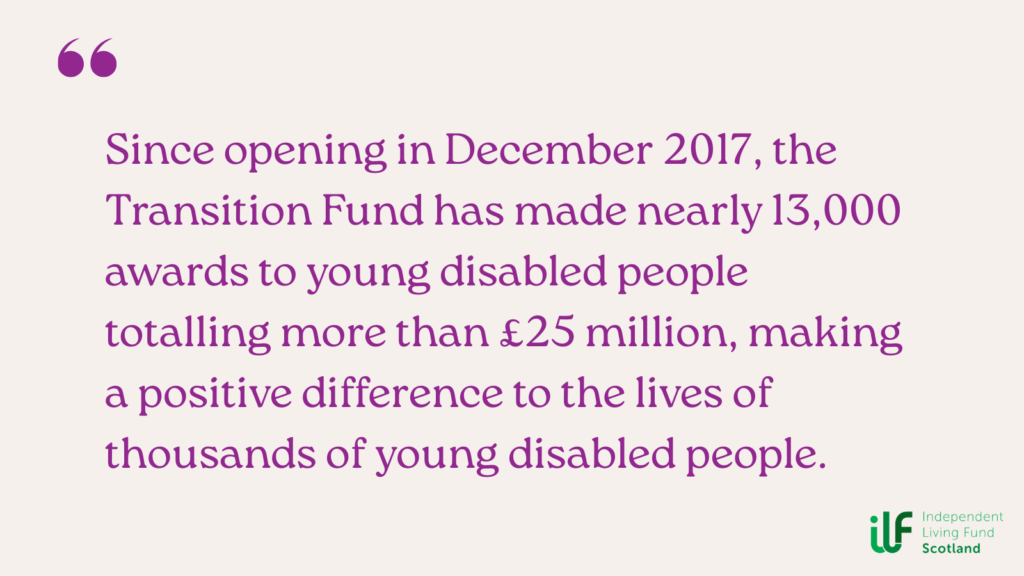
Since the Transition Fund opened, we have provided grants of over £29 million to over 14,500 young disabled people. Of these Recipients, 6,425 were aged 18 and under.
The Independent Living Fund re-opened in April 2024 to new applications in Scotland. This Fund enables disabled people in Scotland with the most complex needs to access the support they need and deserve. Awards are paid on an ongoing, long-term basis.
Since re-opening, we have received over 1,500 applications and provided funding of around £16 million enabling many more disabled people to live independent lives within their chosen communities.
The re-opened Fund is available to people aged 16 and over and since April 2024, we have received more than 50 applications on behalf of Recipients aged under 18.
As well as our Fund Recipients, ILF Scotland has supported young people through the Career Ready Scotland intern programme. Over the past three years, a number of interns aged 16 to 17 from local high schools have spent 4 weeks immersed within ILF Scotland, working with their allocated mentors in a variety of departments to experience the workplace, before delivering a presentation of their experiences to ILF Scotland staff, Career Ready representatives, teachers and their family members.
As well as being a learning opportunity for the interns, ILF Scotland members of staff have found the experience to be valuable and have received positive and helpful feedback from the young people.
We are delighted that one of the previous interns is now a full-time employee at ILF Scotland as a Modern Apprentice, having been successful after applying for an externally advertised post.
“I did my Career Ready internship at ILF Scotland when I was still at school. A year later, when I saw a Modern Apprentice position advertised, I immediately applied and was delighted to get the job, they are a really supportive employer and I am looking forward to progressing my career here.” Mark
“Equality is at the heart of what we do as an organisation and runs through all our everyday activities, thoughts, behaviours and plans. We strive to continuously improve on our commitment to mainstreaming equality across the organisation.”
As well as embedding equality within our culture, ILF Scotland must comply with the Equality Act 2010 (Specific Duties) (Scotland) Regulations 2012 and the specific duties designed to help Scottish public authorities meet the general duty. Regulation 4 of the specific equality duties requires that we base our Equality Outcomes on evidence and involvement of equality groups.
Our Board and staff group are diverse with regards to their own lived experience, and they are also well-informed about equality, diversity and inclusion more broadly. More specifically, we ensure that a programme of training and awareness is in place so that our staff have a high level of knowledge about the needs of young disabled people. Our employees are well qualified in health and social care and we regularly provide updated training.
Since July 2024, our work in this area has included:
delivery of Neurodiversity Awareness Training by The Donaldson Trust to all ILF Scotland staff
introduction of the internal staff Neurodiversity Group and Charter
provision of Trauma Informed training across frontline staff
provision of training on the Experience of Services for care experienced young people
introduction of a guaranteed interview scheme for care experienced applicants to ILF Scotland vacancies, provided the candidate meets the essential criteria for the role
providing an ongoing programme of child and adult protection training delivered by Who Cares? Scotland
How We Ensure Participation with Young People
Engagement and Young Ambassadors
ILF Scotland has a programme of engagement activity, with a focus on increasing awareness of the Transition Fund among priority groups. This helps in strengthening relationships with partner organisations, and providing direct support to young people, their families and professionals involved in supporting young people through transition from children’s to adult services.
In our engagement activity, we have tried to place particular focus on:
young people living in areas of multiple deprivation
care experienced young people
school leavers and young people preparing for transition into adulthood
Young people attending Additional Support Needs (ASN) schools and those schools with provision for deaf pupils
Through this engagement we have provided practical application support to increase access to funding.
Activity has included attendance at:
Social Work Circle meetings
presenting to local organisations and charities
engagement with Skills Development Scotland and Jobcentre Plus events
local schools and meetings with parents and carers
ILF Scotland has a group of young Transition Fund Recipients who are Young Ambassadors. These young Recipients aged 16 to 25 meet a few times each year to discuss common issues and provide feedback on their experiences with the Transition Fund.
The Young Ambassadors have previously discussed and provided feedback on publications and initiatives relevant to young people including:
ILF Scotland communications and promotional materials
The Scottish Government Learning Disability, Autism and Neurodivergence Bill and wider transitions work
accessibility improvements to application processes and digital engagement
website and social media development
providing case studies for ILF Scotland’s website
raising awareness within deaf and disabled communities
sharing lived experiences of navigating transitions from childhood into adulthood
participating in ILF Scotland PR and communications campaigns
The Young Ambassadors have had opportunities to attend events and engagement activities. This included a presentation by one of our Young Ambassadors at the ILF Scotland 10th Anniversary Celebration in June 2025, to an audience of over 100 guests, where they shared their experience of the Transition Fund and what it had enabled them to achieve.
As part our Corporate Parenting role, ILF Scotland works collaboratively with partner agencies including the Centre for Excellence for Looked after Children in Scotland (CELCIS), the Office of the Children’s Commissioner for Scotland and Who Cares? Scotland.
A key area of our Corporate Parenting plan is to ensure that all ILF Scotland staff receive training in adult and child protection. All ILF Scotland staff are considered to have a safeguarding role with a duty to report any concerns of harm. We will continue to provide regular training on an ongoing basis.
What We’ve Done
Since July 2024, we have:
Launched ILF Scotland’s Feedback Strategy, which includes a commitment to a human rights approach to decision making and seeks the views of young people.
Updated our Complaints Process to incorporate Child Friendly Complaints into our existing procedures and revised our internal procedures. We have based our approach on the Scottish Public Services Ombudsman (SPSO) Child Friendly Complaints process guidance and are incorporating this update within our ongoing programme of complaints training, which is delivered to all ILF Scotland staff.
Implemented support calls for new Recipients of the re-opened ILF Scotland Fund, which includes Recipients aged under 18 years old.
Published articles on UNCRC in our internal and external newsletters and on our website.
Presented on UNCRC implementation to both our Scotland and Northern Ireland Advisory Groups.
Worked collaboratively with partner agencies to reach more care experienced young people. Through this work and our engagement programme we have seen an increase in the number of care experienced young people access the Transition Fund, increasing from 13 percent in 2024 to 25 to 15.5 percent in 2025 to 2026.
Reviewed feedback from Transition Fund Recipients and identified a need for greater support of young people through the application and end of grant process. ILF Scotland has now recruited and appointed two Grant Support Officers to assist further in these areas.
Provided additional support to any applicant to the Transition Fund who notes that they are care experienced by allocating a specialist caseworker.
Secured agreement and funding to conduct an independent evaluation of the Transition Fund, including a Peer Research element and a Social Return on Investment analysis.
Attended the UNCRC Listed Authorities Peer Support Network, facilitated by the Scottish Government, which provides a supportive space where listed authorities can come together to share, learn and collaborate on joint priorities to embed a children’s human rights approach and support UNCRC implementation.
Action Plan for 2026 to 2029
We will refresh, review and relaunch our Young Ambassadors programme. We have contacted all existing members to gauge their ongoing interest and establish how they would like to see the Group developed. Our Scotland Advisory Group has agreed that a representative of the Young Ambassadors Group would be welcome to attend their quarterly meetings. We intend to implement this from December 2026. We would like to expand the membership of this Group to include Recipients of the re-opened ILF. UNCRC Articles 3 and 23
We will roll out UNCRC training across ILF Scotland with a commitment for all staff to have completed the online course provided by NHS Scotland by end of December 2026. UNCRC Articles: 2 and 3
We are working with Together Scotland to develop bespoke UNCRC and children’s rights training for frontline staff with the aim to have the initial training completed by end of March 2027. UNCRC Articles: 2 and 3
We aim to produce at least one case study of a new Recipient to the re-opened Independent Living Fund who is aged under 18 within the next 12 months. UNCRC Articles: 23
Our feedback strategy will assist in planning engagement with new Recipients of the re-opened fund who are aged under 18. UNCRC Articles: 2, 3 and 23
We are integrating Children’s Rights Welfare Impact Assessments (CRWIAs) within our existing Equality Impact Assessment (EQIA) framework. We will include training on CRWIAs in our EQIA training programme that we will deliver to ILF Scotland staff (in quarter 3 and quarter 4 of 2026 to 2027). UNCRC Articles: 2, 3 and 23
We will continue to expand our Accessibility initiative using mechanisms such as Easy Read to ensure that our publications are easily accessible by young disabled people. UNCRC Articles: 2, 3 and 23
We will continue to attend the UNCRC Peer group facilitated by Scottish Government where we meet other public bodies to share best practice. UNCRC Articles: 2, 3 and 23
We will continue to ensure that we reference and include UNCRC in ongoing ILF Scotland Strategy and Business Plan updates and within our Mainstreaming and Equality planning and reporting. UNCRC Articles: 2, 3 and 23
Monitoring and Reporting
In addition to our action plan, we anticipate there will be additional areas identified through our ongoing improvement work and policy reviews that we will add to our UNCRC planning process.
We will monitor the progress of this plan and action points on a regular basis and report to our Senior Leadership Team. We will also provide updates to our Board and our Advisory and Ambassador Groups to provide members with assurance on our approach to meeting our UNCRC duties.
In addition, we will publish a report on progress on our website on an annual basis.
ILF Scotland is committed to providing high-quality customer services.
We value complaints and use information from them to help us improve our services
If something goes wrong or you are dissatisfied with our services, please tell us. This leaflet describes our complaints procedure and how to make a complaint. It also tells you about how we will handle your complaint and what you can expect from us.
What is a complaint?
We regard a complaint as any expression of dissatisfaction about our action or lack of action, or about the standard of service provided by us or on our behalf.
What can I complain about?
You can complain about things like:
failure or refusal to provide a service
inadequate quality or standard of service, or an unreasonable delay in providing a service
dissatisfaction with one of our policies or its impact on the individual
failure to properly apply law, procedure or guidance when delivering services
failure to follow the appropriate administrative process
conduct, treatment by or attitude of a member of staff
disagreement with a decision, (except where there is a statutory procedure for challenging that decision, or an established appeals process followed throughout the sector).
Your complaint may involve more than one ILF Scotland service or be about someone working on our behalf.
What can’t I complain about?
There are some things we can’t deal with through our complaints handling procedure. These include:
a routine first-time request for a service
a request for compensation only
issues that are in court or have already been heard by a court or a tribunal (if you decide to take legal action, you should let us know as the complaint cannot then be considered under this process)
disagreement with a decision where there is a statutory procedure for challenging that decision (such as for freedom of information and subject access requests), or an established appeals process followed throughout the sector
a request for information under the Data Protection or Freedom of Information (Scotland) Acts
a grievance by a staff member or a grievance relating to employment or staff recruitment
a concern raised internally by a member of staff (which was not about a service they received, such as a whistleblowing concern)
a concern about a child or an adult’s safety
an attempt to reopen a previously concluded complaint or to have a complaint reconsidered where we have already given our final decision
abuse or unsubstantiated allegations about our organisation or staff; or
a concern about the actions or service of a different organisation, where we have no involvement in the issue (except where the other organisation is delivering services on our behalf).
If other procedures or rights of appeal can help you resolve your concerns, we will give information and advice to help you.
Who can complain?
Anyone who receives, requests or is directly affected by our services can make a complaint to us. This includes the representative of someone who is dissatisfied with our service (for example, a relative, friend, advocate or adviser). If you are making a complaint on someone else’s behalf, you will normally need their written consent. Please also read the section on Getting help to make your complaint below.
Child Friendly Complaints
As outlined in Who can complain? above, anyone who receives, requests or is directly affected by our services can make a complaint.
On occasion this may refer to a young person who is aged under 18 and therefore defined as a child.
If ILF Scotland receives a complaint from a person aged under 18, or a person complaining on their behalf, we will ensure that we handle any such complaint affecting any child in a way that meets all of their rights under UNCRC (United Nations Convention on the Rights of the Child).
ILF will keep the best interests of the child as a top priority in all decisions and actions that affect them (UNCRC Article 3).
The SPSO has created guidance for Child Friendly Complaints that ILF Scotland will refer to when handling complaints from any individual under 18 years. Further information on this guidance can be found at:
You can complain in person at our offices, by phone, in writing or by email using the contact details below.
It is easier for us to address complaints if you make them quickly and directly to the service concerned. So please talk to a member of our staff at the service you are complaining about. Then they can try to resolve the issue.
Normally, you must make your complaint within six months of the event you want to complain about or finding out that you have a reason to complain.
In exceptional circumstances, we may be able to accept a complaint after the time limit. If you feel that the time limit should not apply to your complaint, please tell us why.
What happens when I have complained?
We will always tell you who is dealing with your complaint. Our complaints procedure has two stages.
Stage one: Frontline response
We aim to respond to complaints quickly (where possible, when you first tell us about the issue). This could mean an on-the-spot apology and explanation if something has clearly gone wrong, or immediate action to resolve the problem.
We will give you our decision at stage one in five working days or less, unless there are exceptional circumstances.
If you are not satisfied with the response we give at this stage, we will tell you what you can do next. If you choose to, you can take your complaint to stage two. You must normally ask us to consider your complaint at stage two either:
within six months of the event you want to complain about or finding out that you have a reason to complain or
within two months of receiving your stage one response (if this is later).
In exceptional circumstances, we may be able to accept a stage two complaint after the time limit. If you feel that the time limit should not apply to your complaint, please tell us why.
Stage two: investigation
Stage two deals with two types of complaint: where the customer remains dissatisfied after stage one and those that clearly require investigation, and so are handled directly at this stage. If you do not wish your complaint to be handled at stage one, you can ask us to handle it at stage two instead.
When using stage two:
we will acknowledge receipt of your complaint within three working days
we will confirm our understanding of the complaint we will investigate and what outcome you are looking for
we will try to resolve your complaint where we can (in some cases we may suggest using an alternative complaint resolution approach, such as mediation) and
where we cannot resolve your complaint, we will give you a full response as soon as possible, normally within 20 working days.
If our investigation will take longer than 20 working days, we will tell you. We will tell you our revised time limits and keep you updated on progress.
What if I’m still dissatisfied?
After we have given you our final decision, if you are still dissatisfied with our decision or the way we dealt with your complaint, you can ask the Scottish Public Services Ombudsman (SPSO) / Northern Ireland Public Services Ombudsman (NIPSO) to look at it.
The SPSO / NIPSO are independent organisations that investigate complaints. You can ask the SPSO / NIPSO to look at your complaint if:
you have gone all the way through ILF Scotland’s complaints handling procedure
it is less than 12 months after you became aware of the matter you want to complain about; and
the matter has not been (and is not being) considered in court.
We understand that you may be unable or reluctant to make a complaint yourself. We accept complaints from the representative of a person who is dissatisfied with our service. We can take complaints from a friend, relative, or an advocate, if you have given them your consent to complain for you.
You may wish to get independent support or advocacy to help you progress your complaint. You can find out about advocates in your area by contacting the Scottish Independent Advocacy Alliance, tel: 0131 510 9410, website: www.siaa.org.uk.
You can find out about advisers in your area through Citizens Advice Scotland, website: www.cas.org.uk or check your phone book for your local citizens advice bureau.
We are committed to making our service easy to use for all members of the community. In line with our statutory equalities’ duties, we will always ensure that reasonable adjustments are made to help you access and use our services. If you have trouble putting your complaint in writing, or want this information in another language or format, such as large font, or Braille, please tell us in person, contact us on 0300 200 2022 or email us on enquiries@ilf.scot.
Quick guide to our complaints procedure
Complaints procedure
You can make your complaint in person, by phone, by email or in writing. We will always try to deal with your complaint quickly. But if we think we need to investigate, we will tell you and update you on our progress.
We have a two-stage complaints procedure.
Stage One: Frontline response
We will respond to your complaint within five working days if we can.
If you are dissatisfied with our response, you can ask us to consider your complaint at stage two.
Stage Two: Investigation
We will look at your complaint at this stage if you are dissatisfied with our response at stage one. Or if it is clear that we need to investigate.
We will acknowledge your complaint within three working days.
We will investigate the complaint and give you our decision as soon as possible but within 20 working daysunless we need more time.
Public Services Ombudsman
If you remain dissatisfied with our final decision or about the way we have handled your complaint, you can ask the SPSO or the NIPSO to consider our handling of your complaint.
ILF Scotland is a company limited by guarantee, registered in Scotland, Company Number: SC500075. Registered office: Denholm House, Almondvale Business Park, Almondvale Way, Livingston, EH54 6GA
Charter for Involvement - Progress against Action Plan 2025 to 2026
1. Background
The Charter for Involvement was developed by the National Involvement Network, supported by ARC Scotland. The Charter establishes how disabled people who use support services want to be involved and to have a say about the services they receive, the organisations that provide their services, and their wider communities.
2. Introduction
ILF Scotland signed up to the Charter for Involvement in 2018 and we worked with the Advisory Groups to tailor the Charter Statements so that they were meaningful to our recipients. We co-produced the Charter and Action Plan and published this in April 2021.
This report provides an update to the Board on the progress made during 2025 to 2026. This update was shared and agreed by the Advisory Group members and by our Senior Management Team at its meeting of 26 May 2026 and published on our website on that date.
3. Key Progress
Three joint Scotland and NI Advisory Group meetings were held during the last financial year to enable the Group to review progress to date and identify Charter priorities for ILF Scotland to action. These are highlighted below along with progress made during 2025 and 2026.
Raising the Profile of Independent Living
Group members stressed the importance of raising the profile of Independent Living to a wide range of Stakeholders.
Response: ILF Scotland celebrated its 10th birthday by holding events for our Recipients and their representatives and supporters in Scotland and Northern Ireland in June and July 2025. Attendees included our Advisory Group members, Recipients, carers, PAs, and partners from across government, public sector and third sector organisations. Speeches were delivered from advocates of disability and human rights, and people shared inspiring stories about how ILF Scotland helped them live with choice, dignity, and independence. Our website provides further information, including videos and photographs about the event: https://ilf.scot/news-post/celebrating-10-years-of-ilf-scotland/
Both events were a success and feedback from attendees demonstrated how impactful attendees felt the events were and provided helpful information on accessibility needs, the difference the funding makes in people’s lives, and suggestions for improvements at future events.
PA Recruitment and Retention – Support for Employers
Group members raised the significant difficulties people are experiencing in relation to the recruitment and retention of Personal Assistants (PAs) and asked for ILF Scotland to help promote the role.
Response: 13 November 2025, was celebrated as National PA Day across the UK to recognise PAs in social care who support independent living. Led by ILF Scotland, an inaugural PA week took place week commencing 24 November until 28 November 2025 to highlight the benefits of employing PAs and to highlight the need for PAs for disabled people.
Over the week, ILF Scotland launched our own dedicated content on a daily basis across our social media channels and our website, which included videos, blogs, news articles and graphics from Advisory Group members. We also created a dedicated page on our website for signposting information about employing PAs and we shared some other important resources from key partners / stakeholders, such as the PA Network.
The content was well received and we would like to dedicate the same week again this financial year, but with a lengthier lead in time. This will allow us more time to work with Group members on the content that they would like to see and for our colleagues in our Communications team to promote the content to a wider audience through additional media channels.
Support for Employers: We invited representatives from one of the insurance companies to deliver information sessions for Group members. This covered the support this particular company can provide to employers and the legal requirements of the employer role. The sessions were well attended and a future session has been agreed with an alternative insurance company commonly used by PA employers.
Managing ILF Scotland Awards
Members highlighted the need for further information, advice and guidance for Award Managers, particularly given the number of new Award Manager roles emerging as a result of the re-opening of ILF in Scotland. Members would like this to include, as a minimum, employer commitment, PA recruitment and retention, and independent advocacy.
Response: We have established an internal working group of Independent Living Assessors and Caseworkers to focus on Award Management. They have explored issues from their perspective as they are presented to them by existing and new Award Managers. They will report initial findings and these will be discussed with Advisory Group members with a view to incorporating their input and co-producing identified improvements. We plan to update our Employer Support Information Note and our Your Responsibilities Guide in 2025 to 2026 in consultation with Group members.
ILF Scotland Recipient Reviews
Group members highlighted the importance of continuously improving information, communication, and processes at all stages of reviews and that we continue to make sure that recipient choice is central to review discussions and outcomes.
Response: At least one colleague from our Independent Living Team, which includes all of our Assessors, attends meetings with the Advisory Groups to discuss Charter work and to ensure that they can participate in discussions with Group members and take suggestions on board in planning and conducting reviews and in relation to staff training.
Engagement and Involvement
Group members value the opportunity to influence policy and practice as it affects recipients and to co-produce key documents and initiatives.
Response: All ILF Scotland potential policy changes are discussed with the Group to obtain the views of the Group members as part of the policy development process. The Scotland Advisory Group met with the Minister for Social Care and Mental Wellbeing in January 2026 and the Northern Ireland Advisory Group met with the Minister of Health in February 2026, highlighting important wider policy issues. Group members participated in the co-production events to develop ILF Scotland’s Strategy: Re-Opening and Beyond. Members have been involved in the co-production of our new Feedback Strategy and Service Charter. During the year, the Chairpersons of both Advisory Groups attended ILF Scotland Board meetings and members of the Board also attended the Group’s meetings. Group members co-produced and delivered presentations at ILF Scotland’s 10th Birthday celebratory events in Scotland and Northern Ireland, mentioned above.
Written Communication
Group members stressed the importance of clear communication by ILF Scotland that is as accessible as possible.
Response: Members were consulted in the review and publication of external communications such as our website, newsletters, and letters to recipients, with a focus on both content and accessibility. Members were jointly involved in external consultations that ILF Scotland responded to in 2025 and 2026. ILF Scotland is focusing on the accessibility of its published documents and its correspondence and delivered accessibility training to all staff in 2025 to 2026. It is about to reinstate a working group to take this forward and will invite representation from the Groups.
Re-Opening of ILF in Scotland
The Scotland Advisory Group was highly instrumental in advocating, along with others, for the re-opening of ILF to new applicants in Scotland. The fund opened in April 2024 and since re-opening, has received applications from an additional 1,400 disabled people. Feedback from recipients so far has been very positive with in relation to the difference the funding has made to their lives and there has been strong praise for the overall process.
The Chairperson of the Scotland Advisory Group is a member of the ongoing Co-Production Working Group. This Group made recommendations to the Minister on the policy framework for the re-opened fund and have been engaging with senior ILF Scotland staff since to further inform the development of the policy framework relating to the re-opened fund.
4. Conclusion
We have made significant progress against the Charter Action Plan during 2025 to 2026. It is important that this improvement work is ongoing and we will continue to work with the Advisory Groups in 2025 to 2026 to make further progress towards achieving the Charter Standards.
The Charter provides a valuable opportunity to bring recipients, via the Advisory Groups, closer together and helps facilitate greater collaboration in the organisation’s strategy, policies and delivery of services. We are grateful to Group members for their valuable ongoing commitment to improving our services to disabled people in Scotland and Northern Ireland.
Mainstreaming and Equality Outcomes Report - 2026 to 2028
Foreword
We are pleased to introduce our fourth Mainstreaming and Equality Outcomes Report. This document highlights the progress we have made in delivering our 2024 to 2026 equality outcomes and sets out our equality outcomes for 2026 to 2028 and the actions we will take to achieve them.
We aim to review our progress and planning relating to equality regularly and, as a minimum, to conduct a formal appraisal of our activities including our progress in achieving our mainstreaming equality objectives, on an annual basis.
We introduce this report after successfully operating the re-opened Independent Living Fund in Scotland for two years. Since April 2024, we have received over 1,400 applications and provided funding of £9.7 million, enabling many more disabled people with the most complex needs to access the support they need to live independent lives within their chosen communities.
Equality is at the heart of what we do as an organisation and runs through all our everyday activities, thoughts, behaviours and plans. We strive to continuously improve on our commitment to mainstreaming equality across the organisation.
Our Board and staff group are diverse with regards to their own lived experience and they are also well-informed about equality, diversity and inclusion more broadly. We continue to listen to and learn from disabled people and strive to provide better-informed services relating to equality, diversity and inclusion to our Recipients, our staff and our other key stakeholders. The organisation does not operate in isolation and we continue to seek out best practice, obtain feedback on our services, consider reporting tools and be involved in partnership working.
Our key focus on addressing inequality is in relation to protected characteristics but we are also considerate of broader definitions of diversity that focus on additional areas. This last year, for example, we have had a greater focus on neurodiversity, cognitive diversity, social mobility and socio-economic diversity. We realise the importance of considering the intersectionality and the impact of how a combination or more than one protected characteristic can perpetuate different forms of discrimination or inclusion challenges.
Our plans are informed by a consideration of the existing context, as well as anticipated future impacts, such as the increase in the use of AI technologies, increased regulatory interest in identifying meaningful diversity metrics, the Scottish Government’s revisions to the National Performance Framework, and the introduction of the Human Rights Bill. We also look to incorporate best practice and guidance such as the UK Government’s Disability Action Plan.
We operate a discretionary fund providing ongoing awards to just under 4,000 disabled people in Scotland and Northern Ireland to help them live independently with choice, control and dignity in their own homes and within their local communities.
In addition, we provide one-off grants via our Transition Fund for young disabled people in Scotland aged 16 to 25 to help them increase their independence and participate in their communities. Between 2024 and 2026 we provided grants to just under 5,000 young disabled people.
Our Staff
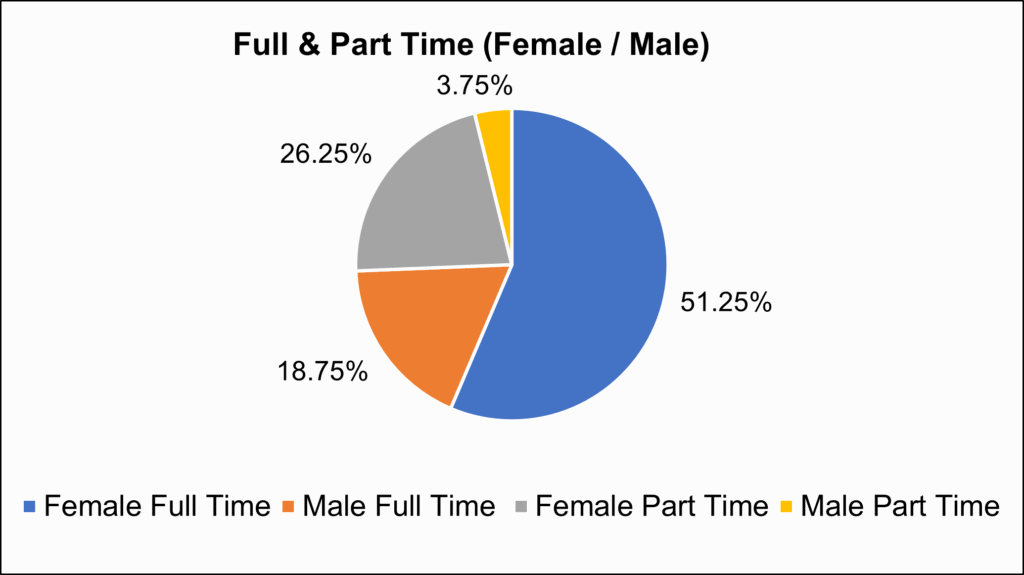
ILF Scotland employs 80 people – 3 on temporary contracts. Of those, 3 members of staff are based in Northern Ireland and 77 work across Scotland. 53 of these are support staff based in the Livingston office and 27 are home-based assessors. We actively recruit colleagues who are disabled and who have long-term health conditions. We are a close team and we regularly listen to what staff have to say both informally and using regular survey tools. On our website there are two case studies from members of our staff to hear from them directly.
Legal Framework
The Equality Act 2010 sets out the general equality duty for all public authorities to have due regard to the need to:
eliminate unlawful discrimination, harassment, and victimisation and other prohibited conduct
advance equality of opportunity between people who share a relevant protected characteristic and those who do not, particularly by removing or minimising disadvantage; meeting the needs of particular groups that are different from the needs of others; and encouraging participation in public life
foster good relations between people who share a protected characteristic and those who do not
The Equality Act 2010 lists nine protected characteristics:
Age
Disability
Gender Reassignment
Marriage and Civil Partnership
Pregnancy and Maternity
Race
Religion or Belief
Sex
Sexual Orientation
and defines direct and indirect discrimination as:
“Where someone is treated less favourably according to a protected characteristic or could be disadvantaged compared to someone who does not share that protected characteristic.”
All people are entitled to equal treatment and the way in which people are treated shapes their lives and lived experiences. We recognise and understand how unequal treatment under each characteristic impacts people, particularly those who are living with more than one or multiple protected characteristics.
ILF Scotland must comply with the Equality Act 2010 (Specific Duties) (Scotland) Regulations 2012 and the specific duties designed to help Scottish public authorities meet the general duty. Regulation 4 of the specific equality duties requires that we base our Equality Outcomes on evidence and involvement of equality groups.
ILF Scotland is required to report on the areas outlined below every two years, apart from the Statement on Equal Pay, which is every four years. We also have a duty to publish diversity information about our board members. This report meets our general and specific duties under the Equality Act 2010 and outlines:
Mainstreaming equality is a long-term, strategic approach to ensure that equality, diversity and inclusion is truly integrated and sits at the heart of organisational culture, strategic planning and operational delivery.
This ambition is evolving and ongoing and we have the commitment, encouragement and support of our Board and our Senior Leadership Team (SLT) to deliver on this. We aim to make sure that every member of our staff team understands, accepts and embraces equality across every part of our organisation and in the services we deliver to our Recipients. We believe that mainstreaming equality has many benefits including helping us to:
put equality at the heart of everything we do
embrace diversity across our organisation and attract and retain a motivated workforce, rich in talent, skills and experiences
continually improve our service delivery and make sure our services meet the diverse needs of our Recipients
help us to be more socially inclusive and engage better with those most excluded in society
We strongly embrace the principles of equality and are proud of the journey we have taken so far.
We became a Non-Departmental Public Body (NDPB) in 2018 and since then there have been changes to the wider equality context in which we work. These include legislative changes, the impact of major events and societal changes bringing certain inequalities into the foreground. Key recent examples to note include:
Legislation Milestones:
The United Nations Convention on the Rights of the Child (UNCRC) came into effect in July 2024. The UNCRC aims to ensure that the rights of children are upheld and that their views are taken into account in decisions that affect them including policy, practice and budget-making decisions. As a public body, ILF Scotland is required to report on our implementation and progress towards compliance as at the end of March 2026. We plan to publish our child friendly statement and plan within the first quarter of 2026 to 2027. As part of ensuring compliance with the UNCRC, we have:
Added a UNCRC page to our website with links to Scottish Government videos and information and ILF commitment to the Act.
Publicised information in our Recipient newsletters and discussed with our Scotland and Northern Ireland Advisory Groups and our Young Ambassador Groups.
Raised awareness of the legislation and our duties and requirements, promoting children’s rights throughout the organisation from our Board to our front-line staff. We are including the online Scottish Government e-learning course, Introduction to Children’s Rights, as a training course for all staff and incorporating it in our induction material for all new staff. Relevant staff will participate in more targeted training courses to be delivered by an external trainer later in the year. Additionally, we will incorporate elements into our existing EQIA, corporate parenting and child protection training courses.
Revised our published complaints process to ensure it is relevant and accessible to children and young people and we are committing to review all our other publications to ensure the material on our website, newsletters, leaflets, correspondence, etc. is child friendly and accessible.
As part of encouraging participation and empowerment of children and young people and ensuring that young people have a voice, we are reviewing and developing a relaunch of our Young Ambassador Group to include Recipients of our re-opened fund, should they wish to join. As part of this exploratory work to ensure we take the views of young people on board, we are liaising with the members of the UNCRC peer group to share best practice and exploring involvement with other relevant, and already established, youth groups.
Incorporated Wellbeing Impact Assessments (CRWIA) in to our existing Equality Impact Assessments.
From 1 April 2025, changes to the Disclosure (Scotland) Act 2020 – Protection of Vulnerable Groups mean that people working in a regulated role must register to become a member of the PVG scheme. This impacted on our disabled Recipients, primarily in relation to our main Independent Living Fund but also our re-opened ILF in 2024.
We published information and individually advised our Recipients of this change ensuring they understood the legal requirement for any Personal Assistants (PAs) who support them, to join the PVG scheme. We confirmed that the legal onus is on the PA not the recipient to join the scheme and that it would be a criminal offence for their PA to continue to support them in paid work if they do not have a PVG membership.
ILF Scotland is considered a relevant public authority under the Consumer Scotland Act 2020 (relevant public authorities) Regulations 2024. This requirement came into effect on 1 April 2025 and places a statutory duty on us as a public body, when making decisions of a strategic nature, to have regard to the impact of those decisions on consumers in Scotland and the desirability of reducing harm to those consumers.
This requirement will be introduced by ILF Scotland formally on 1 April 2026. Guidance from Consumer Scotland recommends the use of an impact assessment and has provided a template incorporating the Consumer Duty Assessment with the Equality Impact Assessment and other statutory impact assessments. ILF Scotland staff members are currently considering the best way to incorporate everything we need in the one impact assessment process, where possible, as part of an overarching Equality Impact Assessment Process with a view to implementing this after appropriate training in 2026 to 2027.
We have met some of the requirements of the 2020 Act during the financial year 2025 to 2026, specifically ensuring we actively consider the impact of our strategic decisions on consumers and having regard to the desirability of reducing harm. For example, we co-produced our 2025 to 2028 strategy with disabled people and their representative and supporting organisations, resulting in a strategy that puts disabled people at the heart of everything we do, leading to improved independent living outcomes that are important to consumers – our Recipients.
We have not, however, met all of the requirements of the 2020 Act during this period. We are currently broadening our Equality Impact Assessment process and we will now include the recommended Consumer Duty Impact Assessment as part of this, which should allow us to confirm full compliance with the duty in next year’s report.
The introduction of the Employment Rights Act (2025) brings important changes to equality and fair work, enhancing protections for employees and reinforcing employers’ responsibilities to create safe, inclusive and supportive working environments, including strengthened duties to prevent and address sexual harassment.
Ongoing debate and legal action to clarify the definition of sex in law and attempts to reform the Gender Recognition Act in Scotland in 2023 has increased awareness of the experiences of transgender people. As a public body, we await guidance on any required changes to policy following the recent court ruling on gender.
The Scottish Government has now committed to introducing a new Human Rights Bill for Scotland. This will incorporate, within the competencies of devolution, the United Nations (UN) human rights treaties of:
International Covenant on Economic, Social and Cultural Rights (ICESCR)
Convention on the Elimination of All Forms of Discrimination against Women (CEDAW)
International Convention on the Elimination of All Forms of Racial Discrimination (CERD)
Convention on the Rights of Persons with Disabilities (CRPD)
The new Bill will also include the right to a healthy environment, as well as rights for older people and LGBTQI+, which includes lesbian, gay, bisexual, transgender, queer (or questioning) and intersex people.
Following the implementation of the Hate Crime and Public Order (Scotland) Act 2021, the Scottish Government is actively consulting on adding sex as a protected characteristic to this Act to specifically address misogynistic harassment, with reports on this activity released in early 2026.
The Scottish Government is working on the Learning Disabilities, Autism and Neurodiversity Bill, with a partial Equality Impact Assessment published in March 2026.
Key Events and Societal Changes
The COVID-19 pandemic drew further attention to societal inequalities with women, disabled people and ethnic minority groups disproportionately impacted by the effects of the virus and of lockdown measures and we continue to see the effects of this. The pandemic has also changed the way we work and live, with more homeworking and reliance on digital technologies.
Population growth in Scotland continues to be driven by international migration and migration from elsewhere in the UK, together with changes in birth and death rates.
The ongoing cost of living crisis continues to intensify, driven in part by rising inflationary pressures linked to the conflicts in Iran and Ukraine. These pressures are widening existing inequalities and increasing levels of poverty, with disabled people disproportionately affected due to higher living costs related to disability, greater reliance on fixed incomes, and reduced access to secure employment.
Recent events in global media have highlighted the serious impact of persisting inequalities related to gender, socio economic disadvantage, and power. Evidence across the UK, including in Scotland and Northern Ireland, demonstrates that these risks can arise across a range of different settings including in private family life, and that exploitation continues across workplaces and communities when vulnerability and power imbalances are not adequately challenged and addressed.
Research indicates that misogyny is deeply ingrained in Scotland’s social and patriarchal structure, with minority groups of women facing higher risks. Women are not adequately protected and current misogynistic behaviour is widespread.
All of the above informs our thinking and our statutory responsibility under the Public Sector Equality Duty. These societal issues highlight the importance of us mainstreaming equality outcomes across policy development, decision making, service delivery, and review and this reports provides us with a vehicle to demonstrate progress in advancing equality and reducing unequal outcomes where we can.
Our Recipients
The Recipients of our funds are disabled people. We have two funds, the Independent Living Fund, which re-opened to applicants in April 2024, and the Transition Fund.
Our funding helps our Recipients to access the same opportunities as others and achieve their personal independent living outcomes. We continuously review our strategies, plans, policies and practice to provide the best service we can.
Here you can find out more about our work from some of our Recipients:
As part of ILF Scotland’s ethos and aim to work in co-production with our Recipients, we meet regularly with members of the ILF Scotland and Northern Ireland Advisory Groups.
The purpose of these Groups is to support the improvement and development of ILF Scotland for Recipients living in Scotland and Northern Ireland, by advising on all matters relating to the operation of the fund, including:
experiences of using the existing fund
experiences of communicating and interacting with ILF Scotland
insight and advice into potential policy developments relating to the existing fund
content and accessibility of ILF Scotland publications
any other relevant matters
The Advisory Groups report to the ILF Scotland SLT, who in turn report learning and outcomes from the Group to the Board and the Scottish Government, as required.
The Groups meet quarterly on an individual basis and meet jointly three times each year with additional occasions meetings with the Minister of Social Care and Wellbeing in Scotland, the Minister for Health in Northern Ireland and with ILF Scotland’s Board members and staff.
The minutes from the Group meetings are available on our website.
We engage with our Recipients in a variety of other ways:
We re-opened ILF in April 2024 with a policy framework co-produced with our Recipients and their supporters and other key stakeholders following a series of in person engagement events at venues across Scotland complimented by online engagement meetings. We have since collected Recipient feedback about the re-opened fund and published this on our website. Overall, the feedback captured demonstrates a high level of satisfaction with the funding awarded and with people’s interaction with ILF Scotland:
88% indicated their independent living outcomes were achieved
95% indicated the funding had a significant impact on their lives
94% indicated they were very satisfied with both the application process and their visit by one of our Assessors
Between 2024 and 2026 members of staff attended more than 100 events with over 2,000 attendees, organised by partner organisations to present or to manage a stall to raise awareness and provide information about the Independent Living Fund and in the majority of occasions, the Transition Fund. A significant amount of this engagement takes place in schools, at transition events and with parent groups. These sessions also regularly involve young people who are care-experienced, supported by social work transitions teams, Looked After and Corporate Parenting staff, or school-based Additional Support Needs leads. We have, in addition, delivered workshops, guidance sessions and targeted outreach with a range of charitable, third, public and government sector organisations supporting young disabled people. This ensures that young people who require additional support, including those who are care-experienced, digitally excluded, or who have limited family resources and who are most at risk of missing out, find out about the possibility of funding from ILF Scotland.
We celebrated ILF Scotland’s 10th birthday by holding events for our Recipients and their representatives and supporters in Scotland and Northern Ireland in June and July 2025. Speeches were delivered from advocates of disability and human rights, and people shared inspiring stories about how ILF Scotland helped them live with choice, dignity and independence. Our website provides further information, including videos and photographs about the events. Both events were a success and feedback from attendees demonstrated how impactful attendees felt the events were and provided helpful information on accessibility needs, the difference the funding makes in people’s lives and suggestions for improvements at future events. We produced a summary of feedback from attendees of both events which is available on our website.
Equality Impact Assessment
We carry out Equality Impact Assessments (EQIAs) when we develop our external policies and publish these on our website. In addition, we conduct screening exercises for all internal policies and produce EQIAs where required. We have incorporated early consideration of Equality Impact Assessments as part of our internal project planning tools and continue to work to extend EQIAs across all our service delivery areas to cover all relevant decision making that affects people with protected characteristics.
We have incorporated Care Experienced young people in our Equality Impact screening and EQIAs, and in the next financial year, we intend to include poverty and rurality as well, because of the effect of these conditions on disabled people.
ILF Scotland is a public authority required to comply with the Consumer Duty, the guidance on which includes a template incorporating the Consumer Duty Assessment with the Equality Impact Assessment and other statutory impact assessments. ILF Scotland staff members are currently considering the best way to incorporate everything we need in the one assessment process, where possible with a view to implementing this after appropriate training in 2026 to 2027.
We believe in the many advantages of conducting EQIAs, in addition to adhering to our statutory duty to do so, including:
enshrining the rights of disabled people to being treated with dignity and respect and being able to exercise choice and control in living their lives
systematically conducting EQIAs early in the planning process ensures that we identify any barriers that we need to avoid or mitigate as part of our decision-making
going through the EQIA process makes sure that we think about how the consequences of our plans and decisions might affect people with protected characteristics, other than disability, ensuring that different groups are included
ensuring that we gather relevant information to demonstrate that our decisions are based on evidence, which is important in the event of challenge
We raised awareness and provided training across the organisation of our Equality Impact Assessment tool and screening assessment plan, taking staff through relevant worked examples of EQIAs on live work-related topics during 2024 to 2025 and 2025 to 2026. We will repeat this training in 2026 to 2027 along with additional worked examples to embed this area further in future, which will enable us to apply good equality practice across the organisation.
Key partners in our approach to equality include the Scottish Government and the Non-Departmental Public Body Human Resources network and forum where core Scottish Government and other Public Bodies share best practice on equality and diversity policy and practice.
In addition, we have developed ongoing positive working relationships with ARC Scotland, Who Cares? Scotland. This ensures that we keep equality at the heart of any decisions we make regarding the services we provide to young disabled people through our Transition Fund. We also signpost disabled people to other sources of support, such as the Scottish Welfare Fund and other charities, benefits agencies / advisory organisations as appropriate.
We also actively seek opportunities to engage with partners across the sector to support the mainstreaming of equalities, sharing learning and contributing to wider improvements in equality outcomes through our continued participation in events and stakeholder meetings.
We value the important input and feedback of our Advisory Group members in Scotland and Northern Ireland on equality when we work with them to develop the Charter for Involvement and through co-production on our strategies and policies.
We aim to adopt a human rights approach to all that we do and the Charter fits with human rights legislation, specifically the United Nations Convention on the Rights of Disabled Persons, supporting the realisation of Article 19 of the United Nations Convention on the Rights of Persons with Disabilities – “living independently and being included in the community”.
Implementing the Charter actions, co-produced by the Advisory Groups, helps ensure that we listen to our disabled Recipients and their representatives so that they remain at the heart of our decision-making.
We continue to embrace ways to work in partnership to improve our services and approach.
Report on Progress on Equality Outcomes for 2024
We set ourselves ambitious equality outcomes and these will be considered in the next section of this report.
Some of our Key Equality Achievements:
We re-opened the Independent Living Fund so that more disabled people could continue to live independently at home with a better quality of life.
We published our first feedback strategy and our feedback findings across various themes, which provided us with important learning.
We organised a variety of engagement events to celebrate and support independent living and also spoke at a variety of other organisations’ events to raise awareness of our funding and the difference it can make to disabled people.
We continued to work with our partners across Scottish and local government and the third and independent sectors to promote the provision of support to enable people to continue to live at home and achieve the independent living outcomes important to them.
Reviewed all of our fund policies to ensure they remain fit for purpose and offer as much flexibility as possible to allow disabled people to maximise their ILF awards or grants in the best way for them.
In June 2024, we were awarded Best Small Employer and in June 2025 we received the Best Practice Family Friendly Champion Award at the Working Families Best Practice Awards. We were also recognised as one of the Top 10 Working Families organisations in both 2024 and 2025
In 2025 we became the first employer in Scotland to be awarded the Gold Standard Kinship Friendly Employer accreditation. Gold standard support includes offering paid leave to all kinship carers, when they take on the care of a child, that equals the organisation’s adoption leave and pay.
In addition, we signed up to the Age Friendly and Dyslexia Friendly Employer pledges demonstrating the commitment and value of recognising and supporting staff. We also set up Neuro Minds, our staff neurodiversity group to raise awareness and celebrate neurodiversity at ILF Scotland.
Picture - Chris Watt Photography
Progress in Relation to Objectives set for 2024 to 2026
Our Equality Objectives were integrated into our business plan as Specific, Measurable, Achievable, Realistic and Timebound (SMART).
Outcome 1: Integrated Equality Impact Assessments
Integrated Impact Assessments are consistently applied across the organisation with a commitment to have our staff members appropriately trained and our board members fully aware of this.
Action: Further embed the use of Equality Impact Screening and Assessment practices across all business functions by providing additional awareness and practice training to Managers by the end of 2024 to 2025.
Update: We provided additional training to staff and managers in 2024 to 2025 and in 2025 to 2026. We have extended the automatic equality impact screening from our public policies to all of our internal policies and have incorporated this process into our project planning framework. During the next plan, we will continue to work to ensure all decisions about service development or changes to service delivery automatically incorporate equality impact screening and assessment where required.
Outcome 2: Promote Neuro-Inclusion
To start the neuro-inclusion journey within ILF Scotland focused on developing a neuro-inclusive culture with the aim of creating even greater comfort and belonging for our diverse staff group.
Action: We provided neurodiversity training to all staff in 2026 through The Donaldson Trust, raising awareness along with specialist training for our front-line staff so they can provide informed customer service to our Recipients who are neurodivergent, plus Leadership training for managers and Senior Leadership Team.
In 2025, we also created Neuro Minds, our staff neurodiversity group with the aim to create a workplace where everyone feels valued, fairly treated, supported and able to thrive. We celebrate the strengths and talents of neurodivergent people and work together to promote understanding, acceptance and meaningful inclusion.
Outcome 3: Corporate Parenting
More young disabled people who are Care Experienced are aware of the Transition Fund and how to apply, and our staff and Board members are aware of the Transition Fund and how it might positively impact Care Experienced young people.
Action: Through our Corporate Parenting Plan, we will further develop our communications strategy to target Care Experienced young people and those that support them to ensure they are aware of the Transition Fund. We will ensure ILF Scotland staff and Board Members are aware of the principles of Corporate Parenting through training courses and induction programmes.
As part of our commitment to advancing equality and supporting diverse family structures, ILF Scotland introduced a Kinship Care Policy in 2025. This policy mirrors the principles of our Maternity and Adoption policies by providing equitable support to employees who take on the primary care of a child through kinship arrangements. It recognises the vital role that family members and close connections play in providing stable, loving care, and ensures that kinship carers have access to protected leave, enhanced pay and flexible working options during this important time. The introduction of this policy reflects our ongoing commitment to fair work, inclusion and ensuring that all forms of caregiving are valued and supported within our organisation.
In 2025, we introduced a positive action recruitment measure to support applicants who are Care Experienced, aligned in approach to the principles of the Disability Confident scheme. When an applicant identifies as being Care Experience and meets all essential criteria outlined in the job description, they are guaranteed progression to the next stage of the recruitment process.
We are proud to collaborate with them to recognise, value and support kinship carers, relatives and friends who step up to raise a child when their parents are unable to. We have ensured all our Family Friendly policies include kinship carers: providing our managers with guidance to help them support kinship carers with flexibility and kindness and raising awareness of kinship care to our staff. We are also proud to be introducing kinship care leave on par with adoption leave.
In 2025 we were recognised by the leading national charity Kinship as Gold Standard Kinship Friendly Employer and the first employer In Scotland to achieve the accreditation.
Outcome 4: ILF Re-Opening
Following an announcement by the First Minister in September 2023, the Independent Living Fund, closed to new applications since 2010, re-opened to new applicants in April 2024. This enabled up to 1,000 additional disabled people with the most complex needs to access the support they need to live independent lives.
A Co-Production Working Group was established in October 2023, consisting of disabled people, carers, disabled people's organisations (DPOs) and representatives of ILF Scotland, the Scottish Government and health and social care statutory partners. A range of engagement events were held to seek views on the policy framework for the re-opened fund. A commitment was given to continue to develop policy in 2024 to 2025.
Action: Facilitate meetings of the Co-Production Working Group every two months in 2024 to 2025, with the first meeting to be scheduled for June 2024. Report on learning from the first two months of receiving applications to the re-opened fund and work together with the group and others as required to further develop policies around the key issues raised by disabled people and others at the re-opening engagement events. Arrange further co-production opportunities with our Recipients and others as part of our strategic planning consultations in the latter part of 2024 to 2025.
Update: The Co-Production Working Group continued to meet regularly during 2024 to 2025 with the first of these meetings held in June 2024. Meetings continued during 2025 to 2026. ILF Scotland senior staff have worked closely with the Group to report on the operation of the re-opened fund, including the number of places allocated and taken up, challenges, learning and feedback. We received positive feedback and reported this back to the Group.
The Group recommended a policy change to include a Care Component. This would allow disabled people who did not currently meet the £800 local authority funding threshold for the re-opened fund, but who would have if account were to be taken of the significant amount of support provided to them by an unpaid carer residing with them. The Minister accepted this recommendation and ILF Scotland implemented a Carer Component in January 2025, which resulted in an additional 218 applications to the re-opened Fund.
During 2025 to 2026 we worked with the Group to develop a DPO supported pilot to test an alternative route to local authority applications, which will provide learning relevant to the consideration of a potential citizen led application route to the re-opened ILF. The pilot will last for 12 months from 2 April 2026 to 31 March 2027 and will be funded as part of the Scottish Government’s Disability Equality Plan. We ran a series of online and in-person events during 2024 to 2025 to co-produce our Strategic Plan 2025 to 2028 with our disabled Recipients and their supporters. They directly influenced our direction of travel through the articulation of aims and objectives important to the achievement of independent living outcomes.
Summary
We made strong progress in achieving the actions set out in our plan as part of our Mainstreaming and Equality Outcomes Report for 2024 to 2026.
We were unable, as planned, to undertake further work on our forms and systems to provide better equality data on protected characteristics across both funds to improve our monitoring and reporting practices in line with good practice. We will therefore carry this action forward to the next plan.
ILF Scotland remains committed to embedding equality outcomes and will pursue further expansion and improvement on our approach to working in partnership with others to promote equality in Scotland.
Board Diversity Duty
The Gender Representation on Public Boards (Scotland) Act 2018 sets an objective that public boards should have 50% of their non-executive members who are women.
ILF Scotland has worked proactively with the Scottish Government over a number of years to strengthen the diversity and gender balance of our Board. We have maintained more than 50% female representation on our non-executive Board since 2015 and have sustained this position through to 2024, with women making up 75% of Board members.
We regularly review the diversity and representativeness of our Board to ensure it reflects the communities we serve, and we recognise that people from ethnic minority backgrounds remain underrepresented. We have 9 Board members, 4 of whom identify as disabled. We will continue to take proactive steps to improve representation, working closely with the Public Appointments Team during future Board recruitment processes to promote wider participation and encourage applications from underrepresented groups. ILF Scotland also follows the Equality and Human Rights Commission’s good practice guidance How to Improve Board Diversity: Six Step Guide to support fair, transparent and inclusive appointment processes.
In 2023 there were 4 women and 3 men. In 2024 there were 6 women and 2 men. In 2025 there were 6 women and 1 man.
2023
2024
2025
Women
4
6
6
Men
3
2
1
Employee Information
Staff (Female / Male)
Female Employees: 77.58% Male Employees: 22.5%
Full and Part Time Female / Male
Female Full Time: 51.25% Male Full Time: 18.75% Female Part Time: 26.25% Male Part Time: 3.754%
Part time working patterns remain predominate toward women.
During 2024 to 2026, 100% of staff worked within our hybrid working offering, with employee choice and control over whether they were working in the office or at home.
We used data capture and analysis to measure the representativeness of our workforce profile and use this information to identify improvement measures such as targeted recruitment.
The accuracy of our equality profile data is important as it can assist our Board and SLT in planning the workforce of the future and provides for the potential justification of allowable positive action to make improvements, leading to a workforce that reflects the population and geographical locations we work in.
Our workforce monitoring data indicates that there is room for improvement in the representation of people from ethnic minority groups and LGBTQI+ colleagues within our workplace. Our organisational demography by the end of Q4 2025 to 2026 was 80 staff and 9 Directors.
Women are well represented in the general workforce and at managerial level: 77.5%:22.5% female: male. At Director and Senior Leadership Team level, however, women remain comparatively underrepresented (25%:75% female: male).
Through our Workforce Plan, we have taken active steps to strengthen gender representation at senior levels. As part of this work, seven women have recently been appointed as Leads across the organisation, broadening the leadership pipeline and increasing opportunities for women to progress into more senior decision-making roles.
We plan to continue addressing this through a sustained focus on leadership and management development, succession planning and strategic recruitment.
We have a good representation of disabled people with 30% self-identifying as disabled. As a comparison, in September 2025, the Scottish Government reported 14.2% of staff were disabled.
We have some representation of people from ethnic minority groups at 3.75%, an increase from our previous representation of 2.6%. In September 2025, for comparison, the Scottish Government reported a figure of 4.0%.
The information we have on sexual orientation and gender reassignment is that 1.25% of staff identify as LGBTQI+. In September 2025, the Scottish Government reported a figure of 8.1%.
Data on the current ILF Scotland workforce is robust in relation to age and sex. However, information on other protected characteristics – including ethnicity, disability, religion or belief, sexual orientation and gender reassignment – remains limited. This is largely due to non-completion of questions within staff surveys or individuals choosing the prefer not to answer option.
We continue to raise awareness across the organisation about the importance and benefits of sharing protected characteristic data, emphasising that all information is held in strict confidence and used solely to support equality monitoring and improvement.
As a positive action measure in recruitment, we actively encourage applications from individuals with protected characteristics to help broaden representation across our workforce. Like many public bodies, we recognise the ongoing challenge of achieving a workforce that fully reflects the diversity of the communities we serve, and this will remain a key area of focus in the years ahead.
The findings from our 2025 employee engagement surveys indicate (84% response rate):
100% of our staff can and do continue to work flexibly and remotely
Life / Balance Opportunities – 98.51% stated that they were in control of this most of the time
ILF Scotland continues to be an outstanding place to work
Our Accreditations
Equality Outcomes 2026 to 2028
These are the new Outcomes for 2026 to 2028. We have consulted with ILF Scotland staff and Advisory and Young Ambassadors Group members. Our Equality Committee and our SLT have recommended them to the Board, who have approved them. We will integrate these as SMART objectives in our business plan.
Outcome 1: Making inclusivity central to how we work and lead, strengthening our commitment to having a workplace where everyone belongs
Action: Over the next two years, we will embed inclusivity as a visible, measurable and shared responsibility across our organisation. We will continue to equip our staff with the skills to foster belonging, ensuring transparent policies and processes, as well our ongoing commitment to actively listen, engage and respond to diverse perspectives. Clear goals and accountability will track our progress and celebrate milestones in doing so, making inclusivity a core part of how we lead, collaborate and continue succeed together.
Outcome 2: Ensure our Equality Impact Assessment is inclusive of all of our relevant public body duties
Action: By the end of 2025 to 2026, review and update our Equality Impact Assessment Screening Toolkit and EQIA template to incorporate all other relevant impact assessments introduced by other legislation where we have a public body duty including the UNCRC, the Consumer Duty and the impending Human Rights Bill.
Outcome 3: Provide improved data on protected characteristics to improve the inclusivity of our services and to demonstrate alignment with Scottish Government equality priorities
Action: Develop our application forms, our online portals, our review process paperwork and processes and our digital systems to systematically request information relating to protected characteristics for applicants to and Recipients of both the Independent Living Fund and the Transition Fund. Monitor and analyse this data and report appropriately in line with good practice on data relating to protected characteristics to our SLT, Board, Equality Committee, Scottish Government and publicly as required.
Outcome 4: Increase our partnership working to improve equality outcomes for people living in Scotland and Northern Ireland
Action: Contribute to working parties, briefing papers, meetings, conferences, information sharing, etc. with the aim of driving improvements generally in equality and diversity. Attend meetings with relevant partner organisations to carry out benchmarking with other public bodies to improve the equality outcomes across the organisation as we continue on our Mainstreaming journey.
These equality outcomes will guide our progress and direction, which will be monitored by our Equality Committee. We will develop action plans and monitor and review these annually to ensure we remain on track and will publish and update our progress annually as well as updating plans with any relevant information due to unplanned and / or unforeseen national and international events.
Conclusion
We continue to set equality outcomes with the intention that we truly embed equality, diversity and inclusion into our strategic and annual delivery plans and our daily activities. We are pleased to report that we have achieved the majority of what we set out to do in the period of this plan. Some actions are ongoing and we have incorporated them in our actions for 2026 to 2028, as we continue to identify opportunities for improvement and as part of our ongoing commitment to our equality mainstreaming journey.
We agreed the actions we need to take to achieve our equality outcomes through engagement with and listening to the views of our Advisory Groups and staff. We discuss these with our Equalities Committee and with our Senior Leadership Team (SLT) and our Board formally approves them. Board members provide the necessary scrutiny to ensure that we meet our duties and that we consider potential equality impacts as part of our corporate decision-making.
Our SLT is responsible for promoting and embedding equality in our plans, projects and operational processes.
Each employee also has an individual responsibility for considering equality issues in all areas of the work we do and in working with others to continually enhance our processes and our contact with our applicants, Recipients and others.
We will continue to identify and implement innovative ways to understand the needs of our Recipients, listening and working hard, to learn and improve what we do.
We will use the employee equality metrics in this report, together with developing best practice, to support and inform our recruitment and employment practices, to improve our workforce equality and diversity and to promote the organisation as an employer of choice.
As a Non-Departmental Public Body, we ultimately aspire to continue to work in partnership with the Scottish Government and other Public Bodies, to be an inclusive employer and to continue to enhance the access to our services and the support provided to disabled people in Scotland and Northern Ireland.
Appendix I: Equal Pay Gap Information
We report our pay gaps using a single measure, comparing the average full-time equivalent earnings of men and women at March 2026. This includes both the mean and median hourly pay, excluding overtime. It is important to recognise that a gender pay gap reflects the difference in average earnings between men and women across the organisation as a whole and does not indicate unequal pay for comparable roles or work of equal value.
Gender Pay Gap by Grade
Administration
Grade A3 Female pay as a percentage of male pay: 105.74% Median Pay Gap: -5.76% Mean Pay Gap: -5.76%
Grade A4 No staff at A4
Specialist Professional and Technical
Grade B1 Female pay as a percentage of male pay: 103.61% Median Pay Gap: -3.61% Mean Pay Gap: -8.46%
Grade B2 Female pay as a percentage of male pay: 98.09% Median Pay Gap: -0.82% Mean Pay Gap: 0%
Grade B3 Female pay as a percentage of male pay: 111.65% Median Pay Gap: -11.62% Mean Pay Gap: -11.28%
Senior Leaders
Grade C1 Female pay as a percentage of male pay: 94.27% Median Pay Gap: 5.75% Mean Pay Gap: 0%
Grade C2 Female pay as a percentage of male pay: 93.32% Median Pay Gap: 6.67% Mean Pay Gap: 6.670%
Grade C3 Female pay as a percentage of male pay: not applicable Median Pay Gap: 0% Mean Pay Gap: 0%
CEO Grade SCS 1 Female pay as a percentage of male pay: not applicable Median Pay Gap: 0% Mean Pay Gap: 0%
All comparable jobs or work of equal value are paid on the same scale. The pay gap in 2025 to 2026 is entirely due to spinal placement on the grade and will even out as employees reach the top of their scale.
This is set out in table form below.
Gender Pay Gap by Grade
Job Type
Grade
Female pay as a percentage of male pay
Median Pay Gap
Mean Pay Gap
Administration
A3
105.73%
-5.76%
-5.76%
Administration
A4
n/a
n/a
n/a
Specialist Professional and Technical
B1
103.61%
-3.61%
-8.46%
Specialist Professional and Technical
B2
100.82%
0.82%
0%
Specialist Professional and Technical
B3
-111.65%
-11.62%
-11.28%
Senior Leaders
C1
94.32%
5.75%
0%
Senior Leaders
C2
93.32%
6.67%
6.67%
Senior Leaders
C3
n/a
0%
0%
CEO
SCS 1
n/a
0%
0%
Where men and women are undertaking work of equal value, they are paid a similar hourly rate and consequently the gender pay gap is low.
Appendix II: Equal Pay Statement
Equal Pay Statement
ILF Scotland is committed to the principle of equal opportunities in employment and to ensuring that all staff are treated fairly, consistently and without discrimination.
We believe that employees should receive equal pay for the same or broadly similar work, for work rated as equivalent, and for work of equal value, regardless of:
age
disability
ethnicity or race
gender reassignment
marital or civil partnership status
pregnancy or maternity
political beliefs
religion or belief
sex
sexual orientation
To achieve this, we operate pay and progression systems that are transparent, objective and free from unlawful bias. Our approach is underpinned by job evaluation, clear pay structures and regular monitoring to ensure equity is maintained and any emerging issues are addressed promptly.
Where a gender pay gap exists, this is primarily due to employees being placed at different spinal points within the grade, based on their time in post. Our pay structure is designed to ensure that staff progress through spinal points in a consistent and transparent way. As colleagues move through the scale, we anticipate that any current differences in average pay will narrow and even out over time.
As part of our commitment to fairness, dignity and equality at work, we are proud to be a Living Wage Employer. We ensure that all directly employed staff, as well as regular third-party contractors, are paid at least the real Living Wage as defined annually by the Living Wage Foundation.
This commitment reflects our belief that fair pay is a core component of promoting equality and reducing socio-economic disadvantage.
We will continue to monitor our pay practices and contractor arrangements to ensure ongoing compliance with Living Wage standards and alignment with our equality objectives.
ILF Scotland will continue to review its policies, practices and pay data to ensure that equal pay is embedded in all aspects of employment and that our workforce is supported to thrive in an inclusive and fair working environment.
Corporate Parenting Plan - 2024 to 2027 - Progress Report at April 2026
Annual review of progress against our Corporate Parenting Actions.
Commitment 1
We will continue to develop existing relationships with other Corporate Parents to make sure that ILF Scotland remains alert to the needs of care experienced young people to inform our policy and practice.
Actions:
We will continue to participate in Who Cares? Scotland’s Collaborative Parenting Network and attend quarterly meetings.
We will continue to work closely with local authority social work departments to ensure staff are aware of the Transition Fund and how they might direct and support young disabled people to apply for funding.
We will continue to communicate with key fostering agencies and with STAF (Scottish Throughcare and Aftercare Forum).
Progress:
ILF Scotland continues to participate in the Who Cares? Scotland Collaborative Corporate Parenting Group attending quarterly meetings in May, August and November 2025 and February 2026.
We continue to communicate with local authorities on the opportunities available to young people aged 16 and above through the re-opened ILF Scotland Fund and the Transition Fund, both through written information and in-person presentations and engagement.
Engagement with fostering agencies and Scottish Throughcare and Aftercare (STAF) has recommenced as planned during the last year and senior ILF Scotland staff attended the STAF conference on 11 November 2025.
Commitment 2
We will assess the requirements of care experienced young people to ensure we meet their needs.
Actions:
We will continue to engage with care experienced young people to increase our understanding of their needs to help us better shape our services to take account of these.
We will consider the impact on care experienced young people as part of our Equality Impact Assessments.
Progress
As part of our published Engagement and Feedback strategy work, we are focusing on how we can increase our engagement with young people, including those who are care experienced.
Our engagement programme with young people through events at venues such as schools, colleges and community events continues as much as possible. A key focus for our engagement is in areas across Scotland that face the greatest challenges, where our funding can have the most impact.
Our Young Ambassador Group will be relaunched during 2026 as part of our UNCRC Implementation Plan and we continue to encourage any care experienced recipients to join the group.
We have incorporated care experience in our Equality Impact Assessments as standard.
Commitment 3
We will develop staff awareness of corporate parenting across our organisation.
Actions:
All ILF Scotland staff and Board members receive training and awareness sessions that outline the principles of corporate parenting, our responsibilities, and the ILF Scotland action plan.
New staff joining ILF Scotland have an understanding of corporate parenting by including it in our induction pack.
To increase awareness of the difference the Transition Fund makes to care experienced young people, we will share experiences of recipients of the Fund and our work with other corporate parenting partners.
Progress:
Trauma Skilled training for frontline staff was provided through two independent online modules in August and September 2025 followed by a face to face workshop on 3 September 2025.
Staff received training on appropriate recording of information and data relating to Care Experienced young people and received awareness training on how this cohort of young people experienced services provided to them by the public sector.
We have included a briefing on our Corporate Parenting role in our induction process to ensure all new staff are aware of our commitments.
Our aim from the last report was to identify and publish a case study of a young person who is care experienced who has successfully applied for a Transition Fund grant. We were unable to identify someone suitable this year but will continue our endeavours in the coming year.
Commitment 4
We will ensure access to our services for care experienced young people.
Actions:
We will ensure our promotion of the Transition Fund and the re-opened Independent Living Fund reaches care experienced young people so they are aware of our funds and what they can potentially offer.
We will continue to engage with care experienced young people through events such as Care Leavers Transition days.
We will fully support care experienced young people to successfully complete the application process.
Progress:
Our engagement programme involves reaching out to young people who are care‑experienced via the organisations that support them including social work transitions teams and Looked After and Corporate Parenting staff as well as through organisations that support disabled young people in for example, educational settings. We do, however, aim to engage further with care services for young people to reach more young disabled people who are eligible for the Transition Fund.
Our staff training and induction programmes ensure that care experienced young people are well supported by knowledgeable and informed staff.
Where an applicant to the Transition Fund voluntarily indicates on the online application portal that they are care experienced, we allocate a specific caseworker to provide additional support through the application process.
Successful applications to the Transition Fund by care experienced young people to date increased from 13% to 15.5% for 2025 to 2026.
Commitment 5
We will consider where we could improve our services and processes for care experienced young people.
Actions:
We will engage with care experienced recipients for feedback on our services and identify areas for improvement.
We will implement systems to identify whether applicants to the re-opened ILF Fund are care-experienced and analyse this data to assist us with future planning.
We will work with other Corporate Parents and care experienced young people to identify how we can improve our plan, services and processes.
We will review our corporate parenting approach and report on progress against the actions in the report annually.
Progress:
Our Engagement and Feedback strategy for 2025 to 2027 includes planning for further engagement with care experienced recipients.
We ask applicants to the re‑opened Independent Living Fund about their care-experienced status at the point of initial assessment. This information is recorded for young people aged 16 up to their 26th birthday, in line with the Children and Young People (Scotland) Act 2014. To date, 36 applications have been received from care experienced disabled young people. Providing this information is optional to respect applicants’ privacy.
We have recruited two additional Grant Support Officers to ensure that young people applying to the Transition Fund have access to consistent and effective support throughout the application process and beyond.
ILF Scotland is a listed authority for UNCRC (Incorporation) (Scotland) Act 2024 and has a legal duty to uphold children’s rights. We will continue to ensure that we build any improvements that come from our UNCRC activity into our Corporate Parenting Plan actions.
ILF Scotland has achieved the Gold Standard Kinship Friendly Employer status – the first organisation in Scotland to achieve this. Gold standard support includes offering paid leave to all kinship carers, when they take on the care of a child, that equals the organisation’s adoption leave and pay.
Service Charter
Service Charter
ILF Scotland is a public body that administers social care funding for disabled people in Scotland and Northern Ireland. It has two funds – the Independent Living Fund and the Transition Fund.
The Independent Living Fund
Through its Independent Living Fund, ILF Scotland provides an ongoing weekly financial award, paid monthly, to disabled people in Scotland and Northern Ireland. This funding enables people to purchase additional social care support, normally complimentary to statutory support, so they can live independently in their communities. Visit What is it? to find out more about the fund.
Transition Fund
ILF Scotland provides one-off, discretionary, grants of up to £4,000 for one year, through its Transition Fund to young disabled people aged 16 to 25, living in Scotland. These grants help young disabled people to become more engaged and active in their community. Visit Transition Fund to find out more about the fund.
As part of the ILF Scotland Feedback Strategy, we have developed an ILF Scotland Service Charter that outlines the minimum levels of service that we commit to provide to Recipients, Award Managers, and others.
The Charter sets out the service standards others can expect from us, and it explains how they will receive services from us, the expected timeframe for delivering those services, and the process people can follow if their expectations are not met.
Ongoing feedback about our services, both positive and negative, is central to ongoing review and development of our Service Charter.
Service Charter Statements
As an organisation we will:
treat everyone with dignity, trust, respect, and compassion based on their individual rights and freedoms
be open, transparent, and accountable in everything we do
work with disabled people and those individuals or organisations who support them to develop our services
act ethically, with empathy towards disabled people and the people who care for and support them
meet our statutory obligations
provide the best possible services as our finances allow
support our Recipients in the most sustainable, carbon neutral manner to protect the climate
ensure our information is in a format that can be easily accessed and understood by you
answer your telephone calls
acknowledge your emails by receipt
respond to social media communications promptly
process your Transition Fund application within our published timescales
take a human-rights based approach to decision making as opposed to automated decision-making processes
acknowledge Decision Review requests within 5 working days and communicate the outcome of the Decision Review within 15 working days Policy 13 - Decision Review Requests
complete support calls after one year after implementation for all Independent Living awards under the re-opened Fund.
encourage and help you to complain and handle any complaints with professionalism and learn lessons if we fall short of our standards. For Stage One complaints we will investigate in 5 working days or less, or for Stage Two complaints, we will investigate within 20 working days. Complaints Handling Procedure
endeavour to support our Recipients in the most carbon neutral manner to protect ourselves and the planet for the future
To develop our services, we will:
encourage you to give us feedback using the methods set out in this feedback strategy
put you at the centre when we are designing or developing our services and co-produce new policies and services with you whenever possible
publish our performance to show you how we are doing
To help us, we would like you to:
treat us politely and respectfully
ask us to explain things you are not sure of
acknowledge we may need to pass on your request (internally or externally) so we can deal with it in line with our Data Sharing Agreement
recognise that we will not be able to meet every need but be aware that we will record and report on unmet needs anonymously to our colleagues and partners to help shape future social care policy
be aware of our financial constraints
offer us ideas to help us improve what we do
take part in feedback opportunities such as surveys or focus groups to develop our services and policies if you would like to
take part in training opportunities for our staff teams if you would like to
take part in awareness raising or promotional activities as part of ILF Scotland campaigns if you would like to
let us know if we fall short of our standards and you wish to complain by using our Complaints Procedure
Review and Update of Our Charter
We will review and update our Service Charter regularly. The review process will include consideration of any changes to service delivery, policy amendments, wider policy issues and relevant emerging research / literature, feedback projects, complaints, equality impact assessments, and recent / pending improvements.
We will ensure that our charter is accessible, visible, flexible, and current. In line with our organisational principle of co-production, we will involve our key stakeholders in future development of the Charter.
Independent Living is, and always will be, at the centre of everything ILF Scotland does. To provide the best service we can, we must engage with Recipients and others who use our services to listen to their feedback, understand their experiences, and use this information to improve what we do and help address some of the challenges and barriers disabled people face.
Using a range of practical, co-designed mechanisms, we will continue to seek and encourage feedback from Recipients and our other stakeholders as appropriate. We will involve Recipients, particularly the members of our Advisory Groups in Scotland and Northern Ireland to help shape what we do and the way we do it.
We will use the data we gather to evidence how successfully we deliver our services. We will continue to evaluate our services, their effectiveness, and the outcomes they generate, so we can best understand the needs of those we deliver services to and continue to grow and evolve these services.
We will analyse the feedback we receive to identify any trends and continue to share our findings with ILF Scotland’s Board, with Scottish Government, the Northern Ireland Executive and with other key stakeholders where appropriate to support the wider policy landscape and influence improvements in social care in both countries to help disabled people achieve the independent living outcomes important to them.
Strategy Framework
The Feedback Strategy sits within ILF Scotland’s Strategic priorities 2025 to 2028 in which we are committed to:
listen to disabled people and put them at the heart of our decision-making processes
evidence success and satisfaction with the delivery of our services
provide an evidence base to inform future policy and the potential to better support disabled people to live independently
use feedback to develop the evidence base to support the improvement, expansion, and development of the organisation’s service offerings
The Feedback Strategy sets out the framework for feedback opportunities from Recipients and applicants who interact with our services. Initially we will focus on the feedback priorities for the 2025 to 2026 financial year as determined by the co-production events (see below) and then review at the end of the year to determine progress and to review completed projects and their effectiveness in providing us with useful data. This is a live document and will be reviewed on a regular basis to complement our annual Business Plans.
2. Service Charter
This section is also available as a stand-alone document.
ILF Scotland is a public body that administers social care funding for disabled people in Scotland and Northern Ireland. It has two funds – the Independent Living Fund and the Transition Fund.
The Independent Living Fund
Through its Independent Living Fund, ILF Scotland provides an ongoing weekly financial award, paid monthly, to disabled people in Scotland and Northern Ireland. This funding enables people to purchase additional social care support, normally complimentary to statutory support, so they can live independently in their communities. Visit What is it? to find out more about the fund.
Transition Fund
ILF Scotland provides one-off, discretionary, grants of up to £4,000 for one year, through its Transition Fund to young disabled people aged 16 to 25, living in Scotland. These grants help young disabled people to become more engaged and active in their community. Visit Transition Fund to find out more about the fund.
As part of the ILF Scotland Feedback Strategy, we have developed an ILF Scotland Service Charter that outlines the minimum levels of service that we commit to provide to Recipients, Award Managers, and others.
The Charter sets out the service standards others can expect from us, and it explains how they will receive services from us, the expected timeframe for delivering those services, and the process people can follow if their expectations are not met.
Ongoing feedback about our services, both positive and negative, is central to ongoing review and development of our Service Charter.
Service Charter Statements
As an organisation we will:
treat everyone with dignity, trust, respect, and compassion based on their individual rights and freedoms
be open, transparent, and accountable in everything we do
work with disabled people and those individuals or organisations who support them to develop our services
act ethically, with empathy towards disabled people and the people who care for and support them
meet our statutory obligations as listed in Appendix 1
provide the best possible services as our finances allow
support our Recipients in the most sustainable, carbon neutral manner to protect the climate
ensure our information is in a format that can be easily accessed and understood by you
answer your telephone calls
acknowledge your emails by receipt
respond to social media communications promptly
process your Transition Fund application within our published timescales
take a human-rights based approach to decision making as opposed to automated decision-making processes
acknowledge Decision Review requests within 5 working days and communicate the outcome of the Decision Review within 15 working days Policy 13 - Decision Review Requests
complete support calls after one year after implementation for all Independent Living awards under the re-opened Fund.
encourage and help you to complain and handle any complaints with professionalism and learn lessons if we fall short of our standards. For Stage One complaints we will investigate in 5 working days or less, or for Stage Two complaints, we will investigate within 20 working days. Complaints Handling Procedure
endeavour to support our Recipients in the most carbon neutral manner to protect ourselves and the planet for the future
To develop our services, we will:
encourage you to give us feedback using the methods set out in this feedback strategy
put you at the centre when we are designing or developing our services and co-produce new policies and services with you whenever possible
publish our performance to show you how we are doing
To help us, we would like you to:
treat us politely and respectfully
ask us to explain things you are not sure of
acknowledge we may need to pass on your request (internally or externally) so we can deal with it in line with our Data Sharing Agreement
recognise that we will not be able to meet every need but be aware that we will record and report on unmet needs anonymously to our colleagues and partners to help shape future social care policy
be aware of our financial constraints
offer us ideas to help us improve what we do
take part in feedback opportunities such as surveys or focus groups to develop our services and policies if you would like to
take part in training opportunities for our staff teams if you would like to
take part in awareness raising or promotional activities as part of ILF Scotland campaigns if you would like to
let us know if we fall short of our standards and you wish to complain by using our Complaints Procedure
Review and Update of Our Charter
We will review and update our Service Charter regularly. The review process will include consideration of any changes to service delivery, policy amendments, wider policy issues and relevant emerging research / literature, feedback projects, complaints, equality impact assessments, and recent / pending improvements.
We will ensure that our charter is accessible, visible, flexible, and current. In line with our organisational principle of co-production, we will involve our key stakeholders in future development of the Charter.
3. Existing Feedback Mechanisms
Existing feedback mechanisms in place include:
Assessors / Casework feedback from direct contact with Recipients / applicants – this can be in person during reviews or by phone, letter, or email to a specific member of staff, or via emails to our enquiries mailbox.
Social Media. Individuals can comment or send a direct message through our social media channels on Facebook, X, and Instagram.
Charter for Involvement. The Charter for Involvement establishes how disabled people who use support services want to be involved and have a say about the services they receive, the organisations that provide their services, and their wider communities. The Advisory Groups meet jointly three or four times each year, in addition to the individual Group routine meetings, to discuss the Charter. At these meetings, Group members provide us with direct feedback and work with us to identify and progress key priorities for current issues where relevant to the Charter Statements.
Scotland and NI Advisory Groups. These Groups meet individually and jointly to support the improvement and development of ILF Scotland, for Recipients living in Scotland and Northern Ireland. The Groups provide insight on all matters relating to the operation of the Fund, including experiences of using the Fund and of communicating and interacting with ILF Scotland, insight and advice into potential policy developments, content and accessibility of ILF Scotland publications, and any other relevant matters. The Advisory Groups report to the ILF Scotland Senior Leadership Team, who in turn report learning and outcomes from the Group to ILF Scotland’s Board and the Scottish Government, as required.
Young Ambassador Group. This Group of young people have previously received funding from us. Members of the Group help spread the word about the Transition Fund and are integral to any changes to or development of the Fund. The Group attend quarterly meetings with other Young Ambassadors and attend events in person and online to raise awareness of the Fund. The Group also works with ILF Scotland on podcasts, vlogs and blogs to share their experiences of the Fund as a means of raising awareness for other young people.
Complaints. We regard a complaint as any expression of dissatisfaction about our action or lack of action, or about the standard of service provided by us or on our behalf. Anyone who receives, requests or is directly affected by our services can make a complaint to us. This includes the representative of someone who is dissatisfied with our service (for example, a relative, friend, advocate, or adviser). People can complain in the easiest way for them - in person at our offices, by phone, in writing by post or by email. We record all complaints on a learning log and take appropriate action such as introducing additional staff training or making changes to written procedures or correspondence, or operational processes.
Compliments. We record all compliments and expressions of satisfaction with our services and / or staff, received by email, card, telephone, or in person. We share these messages with our staff team, our Board, Scottish and Local Government and Third Sector colleagues where appropriate to demonstrate the difference that ILF makes to the lives of disabled people.
Meetings. We receive feedback from our meetings with external stakeholders including Disabled People’s Organisations, local authority colleagues, third sector professionals, Scottish Government sponsors and other relevant parties.
Co-Production Working Groups. Over the past year, the Co-Production Working Group and its sub-groups met sixteen times. There work is ongoing as we continue to learn from the experience of re-opening ILF and we receive feedback relevant to this from members at each meeting.
Engagement Events. These include the re-opening of the 2015 Fund in 2024, events in Scotland and Northern Ireland on the co-production of our 2025 to 2028 Strategy, and celebration events such as the Joint Stakeholder Parliamentary event and the Transition Fund 5-year anniversary.
4. Completed Feedback Projects Pre 2025
To date, we have completed the following feedback specific projects:
Social Return on Investment Impact Evaluations for the 2015 Fund in Northern Ireland and Scotland
Glasgow University Transition Fund Evaluation. December 2019 - internal report
Transition Fund Review 2023. Internal report
2015 and Transition Fund Surveys. These ceased in 2022 due to low response rates, which made meaningful evaluation impossible. We believe this was influenced by survey fatigue, which is common in research, and the impact of COVID-19 on people’s lives. As a consequence, we decided to halt further standard surveys.
COVID-19 Recipient Feedback Survey. We asked how COVID-19 affected people, how ILF Scotland helped during that period and what else we could have done. Recipient Feedback Survey Results 2021
Group 4 ILF Recipient Support and Feedback calls. To collect information and data relating to the success of the re-opened ILF in Scotland, we agreed to contact recipients by telephone once they had been in receipt of funding for a 12-month period. The purpose is to capture their experiences of using the funding and the difference it is making to address unmet need, and also to get feedback on their experience of interacting with ILF Scotland during the process.
Overall, the feedback captured from the Support and Feedback calls carried out to date demonstrate a high level of satisfaction with the funding awarded and with people’s interaction with ILF Scotland.
88% indicated their independent living outcomes were achieved
95% indicated the funding had a significant impact on their lives
94% indicated they were very satisfied with both the application process and their visit by one of our Assessors
Complaints. We record every complaint in our learning log and take appropriate action to learn from this feedback and improve our standards and services. We report all complaints quarterly to our Board and published annually on our website. Number of complaints each year.
We used this feedback to inform valuable service improvements including delivering staff training on front line handling of complaints, to strengthen record‑keeping practices, and to make revisions to Transition Fund end of grant letters to improve clarity and accuracy.
Compliments. We capture feedback from Recipients and Award Managers and circulate this anonymously to staff to demonstrate the impact of ILF Scotland funding for disabled people. We are currently compiling this feedback and will report on this in the next quarter.
From 1 April 2025 to 31 March 2026, we received 55 compliments by email and in person. These are individual proactive comments received in addition to the feedback referenced in this report from different sources. 52 of these compliments to the Transition Fund and 3 related to the Independent Living Fund.
We have produced a comprehensive report incorporating all feedback elements from the above to our Board and our other key stakeholders and will publish this on our website shortly.
6. Future Feedback Mechanisms
The next stage of our Feedback Strategy is to consider and co-produce potential feedback mechanisms for the next financial year 2026 to 2027.
Re-Opened ILF. We will continue to gather feedback from Recipients of the re-opened Fund through support calls after 12 months of the start of the award. We will evaluate this information on a regular basis and provide a report on findings to our Board via our quarterly performance reporting mechanisms no later than from Q4 onwards.
ILF Reviews. We will gather feedback from Recipients following the two-yearly reviews. We will determine the questions prior to the year end, taking account of those relevant to the re-opened Fund, tailored as required. We will analyse these findings and report to our Board as part of our quarterly performance reporting mechanisms beginning in 2026 to 2027.
Transition Fund. We will develop the scope and remit for an independent evaluation of the Transition Fund, building on the independent evaluation conducted in December 2019. Since then, there have been significant policy changes, including the increase of the maximum age from 21 to 25, the reduction of the maximum grant from £7.5 k to £4 k, and a change in policy to one grant only with the addition of a Technology Grant where required. This next evaluation will focus on the difference and lasting impact of a one-off Transition Fund grant on young disabled Recipients and the long-term sustainability of the Fund. The timeframe for the project is approximately 6 months beginning in April 2026 with a completion date of the end of September 2026. The final report will provide a streamlined evidence base of the current and future context of the Transition Fund.
Peer Research. In September 2025, the Health and Social Care Alliance Scotland (The Alliance) published a report, Commissioning Peer Research to Support Human Rights in Practice: Guidance for Duty Bearers in response to the lack of direct engagement of lived experience within human rights policy and practice and a need to include the voices of diverse communities within this process. The report highlights that for people to fully experience their human rights, they must be embedded in service delivery and practice, and this can be achieved by adopting a human-rights-based approach. The report sets out how peer research could be an important tool to help us meet our duties as a non-departmental public body to observe and implement human rights in practice.
Peer research is research that is conducted by and with people with lived experience of the topic being explored that commits to developing research with people, rather than just about or for people. It brings people and organisations together to explore issues, often investigating the experiences and needs of a particular group using a cycle of research, action, and reflection. This process in turn creates an evidence base, shapes decision-making, and informs actions that impact on people’s human rights. It also supports duty bearers in recognising and responding to the issues people encounter when claiming their rights. This aligns closely with ILF Scotland and our organisational principles of adopting a human-rights-based approach in all that we do. It is also timely given the introduction of the new Human Rights Bill, which may be implemented in 2026 to 2027 depending on the outcome of the Scottish election process. We are therefore keen to further develop our approach to Peer Research during 2026 to 2027.
We have identified an issue in relation to how we engage and obtain meaningful feedback from young people. We believe that traditional feedback mechanisms can be improved upon so we would like to review and revise our current approach. We believe that Peer Research will provide us with more effective ways of communicating, engaging, and obtaining feedback that will help us improve our service offering to young people using our services. As part of this, we will take account of our new responsibilities under the UNCRC (UN Convention on the Rights of a Child).
In the spirit of co-production, we commit to working alongside our Advisory Groups, Young Ambassador Group, staff members, and other key stakeholders to co-produce the detail of the surveys we intend to implement during 2026 to 2027. We will review our feedback mechanisms periodically as required, but at least on an annual basis.
To keep our Recipients and other stakeholders informed, we will implement a feedback loop by publishing feedback received from our surveys, at least annually in the format of ‘We asked, you said, we did.’
This feedback strategy will be reviewed to coincide with ILF Scotland’s next strategic plan 2028 to 2031.
Appendix 1:
Statutory Obligations / Public Body Reporting Requirements
Mainstreaming and Equality Outcomes Report Update on Progress at April 2025
Equality Outcomes 2024 to 2026
These are the Outcomes for 2024 to 2026. ILF Scotland staff and Advisory and Young Ambassadors Group members have been consulted on these. They were submitted to the ILF Scotland Equality Committee and ILF Scotland’s Senior Management Team for sign off and then to the Remuneration Committee and the Board for information. They have been integrated as SMART objectives into our business plan.
Integrated Impact Assessments are consistently applied across the organisation with a commitment to have our staff members appropriately trained and our board members fully aware of this.
Action: Further embed the use of Equality Impact Screening and Assessment practices across all business functions by providing additional awareness and practice training to Managers by the end of 2024 to 2025.
Progress: Equality Impact Assessments (EQIAs) have been revised to include “care experienced” as part of the assessment process. As part of the implementation of UNCRC (Incorporation) (Scotland) Act 2024, EQIAs are being reviewed to incorporate Child Rights and Wellbeing Impact Assessments (CRWIA). Training and awareness sessions were provided to staff in 2024 and a further session is planned in quarter one of 2025. We also intend to more formally incorporate poverty considerations as part of our EQIA screening and will develop or thinking and practice around this during 2025 to 2026.
Outcome 2 - Promote Neuro Inclusion
To start the neuro inclusion journey within ILF Scotland, focused on developing a neuro inclusive culture with the aim of creating even greater comfort and belonging for our diverse staff group.
Action: Raise awareness of neurodiversity and provide staff training to cover this area specifically as part of our equality and diversity training. Provide more detailed training to front line staff so that they can provide an informed customer service to young people who are neurodivergent.
Progress: We have been discussing the training needs of our staff to raise awareness and to help deliver a neuro inclusive culture in the longer term and are consulting with them to identify gaps in knowledge. We plan to deliver a full training programme beginning in quarter three of 2025 to 2026.
Outcome 3 - Corporate Parenting
More young disabled people who are care experienced are aware of our funds and how to access them. Our staff and Board members are also aware of how our funding might positively impact care experienced young people.
Action: Through our Corporate Parenting Plan, we will further develop our communications strategy to target care experienced young people and those who support them to ensure they are aware of our funds. We will ensure ILF Scotland staff and Board Members are aware of the principles of Corporate Parenting through training courses and induction programmes.
Progress: All ILF Staff and Board Members have received training and awareness of Corporate Parenting in the last year. We continue to review our communication strategies to ensure that young people are aware of both the Transition Fund and the re-opened Independent Living Fund as this is also accessible to 16 to 18 year olds.
Outcome 4 - ILF Re-Opening
Following an announcement by the First Minister in September 2023, the Independent Living Fund, closed to new applications since 2010, re-opened to new applicants in April 2024 with the aim of enabling up to 1,000 additional disabled people with the most complex needs to access the support they need and deserve to live independent lives.
A Co-Production Working Group was established in October 2023, consisting of disabled people, carers, disabled people's organisations (DPOs) and representatives of ILF Scotland, the Scottish Government and health and social care statutory partners. A range of engagement events were held to seek views on the policy framework for the re-opened fund. A commitment was given to continue to develop policy in 2024 to 2025.
Action: Facilitate meetings of the Co-production Working Group every two months in 2024 to 2025, with the first meeting to be scheduled for June 2024. Report on learning from the first two months of receiving applications to the re-opened fund and work together with the group and others as required to further develop policies around the key issues raised by disabled people and others at the re-opening engagement events. Arrange further co-production opportunities with our recipients and others as part of our strategic planning consultations in the latter part of 2024 to 2025.
Progress: The Co-Production Working Group continues to meet every two months, reviewing the progress of applications to the re-opened Fund. During the past year, a recommendation to introduce an element of Unpaid Care into the calculation of the Threshold Sum has been implemented, which allows additional applications from disabled people who receive a significant amount of unpaid care from someone living with them. The group will continue to meet in 2025 to 2026 to further develop ILF Scotland policies. We held a further six engagement events to discuss strategy and policy with our recipients and other stakeholders and fed views into the development of our new strategic plan, 2025 to 2028.
Conclusion
These equality outcomes guide our progress and direction. We have developed action plans to implement our stated outcomes and we monitor and review these annually to ensure we remain on track. We will publish an update of progress annually. Progress is monitored by our Equality Committee, which meets regularly and has oversight of all relevant action plans and reports.
We set equality outcomes with the intention to truly embed equality, diversity and inclusion into our strategic and annual delivery plans and our daily activities. While we have not been able to achieve everything we set out to do, we have progressed well and we remain committed to continue our equality journey.
Our Equality outcomes are co-produced through the work we do to engage with and listen to our recipients. We will continue to instigate and implement innovative ways to understand the needs of our recipients, listening and working hard, to learn and improve what we do.
Board members provide the necessary scrutiny to ensure that we meet our duties and consider potential equality impacts as part of our corporate decision-making. Our senior management team shares responsibility for promoting and embedding equality in our plans, projects and operational processes and our Equality Committee oversees this work.
Each employee also has an individual responsibility for considering equality issues in all areas of the work we do and in working with others to continually enhance our processes. We consult with and listen to our staff members to help mainstream equalities across the organisation.
We will continue to develop best practice to support and inform our recruitment and employment practices, to improve our workforce equality and diversity targets and to promote the organisation as an employer of choice.
As a Non-Departmental Public Body, we ultimately aspire to continue to work in partnership with the Scottish Government and other Public Bodies, to be an inclusive employer and to continue to enhance the access to our services and the support provided to disabled people in Scotland and Northern Ireland.
Framework: Scottish Government and ILF Scotland - 2025
Approved: 22 April 2025 Version: 2025.1 Next Review: April 2028 Signed by: Peter Scott, for ILF Scotland following approval by the Board of ILF Scotland Steven Hanlon, for Scottish Government following approval by Minister for Social Care, Mental Wellbeing and Sport
1. This framework document is agreed between Independent Living Fund Scotland (ILF Scotland)and the Scottish Ministers. It summarises how ILF Scotland and Scottish Government (SG) will work together, and the key roles and responsibilities of:
the Board
the Chief Executive and Accountable Officer of ILF Scotland;
the Scottish Ministers; and
the Portfolio Accountable Officer within the SG whose remit includes ILF Scotland.
While this document does not confer any legal powers or responsibilities, it forms a key part of the accountability and governance framework and as a live document it should be reviewed by SG and ILF Scotland regularly, and at least every 2-3 years. Any significant changes will be agreed between the Board and the Scottish Ministers.
2. Any question regarding the interpretation of the document will be determined by the SG after consultation with ILF Scotland. Legislative provisions take precedence over any part of the document.
3. ILF Scotland is not permitted to establish any subsidiaries or enter into joint ventures without express approval from Scottish Ministers.
Copies of the document will be published on the ILF Scotland website.
5. ILF Scotland is a Scottish registered company limited by guarantee and having company number SC500075. The constitution of ILF Scotland is set out in the Articles of Association. The basis upon which ILF Scotland carries out the administration and distribution of the ILF is agreed within the Service Level Agreement between the Scottish Ministers and ILF Scotland signed and dated on 24 June 2019. ILF Scotland does not carry out its functions on behalf of the Crown.
6. ILF Scotland’s purpose is to:
Provide for the administration of the Independent Living Fund (ILF), which includes distribution of financial support to eligible disabled recipients. This is carried out to bring effect to Scottish Ministers’ duties to promote health improvement, specifically the duty to “promote the improvement of the physical and mental health of the people of Scotland”. Scottish Ministers are empowered to do “anything which they consider is likely to assist in discharging that duty” as set out in Section 1A of the National Health Service (Scotland) Act 1978 (as inserted by Section 9 of the National Health Service Reform (Scotland) Act 2004). This includes an ability to make payments to individuals - in this instance, to deliver the ILF nationally. These powers (including decision-making powers) are retained by Scottish Ministers who directly engage ILF Scotland to provide services on their behalf within the operational framework set out in a Service Level Agreement (Schedule 5). As a company wholly owned by Scottish Ministers, ILF Scotland are formally accountable to Scottish Ministers.
7. ILF Scotland’s duties, as agreed by the Scottish Ministers, are to:
Promote and advance physical and mental health principally through the delivery of independent living outcomes for Scotland’s disabled population. Independent living means, “Disabled people have the same freedom, choice, dignity and control as other people at home, at work, and in the community. It does not mean living by yourself or looking after yourself on your own. It means the person has rights to practical assistance and support to participate in society and live an ordinary life.” (Independent Living in Scotland project, 2008) This is effected primarily by delivering ILF financial support packages to eligible disabled people in Scotland through the “2015 Fund”, the re-opened Fund, and “Transition Fund” in line with the ILF Scotland Awards Policies agreed with Scottish Ministers. ILF Scotland should aim to maximise the effectiveness of the “2015 Fund”, the re-opened Fund, and “Transition Fund”, (together forming the ILF) achieving the best possible value for and allocation of money and maximum independent living outcomes for recipients of the funds. In carrying out this duty, ILF Scotland will support Scottish Ministers’ commitments to equality and human rights for disabled people, with particular focus on realising the right to live independently and be included in the community set out in Article 19 of the UN Convention on the Rights of Persons with Disabilities.
Distribute in line with the ILF Scotland policies specific to Northern Ireland, financial support packages to eligible disabled people in Northern Ireland under the relevant Memorandum of Understanding between The Department of Health in Northern Ireland, the Scottish Ministers and ILF Scotland.
9. Members of the Board of ILF Scotland, including the Chair, are non-executives appointed by the Scottish Ministers in line with the Code of Practice for Ministerial Public Appointments in Scotland. The Chair and Board Members are accountable to the Scottish Ministers and also to the Scottish Parliament and may be required to give evidence to Parliamentary Committees.
10. The Board has overall responsibility for the delivery of the functions of ILF Scotland, as set out at paragraphs 5 to 7 above, in accordance with the aims, policies and priorities of the Scottish Ministers. It [the Board] has corporate responsibility, under the leadership of the Chair, to:
set strategic plans to deliver the functions of ILF Scotland, focusing on how the work of ILF Scotland can most effectively contribute to achievement of the outcomes in the National Performance Framework, the Programme for Government and Scotland’s Economic Strategy in collaboration with the SG and other public bodies;
regularly scrutinise current and projected performance against the aims, objectives and targets set out in plans and take decisions on remedial action where required;
ensure that effective governance is established and maintained, including ensuring that decision-taking is open and transparent and, with support from the ILF Scotland Accountable Officer and the ILF Scotland Audit and Risk Committee, ensure that key risks and issues are identified and managed;
together with the Accountable Officer of ILF Scotland, approve the annual report and accounts and ensure these are provided to the Scottish Ministers to be laid before the Scottish Parliament;
promote the efficient, economic and effective use of resources consistent with the principles of Best Value, and regularly scrutinise financial performance and compliance with financial guidance issued by the SG;
promote the wellbeing, learning and development of staff, provide support and challenge to the Chief Executive on staffing matters and ensure that ILF Scotland meets the NDPB staff management responsibilities described in the section below.
11. The Chair will:
lead the Board, ensuring that all Board members have suitable induction to understand the role and their responsibilities, that the skills and experience of all Board Members are used effectively and that the Board undertakes regular self-assessment of its performance;
ensure that the performance of each Board member is reviewed at least once per year and that the Board and / or individual Board members undertake development activity when required to ensure the effectiveness of the Board;
ensure that the Board reviews its effectiveness annually;
ensure that a Code of Conduct (aligned to the Model Code of Conduct for Board Members) is in place, that corporate actions are taken to implement it as required and that Members understand their responsibilities, using the guidance provided by the Standards Commission;
work with the Portfolio Accountable Officer or their delegate(s) and the Public Appointments Team in SG on succession planning for the Board, action necessary to fill vacancies as they arise, skills requirements and promoting diversity by encouraging applications from less represented groups, including younger people, people from minority ethnic backgrounds and disabled people.
12. Specific guidance on how the Chair and Board Members should discharge their duties will be provided in their appointment letters and in On Board – A Guide for Members of Statutory Boards. Guidance on governance good practice is available in the Scottish Public Finance Manual and from the sponsor team, who may consult the SG Governance and Risk Team. A list of key aspects of governance to consider is included in the section on Governance and Risk below.
13. The Chief Executive is employed and appointed by the Board with the approval of the Scottish Ministers and is the principal adviser to the Board on the discharge of its functions and is accountable to the Board. The Chief Executive role is to provide operational leadership to staff working for ILF Scotland and to ensure that its aims and objectives are met, its functions are delivered, and its targets are met through effective and properly controlled executive action.
14. The specific duties of the Chief Executive will be set out in a job description, and annual objectives will be agreed with the Chair and used in appraisal of the Chief Executive’s performance.
15. In addition to any other specific duties, the Chief Executive will:
advise the Board on the discharge of its responsibilities – as set out in this Framework Document, in the founding legislation and in any other relevant instructions and guidance issued by or on behalf of the Scottish Ministers;
implement or oversee implementation of the decisions of the Board;
work with the Board on preparation of the Corporate Plan, including liaising with the Scottish Government’s ILF Scotland Senior Sponsor and/or Sponsor Team on key points which need to be addressed and the timetable for preparation and review, and work with the Board to ensure that business plans are put in place to meet the Corporate Plan aims, objectives and performance measures;
lead and manage the staff of ILF Scotland, ensuring their wellbeing, learning and development are prioritised, and ensuring that the NDPB staff management responsibilities set out in the section below are addressed;
manage the budget for ILF Scotland in line with Scottish Government Finance guidance, policies and procedures, including the Scottish Public Finance Manual, and advise the Board on financial implications of all Board decisions, ensuring that appropriate financial appraisal and evaluation techniques are followed (see the Appraisal and Evaluation section of the SPFM);
agree with the Board and the Portfolio AO or Senior Sponsor what information is required to enable the Board and SG to scrutinise the performance of ILF Scotland and progress against overall strategic and business plan aims and objectives, and ensure that the agreed information is provided and that is both accurate and timely;
the Chief Executive’s Executive Team will manage the day-to-day relationship with the Senior Sponsor and / or Sponsor Team, with other SG officials who have an interest in the work of ILF Scotland and other key stakeholders, including staff of other public bodies.
16. In advising the Board, the Chief Executive will ensure that the key governance issues highlighted in the section on Governance and Risk below are addressed.
17. The Principal Accountable Officer for the Scottish Administration will designate a senior official in ILF Scotland, usually this will be the Chief Executive unless there are specific reasons not to, as the Accountable Officer of ILF Scotland. The Accountable Officer is personally responsible for the propriety and regularity of the public finances of ILF Scotland and ensuring that its resources are used economically, efficiently and effectively, as required by section 15 of the Public Finance and Accountability (Scotland) Act 2000 and may be called to give evidence to the Public Audit Committee of the Scottish Parliament. The responsibilities of the Accountable Officer of ILF Scotland are set out in full in the Memorandum to Accountable Officers for Other Public Bodies in the Scottish Public Finance Manual. The Accountable Officer for ILF Scotland and the Board must both sign the annual report and accounts.
18. It is important for the Chair and Board members to recognise that one aspect of these duties is the requirement under section 15(8) of the Public Finance and Accountability (Scotland) Act 2000, where the Accountable Officer of ILF Scotland considers that any action they are required to take is not consistent with their Accountable Officer responsibilities, they must obtain written authority from the Board and send a copy of the written authority to the Auditor General for Scotland as soon as possible and send to the Clerk of the Public Audit Committee. The Accountable Officer of ILF Scotland should consult the Portfolio Accountable Officer before seeking written authority from the Board in these circumstances and should always notify the Portfolio Accountable Officer when such a written authority has been issued.
19. Where the duties of the Accountable Officer of ILF Scotland and the Chief Executive are not combined in one person, the Accountable Officer will work closely with the Chief Executive on governance, and in particular to ensure that the key governance issues highlighted in the section on Governance and Risk below are addressed.
The Scottish Ministers appoint the Chair and Board Members and hold the Board to account for the performance of ILF Scotland and its use of resources. Ministers are ultimately accountable to the Scottish Parliament for ensuring that the Board is discharging its duties effectively, although the Parliament will scrutinise the performance of ILF Scotland directly as it does with all public sector bodies. The Scottish Ministers are not directly responsible for the operation of ILF Scotland.
21. The Scottish Ministers will:
agree the strategic aims, objectives and key targets of ILF Scotland as part of the corporate planning process;
agree the budget for ILF Scotland, and secure the necessary Parliamentary approval;
approve the Code of Conduct of the ILF Scotland Board;
approve pay remits or proposals and superannuation arrangements for the staff, Chief Executive, Chair and Board members;
Lay the accounts of the ILF Scotland before the Scottish Parliament;
carry out responsibilities specified in the Articles of Association, such as appointments to ILF Scotland’s board and approving the terms and conditions of board members; and
agree how ILF Scotland’s Funds are to be applied (through operational policies).
22. The Principal Accountable Officer for the Scottish Administration (the Permanent Secretary of the SG) has designated the Director General for Health and Social Care as the Portfolio Accountable Officer (AO) for the SG portfolio budget which will provide funding for the ILF Scotland.
23. The Portfolio AO’s duties are to establish a framework for the relationship between SG and a public body, oversee the operation of that framework, ensure the public appointments to the body are made appropriately and ensure that appropriate assurance is provided on the performance and governance of the body. These activities are known collectively as ‘sponsorship’. In practice, the Portfolio AO is likely to delegate some or all sponsorship duties to a Director or Deputy Director as Senior Sponsor and/or to other SG officials in a ‘Sponsor Team’. The responsibilities of a Portfolio Accountable Officer are set out in detail in the Memorandum to Accountable Officers for Parts of the Scottish Administration.
24. The Portfolio AO will:
a. make sure the framework document is agreed between the Scottish Ministers and the Board of ILF Scotland, reviewed regularly and oversee the operation of the roles and responsibilities set out;
b. ensure that financial and other management controls being applied by ILF Scotland are appropriate and sufficient to safeguard public funds and conform to the requirements both of propriety and of good financial management;
c. in line with Code of Practice for Ministerial Appointments, ensure that public appointments are made in good time and secure appropriate skills, experience and diversity amongst Board members, working with the Chair on succession planning; that there is effective induction for new appointees; and ensure that there is regular review and a formal annual appraisal of the performance of the Chair;
d. support regular (normally at least once per year) and effective engagement between ILF Scotland and the relevant Scottish Minister(s); and
e. make sure there is clear, documented delegation of responsibilities to a Senior Sponsor and/or Sponsor Team and that the Board and senior officials of ILF Scotland are aware of these delegated responsibilities.
25. The Portfolio AO remains personally answerable to the Scottish Parliament for the effectiveness of sponsorship activity.
Relationship between Scottish Government and ILF Scotland
26. Strategic engagement between the SG and ILF Scotland is essential in order that they work together as effectively as possible to maintain and improve public services and deliver improved outcomes. Specific governance and accountability roles are described in the section above, but more generally, both the SG and ILF Scotland will take all necessary steps to ensure that their relationship is developed and supported in line with the jointly agreed principles set out in the statement on ‘Strategic Engagement between the Scottish Government and Scotland’s NDPBs’. This emphasises the need for cooperation and good communication, and particularly early warning from either side about any emerging risk or issue with significant implications for the operation or governance of ILF Scotland.
27. The Sponsor Team’s primary function is to carry out the responsibilities delegated to it by the Portfolio AO, directly or via the Senior Sponsor, as described above. In addition to ensuring that the arrangements in this framework document operate effectively, managing public appointments and providing assurance to the Portfolio AO, the Sponsor Team will usually be the first point of contact for the body on any issue with SG. As part of the assurance they provide to the Portfolio AO, they must ensure that key actions and decisions agreed are documented and implemented. This includes ensuring that SG teams implement any agreed actions.
28. The Chief Executive, challenged and supported by the Board, has responsibility for the recruitment, retention and motivation of its staff. The broad responsibilities toward staff are to ensure that:
HR policies, practices and systems comply with employment and equalities legislation, and standards expected of public sector employers;
the level and structure of staffing, including grading and staff numbers, are appropriate to its functions and the requirements of economy, efficiency and effectiveness (subject to the SG Pay Policy for Staff Pay Remits);
the performance of staff at all levels is regularly appraised and performance management systems are reviewed from time to time;
staff are encouraged to acquire the appropriate professional, management and other expertise necessary to achieve the body’s objectives;
proper consultation with staff takes place on key issues affecting them, as appropriate, including working in partnership with trade unions;
effective grievance and disciplinary procedures are in place and ensures that staff know where to access and how to use;
effective whistle-blowing policy and procedures consistent with the Public Interest Disclosure Act 1998 are in place and ensures that staff know where to access and how to use; and
29. ILF Scotland will comply with SG Pay Policy in relation to staff and the Chief Executive. The Chief Executive will ensure that a pay remit, in line with the guidance for analogue bodies in the SG Pay Policy for Staff Pay Remits, is submitted to the SG for approval in line with the timetable notified and ensure that the pay settlement implemented is within the terms of the approved remit. This should normally be done annually, unless a multi-year deal has been agreed. Payment of salaries should also comply with the Tax Planning and Tax Avoidance section of the SPFM. Proposals on non-salary rewards will comply with the guidance in the Non-Salary Rewards section of the SPFM.
30. ILF Scotland will also seek appropriate approval under the SG Pay Policy for Senior Appointments for the chief executive’s remuneration package prior to appointment, annually or when a new appointment or change to the remuneration package is being proposed.
31. Superannuation arrangements for staff are subject to the approval of the Scottish Ministers. ILF Scotland staff will normally be eligible for a pension provided by PCSPS. Staff may opt out of the occupational pension scheme provided, but the employers’ contribution to any personal pension arrangement, including stakeholder pension, will normally be limited to the national insurance rebate level.
32. Any proposal by ILF Scotland to move from existing pension arrangements, or to pay any redundancy or compensation for loss of office, requires the prior approval of the Scottish Ministers. Proposals on compensation payments will comply with the Settlement Agreements, Severance, Early Retirement and Redundancy Terms section of the SPFM. This includes referral to the Scottish Ministers of any proposed severance scheme (for example, a scheme for voluntary exit), business case for a settlement agreement being considered for an individual, or proposal to make any other compensation payment. In all instances, a body should engage with the Sponsor Team prior to proceeding with proposed severance options, and prior to making any offer either orally or in writing.
33. ILF Scotland will co-produce, with disabled people and other key stakeholders, a corporate plan, normally every 3 years, setting out its aims, objectives and targets over that period for consideration by the Scottish Ministers. When a new plan is to be prepared, the Chief Executive or their delegate will liaise with the Sponsor Team to agree the key points to be addressed and the timetable for preparation and review. The final, agreed version of the strategic or corporate plan will be published by ILF Scotland on its website.
34. The corporate plan will include ILF Scotland’s:
purpose and principal aims;
contribution to the national outcomes set out in the National Performance Framework, the Programme for Government and Scotland’s Economic Strategy in collaboration with the SG and other public bodies;
analysis of the environment in which it operates;
key objectives and associated key performance targets for the period of the plan, and the strategy for achieving those objectives;
indicators against which its performance can be judged;
details of planned efficiencies, describing how better value for money will be achieved, including through collaboration and use of shared services; and
other key points agreed with the Sponsor Team as described above.
35. The corporate plan will inform the development of a separate annual business plan which ILF Scotland will prepare for each financial year, and which will include key targets and milestones for the year immediately ahead, aligned to the NPF, and be linked to budgeting information so that, where possible, resources allocated to achieve specific objectives can be identified. A copy of the business plan will be provided to the sponsor unit prior to the start of the relevant financial year.
36. ILF Scotland will publish an annual report of its activities together with its audited accounts after the end of each financial year. The annual report and accounts will cover the activities of any corporate, subsidiary or joint ventures under the control of ILF Scotland. It will comply with the Government Financial Reporting Manual (FReM) and outline the NDPB’s main activities and performance against agreed objectives and targets for the previous financial year. The accounts must be signed by a director on behalf of the board, and by the Chief Executive, as Accountable Officer.
37. The accounts will be prepared in accordance with relevant statutes and the specific accounts direction and other relevant guidance issued by the Scottish Ministers. Any financial objectives or targets set by the Scottish Ministers should be reported on in the accounts and will therefore be within the scope of the audit.
38. The SG Sponsor Team should receive a copy of the annual report for comment, and a copy of the draft accounts for information, by the end of September each year. ILF Scotland is responsible for the publication of the annual report and accounts after they have been laid by the Scottish Ministers. Whilst the statutory deadline for laying and publishing accounts audited by the AGS is 31 December after the end of the relevant financial year, the Scottish Ministers expect that accounts will be laid before the Scottish Parliament and published as early as possible.
39. The Auditor General for Scotland (AGS) audits, or appoints auditors to audit, ILF Scotland’s annual accounts and passes them to the Scottish Ministers who then lay them before the Scottish Parliament, together with the auditor’s report and any report prepared by the AGS. The AGS, or examiners appointed by the AGS, may also carry out examinations into the economy, efficiency and effectiveness with which the body has used its resources in discharging its functions and/or carry out examinations into the arrangements made by ILF Scotland to secure Best Value.
40. The AGS, or the AGS’s appointed auditors or examiners, have a statutory right of access to documents and information held by relevant persons, including any contractors to or recipients of grants from ILF Scotland. ILF Scotland will ensure that this right of access to documents and information is made clear in the terms of any contracts issued or conditions of any grants awarded and will also use its best endeavours to secure access to any other information or documents required which are held by other bodies.
set up an Audit Committee of its Board, in accordance with the Audit Committees section of the SPFM, to advise both the board and the Accountable Officer;
ensure that the Sponsor Team and the Portfolio AO/Senior Sponsor receive promptly after they are produced or updated: the audit charter, strategy, periodic audit plans and annual audit assurance report, including the Head of Internal Audit opinion on risk management, control and governance – and provide any other relevant audit reports as requested by sponsors;
keep records of, and prepare and forward promptly to the SG an annual report on fraud and theft suffered by ILF Scotland and notify the Portfolio AO or Senior Sponsor immediately of any unusual or major incidents.
42. The SG’s Internal Audit and Assurance Directorate has an expectation of cooperation and access to relevant material when required, the parameters for which would be set out in an engagement document before information was shared. ILF Scotland should make it clear on their own Privacy Notice that material may be shared with SG’s Internal Audit and Assurance Directorate in certain circumstances.
43. Each year the Sponsor Team will send the Board a Budget Allocation and Monitoring letter, notifying ILF Scotland of the budget provision, any related matters and details of the budget monitoring information required. ILF Scotland will comply with the format and timing of the monitoring information requested and with any requests for further information.
44. The statement of budgetary provision will set out the budget within the classifications of resource Departmental Expenditure Limits (RDEL), capital DEL (CDEL) and Ring-fenced (non-cash) (RfDEL) – and, where applicable, Annually Managed Expenditure (AME). These categories are explained in Annual Budget Processing in the SPFM, and ILF Scotland will not transfer budgetary provision between the categories without the prior approval of the SG Health and Social Care Finance, Digital and Governance Directorate (‘Health Finance’), which should be sought via the Sponsor Team. Transfers within the categories are at the discretion of the Board or, subject to delegated authority, the Chief Executive or relevant senior manager, if these do not breach any other constraints, for instance the approved pay remit.
Where budgetary provision includes projected income, including any income from disposal of non-current assets, the Chief Executive will ensure that Health Finance and the Sponsor Team are made aware promptly of any forecast changes in income – usually via the monthly budget monitoring statement. The Scottish Ministers expectation is that any shortfall in income will be offset by a matching reduction in gross expenditure, and prior approval Health Finance and the Sponsor Team must be sought for any alternative arrangement. Similarly, if income is higher than originally projected, this may only be used for additional spending or to meet pressures with the prior approval of the SG Finance Directorate and Sponsor Team. Failure to obtain prior approval for the use of excess income to fund additional expenditure may result in corresponding reductions in budgets for the following financial year. The only exception is where the income is from gifts, bequests and donations but this must be spent within the same financial year as the receipt.
45. ILF Scotland’s specific delegated financial authorities - as agreed in consultation between the Board and the Scottish Ministers - are set out in Annex A. The Board will obtain the prior written approval from sponsors and Health Finance before entering into any undertaking to incur any expenditure that falls outside these delegations, and before incurring expenditure for any purpose that is or might be considered novel, contentious or repercussive or which has or could have significant future cost implications.
47. If in any doubt about a governance issue, the Chair or Chief Executive should consult the Senior Sponsor or Sponsor Team in the first instance, and sponsors may in turn consult the SG Public Bodies Unit, the SG Governance and Risk Branch and / or other teams with relevant expertise.
48. The Board and Chief Executive are advised to pay particular attention to guidance on the following issues.
49. ILF Scotland must develop an approach to risk management consistent with the Risk Management section of the Scottish Public Finance Manual and establish reporting and escalation arrangements with the Portfolio AO or Senior Sponsor.
50. The Board should have a clear understanding of the key risks, threats and hazards it may face in the personnel, accommodation and cyber domains, and take action to ensure appropriate organisational resilience, in line with the guidance in: Having and Promoting Business Resilience (part of the Preparing Scotland suite of guidance) and the Public Sector Cyber Resilience Framework.
51. The Board should establish clear internal delegated authorities with the Chief Executive, who may in turn delegate responsibilities to other members of staff and establish an assurance framework consistent with the internal control framework in the SPFM.
52. Counter-fraud policies and practices should be adopted to safeguard against fraud and theft - see the Fraud section of the SPFM.
53. Any major investment programmes or projects undertaken should be subject to the guidance in the Major Investment Projects section of the SPFM and in line with delegated authorities. The Sponsor Team must be kept informed of progress on such programmes and projects and Ministers must be alerted to any developments that could undermine their viability. ICT investment plans must be reported to the SG’s Office of the Chief Information Officer.
54. ILF Scotland must comply with the requirements of the Freedom of Information (Scotland) Act 2002 and ensure that information is provided to members of the public in a spirit of openness and transparency. ILF Scotland must also register with Information Commissioners Office and ensure that it complies with the Data Protection Act 2018 and the General Data Protection Regulations, commonly known as GDPR.
55. Unless covered by a specific delegated authority, financial investments are not permitted without the prior approval of sponsors and SG Finance. This includes equity shares in ventures which further a body’s objectives. Public bodies should not invest in any venture of a speculative nature.
56. Non-standard tax management arrangements should always be regarded as novel and/or contentious and must therefore be approved in advance by the Portfolio AO and SG Finance. Relevant guidance is provided in the Tax Planning and Tax Avoidance section of the SPFM. ILF Scotland must comply with all relevant rules on taxation, including VAT, recover input tax where it is entitled to do so.
57. Optimising income (not including grant-in-aid) from all sources should be a priority, and sponsors should be kept informed about any significant projected changes in income. Novel or contentious proposals for new sources of income or methods of fundraising must be approved by sponsors and SG Finance. Fees or charges for any services supplied must be determined in accordance with the Fees & Charges section of the SPFM.
58. Gifts, bequests or donations received score as income and should be provided for in the agreed resource DEL and capital DEL budgets, but should not fund activities or assets normally covered by SG grant-in-aid, trading or fee income, and conflicts of interest must be considered – see the principles in the Gifts section of the SPFM. Note that this relates to gifts to the body - gifts to individuals are covered in the Model Code of Conduct.
59. Borrowing cannot be used to increase ILF Scotland’s spending power. All borrowing - excluding agreed overdrafts - must be from the Scottish Ministers in accordance with guidance in the Borrowing, Lending & Investment section of the SPFM.
60. Any lending must be in line with the guidance in the Borrowing, Lending & Investment section of the SPFM on undertaking due diligence and seeking to establish a security. Unless covered by a specific delegated limit ILF Scotland must not lend money, charge any asset, give any guarantee or indemnity or letter of comfort, or incur any other contingent liability (as defined in the Contingent Liabilities section of the SPFM), whether or not in a legally binding form, without the prior approval of sponsors and SG Finance. Guarantees, indemnities and letters of comfort of a standard type given in the normal course of business are excluded from this requirement.
61. An accurate and up-to-date record of current and non-current assets should be maintained, consistent with the Property: Acquisition, Disposal & Management section of the SPFM. ILF Scotland is also subject to the SG Asset Management Policy, including the requirement for acquisition of a new lease, continuation of an existing lease, decision not to exercise a break option in a lease or purchase of property for accommodation / operational purposes, to be approved in advance by Scottish Ministers. The Property Controls Team should be consulted as early as possible in this process.
62. Assets should be recorded on the balance sheet at the appropriate valuation basis in accordance with the FReM. When an asset (including any investment) suffers impairment, when there is significant movement in existing provisions and/or where a new provision needs to be created, this should be communicated to sponsors and SG Finance as soon as possible to determine the implications for the NDPB’s budget.
63. Any funding for expenditure on assets by a third party should be subject to appropriate arrangements to ensure that they are not disposed of without prior consent and that a due share of the proceeds can be secured on disposal or when they cease to be used by the third party for the intended purpose, in line with the Clawback guidance in the SPFM.
64. Unless covered by a specific delegated authority, prior approval from sponsors and SG Finance is required before making gifts or special payments or writing off losses. Special payments and losses are subject the guidance in the Losses and Special Payments section of the SPFM. Gifts by management to staff are subject to the guidance in the Non-Salary Rewards section of the SPFM.
65. Unless covered by a specific delegated authority ILF Scotland must not enter into any finance, property or accommodation related lease arrangement – including the extension of an existing lease or the non-exercise of a tenant’s lease break - without prior approval from sponsors. Before entering/ continuing such arrangements the NDPB must be able to demonstrate that the lease offers better value for money than purchase and that all options of sharing existing public sector space have been explored.
Non-property / accommodation related operating leases are subject to a specific delegated authority. There must be capital DEL provision in the budget allocation for finance leases and other transactions which are in substance borrowing.
66. Procurement policies should reflect relevant guidance in the Procurement section of the SPFM and any other relevant guidance issued by the SG’s Procurement and Property Directorate. The SG’s directory of SG Framework Agreements, is available to support organisations but they should check the Framework Agreement’s ‘buyer’s guide’ before proceeding to ensure they are eligible to use the Framework.
67. All matured and properly authorised invoices relating to transactions with suppliers should be paid in accordance with the Expenditure and Payments section of the SPFM wherever possible and appropriate within Scottish Ministers’ target of payment within 10 working days of their receipt.
68. ILF Scotland is subject to the SG policy of self-insurance. Commercial insurance must however be taken out where there is a legal requirement to do so and may also be taken out in the circumstances described in the Insurance section of the SPFM - where required with the prior approval of sponsors and their finance business partner subject to the level of inherent financial risk. In the event of uninsured losses being incurred the SG shall consider, on a case by case basis, whether or not it should make any additional resources available to the NDPB. The relevant sponsor team will provide a Certificate of Exemption for Employer's Liability Insurance.
69. Unless covered by a specific delegated authority ILF Scotland must not provide grant funding to a third party without prior agreement from sponsors and SG Finance. Guidance on a framework for the control of third party grants is provided as an annex to the Grant & Grant in Aid section of the SPFM. Subsidy control requirements for any such funding are discussed below.
70. The EU State aid regime was effectively revoked from UK law from 1 January 2021. Following this, subsidy control provisions were covered by the UK-EU Trade and Cooperation Agreement (TCA) and the UK’s international obligations, including various Free Trade Agreements and those arising as a consequence of World Trade Organisation membership. However, a new UK subsidy control regime came into force on 4 January 2023 as a result of UK Government’s Subsidy Control Act 2022. Currently, any activity that a public body undertakes itself, or funds other bodies to undertake, that can be offered on a commercial market for goods and services, is subject to the regulations set out in the Subsidy Control Act 2022. A full assessment is required prior to disbursing any funding, subject to the guidance in the subsidy control section of the SPFM.
71. Remuneration, allowances and any expenses paid to the Chair and Board Members must comply with the latest SG Pay Policy for Senior Appointments and any specific guidance on such matters issued by the Scottish Ministers.
72. Staff pay, pensions and any severance payments must be in line with the requirements of Public Sector Pay Policy and the responsibilities described in the section on NDPB Staff Management Responsibilities.
73. All individuals who would qualify as employees for tax purposes should be paid through the payroll system with tax deducted at source.
74. Banking arrangements must comply with the Banking section of the SPFM.
75. Cash management arrangements need to be addressed as well as overall budget management. Any grant in aid (i.e. the cash provided to ILF Scotland by the SG to support the allocated budget) for the year in question will be authorised by the Scottish Parliament in the annual Budget Act. ILF Scotland will normally receive monthly instalments based on updated profiles and information on unrestricted cash reserves and will not seek any payment in advance of need. ILF Scotland will keep its unrestricted cash reserves held during the year to the minimum level needed for efficient operation and any relevant liabilities which have to be met at the year-end. Grant in aid not drawn down by the end of the financial year will lapse. ILF Scotland will not pay Grant-in-Aid into any restricted reserve it holds.
76. The Public Bodies Support Unit has produced a register of reporting requirements for devolved public bodies which will help in regard to compliance with certain legislative asks. Copies of the register can be obtained from the PBSU mailbox.
Commit expenditure and authorise payments in the ordinary course of business Delegated Limit: Up to the budgets provided for in ILF Scotland’s annual Budget Allocation and Monitoring Letter.
Operating leases – other than property / accommodation related leases Delegated Limit: £25,000 per year
Gifts Delegated Limit: £5,000 per year, individual transactions up to £200
Special payments Delegated Limit: £30,000 per year
Claimed waived or abandoned Delegated Limit: £10,000 per year
Write-off of bad debt and / or losses Delegated Limit: £10,000 per year
Grants Delegated Limit: As provided for in the policies agreed by Scottish Ministers
Major investment programmes / projects Delegated Limit: Total projected value up to £100,000