ILF Scotland Annual Report and Financial Statements
Year ended 31 March 2025
Company Number SC500075
Any enquiries related to this publication should be sent to:
ILF Scotland, Denholm House, Almondvale Business Park, Almondvale Way, Livingston, EH54 6GA
Registered in Scotland.
Phone: 0300 200 2022
Email: enquiries@ilf.scot
Performance Report
Accountability Report
Independent Auditor's Report to the members of ILF Scotland
Financial Statements
ILF Scotland is a Non-Departmental Public Body (NDPB) of the Scottish Government. Our role is to provide a high quality service to, currently, around 7,000 disabled people in Scotland and Northern Ireland, supporting them to achieve positive independent living outcomes, and to have greater choice and control over their lives.
ILF Scotland commenced operations in July 2015. We work in partnership with 37 Health and Social Care Partnerships / Trusts (HSCP / Ts) across Scotland and Northern Ireland by jointly assessing and funding person centred care and support.
Operating from our central office in Livingston we employ (at 31 March 2025) 79 dedicated people including our social care professionals. Our assessors visit our recipients in their own homes every two years to identify their needs often in conjunction with Local Authority or Trust social services departments.
ILF Scotland
Denholm House
Almondvale Business Park
Almondvale Way
Livingston
EH54 6GA
Registered in Scotland
Tel: 0300 200 2022
Email: enquiries@ilf.scot
Website: www.ilf.scot
ILF Scotland was set up in 2015 and carries out the functions previously carried out by the Independent Living Fund (2006) within Scotland and Northern Ireland. Its aim is to deliver discretionary cash payments to disabled people, allowing them the choice and control to purchase personal support and live independent lives in their communities. The organisation is an NDPB of Scottish Government and receives funding in the form of Grant in Aid. There is also an agreement between Scottish Government and the Department of Health in Northern Ireland (DOH) for ILF Scotland to administer ILF payments to ILF recipients based in Northern Ireland.
Details of the Directors can be found here via the link below or directly on the company website:
Board of Directors - ILF
Details of the Senior Management Team (SMT) can be found here
Important external contacts are noted below:
Statutory auditor
Audit Scotland
8 Nelson Mandela Place
Glasgow G2 1BT
Solicitor
Central Legal Office
Breadalbane Street
Edinburgh
EH6 5JR
Internal auditor
MHA Henderson Loggie
29 Greenmarket
Dundee
DD1 4QB
Banker
Royal Bank of Scotland
36 St. Andrew Square
Edinburgh
EH2 2AD
The Performance report contains an Overview section summarising the whole report, explaining our purpose and strategy, our business model, our activities, our operational risks and summarises our performance. It also has an Analysis section which sets out our progress against this year’s performance measures and our financial performance.
2024 to 2025 has been a very important year for ILF Scotland. Following the Scottish Government’s announcement that the Independent Living Fund was to re-open to new applicants for the first time since 2010, we worked exceptionally hard to ensure we were in a position to accept applications from April 2024. This was a remarkable achievement in a short period of time, and was successful primarily due to the dedication and professionalism of our staff and the excellent collaboration and joint working of the co-production working group established to support the development of the re-opened Fund.
The objective of re-opening the Fund was to enable more of our most disabled citizens, those who face the greatest barriers to independent living, to overcome these barriers and to lead independent lives - to be active citizens, participating in and contributing to their communities. We are therefore very pleased to have received just over 800 applications to the re-opened ILF by the end of the year, broadly in line with our objective for the first year. We expect this number to grow in the years ahead.
We are of course particularly pleased to see the impact of the Fund in the lives of our new recipients, as we hear new stories of lives being improved and transformed as a result of a relatively small investment. These stories, a few of which can be seen here, Case studies | ILF Scotland, illustrate in very human terms why the Social Return on Investment (SROI) studies on the Independent Living Fund found that for each £1 spent by ILF around £12 was generated in wider social value. It is important to note this preventative nature of our services, particularly in the context of Audit Scotland’s recent observation that “a shift towards prevention and reducing failure demand is key to delivering more sustainable public services”. 1 ILF Scotland’s work is prevention in action! Social Return on Investment (SROI) Evaluation - Scotland | ILF Scotland.
Moving on, the ILF Scotland Transition Fund, which supports young disabled people, continues to face exceptional demand. Preventative by design, and impactful by nature, the Fund is an exemplar illustration of the benefits of early intervention – to the young disabled people who have benefited from it, along with their families, communities and our wider public services.
With regard to Northern Ireland, we continue to engage with our colleagues, where we are exploring the possibility of re-opening the Fund.
Given our success with the re-opening of the Fund in Scotland, it is important that we recognise the contribution of our many partners who worked, and continue to work with us, in its design, delivery and ongoing development. Firstly, I would like to thank our Scottish Government colleagues, particularly our Sponsor Team. Their ongoing support for ILF Scotland has been key to our success as a public body. I also want to thank all members of our Co-production Working Group 2. The work of this group has been truly remarkable, and it has been a privilege to have worked alongside such diverse members who have committed significant time and expertise. In the words of Jim Elder-Woodward, Chair of our Scottish Advisory Group, “it has been an example of best practice in genuine co-production”. I also want to thank our Local Authority Social Work colleagues across the country, with whom we have held over 200 sessions throughout the year, and without whom the re-opened Fund could not have opened so quickly and so successfully.
I would also like to thank our staff and Directors. Re-opening the Fund could not have happened without our staff professionalism, selflessness, commitment to the organisation and to the right to independent living. I am also very grateful to our Board of Directors, whose support has been unwavering. We are very fortunate at ILF Scotland to have Directors with such a range of skills and experience including, critically, lived experience of being disabled, relying on social care support, and being an unpaid carer. I want to thank in particular Etienne D’Aboville who retired from the Board in February 2025 due to health reasons. Etienne, who is rooted in the independent living and disability rights world, brought a wealth of personal and professional experience to the Board and we will all miss his insightful and thoughtful contributions. I would also like to pay tribute to Liz Humphreys and Betty McAtear for their unwavering support over the years, both of whom completed their term of office during the year.
Finally, I want to recognise the immeasurable contribution of our Advisory Groups in Scotland and Northern Ireland. Chaired by Jim Elder-Woodward and David McDonald respectively, these groups ensure all of us at ILF Scotland remain focused on our mission, never losing sight of our shared vision to make independent living a reality for our disabled citizens.
Signed: Peter Scott, OBE
25 June 2024
1 Public Service Reform in Scotland
2 Co-Production Working Group members: ILF Scotland Advisory Group; Inclusion Scotland; Glasgow Disability Alliance; Glasgow Centre for Inclusive Living; Lothian Centre for Inclusive Living; Disability Equality Scotland; SDS Scotland; Scottish Human Rights Commission; CCPS; SCLD; Carers Scotland; PAMIS; Scottish Government; COSLA; Social Work Scotland; Glasgow City Council.
Our key outcomes from our Strategic Plan are listed below:
Further information on these outcomes is set out on pages 13 to 18 together with the Key Performance Indicators (KPI’s) against which we monitor performance.
This year our principal risks and uncertainties were mainly in connection with managing the project to re-open our main Fund to new applications; the continued growth in demand for the Transition Fund; the management of resources; the movement of personal and sensitive information; managing the project to replace our main client database as part of our Information Technology (IT) infrastructure; IT security; dealing with the current social care crisis and our core long standing risks in relation to funding and policy changes. We believe that we responded well to all risk areas and this is explored further in the Analysis section of this report.
Risk is further addressed in the Annual Governance Statement on pages 35 to 36.
The past year marks the end of the current strategic cycle and as we embark on our new one we can reflect that we successfully re-opened the Independent Living Fund to new applications after working towards this over the previous nine years and we now have had one full year of its operation. The narratives will cover what we have learned to date and suggest ideas for how we might increase the reach and impact of the Fund.
Of key importance, last year saw the introduction of the emergency spending controls by Scottish Government and we witnessed the impact across the whole organisation and how it limited some of our own development plans for ILF Scotland. As we move into the new cycle, the spending controls are still in place so we are mindful about what may or may not be possible as we embark on this new time of growth and development for the organisation.
We made strong progress against the annual business plan and final year of our current strategic plan with particular focus on the re-opening of the ILF to new applications. We have worked in conjunction with the Scottish and Northern Irish Governments, HSCP/T’s, Disabled Peoples Organisations (DPOs), other key stakeholders and most importantly disabled people, to support more individuals than any time in our history. This work has been carried out against a challenging landscape both organisationally and for those disabled people we work alongside.
The issues facing disabled people continue to be extremely difficult and in some cases have become even more acute with the compound impact of cost-of-living, the recruitment crisis and spiralling costs of procuring support. Indeed, we are starting to see costs exceed £30 per hour, which may be partly driven by private companies increasing market share as voluntary sector providers face unprecedented risk and challenge. This situation is predicted to only get worse and will have consequences in terms of additional investment for disabled people to maintain their levels of support unless this is somehow rectified. As ILF Scotland do not have any contractual relationships with providers, we have no control over this. In tandem with this, ILF Scotland is not immune from the wider challenges facing health and social care.
The consequence of these factors is that we have had our busiest year to date stepping even further into the vacuum left by this reduction in support across the wider health and social care environment. Every part of the organisation has been stretched very thin with staff having to deal with considerable workloads. Indeed, without the extensive support, wellbeing initiatives, constant reprioritisation of tasks and strong positive leadership, we would have seen a much greater impact on the health of colleagues.
At the beginning of the financial year we successfully re-opened the Fund to new applications for the first time since 2010. This will enable a whole new group of disabled people to experience the positive life changing impact of our funding. This could not have happened without the time, effort and commitment of the Scottish Government who have played a critical role in this by not only agreeing the finance, but also playing a central role in the design and implementation. In addition and just as critical, the Co-Production Working Group made up of representatives from Local Government, DPOs, organisations that support disabled people, care providers and disabled people have worked at pace under time pressure to work in true collaboration to achieve this historic landmark.
By the year end we had received just over 800 completed applications to the re-opened ILF, with a further 168 partially completed in the system. Though slightly below the 1,000 applications targeted, we were extremely pleased to achieve this taking into account the wider pressures on social workers who were required to support this new initiative.
In terms of the ILF Transition Fund, average grants per person remained relatively static being approximately £2,200 for the last four years demonstrating the positive impact that a relatively small amount of funding has on the life of a young disabled person. The operational environment continues to be even more difficult and mainly centres around the wider challenges to the transitional support available to young disabled people through statutory and voluntary sector providers.
During the year we published our third Equality Outcomes and Mainstreaming report, our second Corporate Parenting Plan and reported progress against the previous publications including the Charter for Involvement Standards. Alongside this, we continued to meet with the Co-production Working Group established to support the reopening of the ILF to new applications, working with members and our Scottish Government colleagues to further develop the policy framework for the re-opened fund based on stakeholder feedback. We introduced a revised policy to allow greater access to the Fund for people who receive a significant amount of unpaid care from someone who resides with them and began discussions on alternative access routes to funding including direct citizen led applications as well as looking at alternatives to a fixed financial threshold sum as part of the access principles of applying for funding.
With regard to Information Technology (IT) the first phase of the replacement of our core client database was achieved and a full business case was submitted to Scottish Government to ensure a full system replacement by February 2026 and this was approved. Over the year we have onboarded a new Resilience Management Tool and the Resilience Hub has met to discuss ways of embedding resilience across the organisation. We have continued to focus considerable resource in our cyber security posture in line with a concurrent upgrade to the main applications portal. Training and awareness around cyber and data security remain high and this is reflected in the low number of data and cyber incidents we have had over the year and, in addition, we have retained our Cyber Essentials status. Finally in this section, we have established a long planned Programme Management Office (PMO). The primary function of the office will be as an enabling one to support teams to run their own projects but where required the PMO will run or co-ordinate major projects (with climate change, strategy and a new corporate reporting suite included).
In summary whilst current spending controls have heavily influenced our business activity adding further complexity to an already challenging operating environment, we have successfully delivered the final year of our current strategy and with the exception of growing Transition Fund numbers, our annual business plan as well.
Lastly in this section, we would like to pay testament to our colleagues Karen Lee Bain and Trisha Beveridge who sadly passed away this year. They exemplified the values we cherish as an organisation and their loss leaves a void in our collective lives. Their work has had a hugely positive impact on the lives of disabled people across Scotland and Northern Ireland and we are thankful for their hard work, company and friendship.
We will now focus on working towards implementing our new strategy, renewing our core business systems, extending the Transition Fund and ILF in Scotland to new recipients, re-opening the ILF to new applications in Northern Ireland (subject to Ministerial approval) and supporting both Scottish and Northern Ireland Governments to deliver their priorities for disabled people to live independently with choice, control and dignity.
Looking to the future and fulfilling the current strategy, the progress made on the digital transformation business case, coupled with work on organisational sustainability, are significant stepping stones. Both areas look to achieve greater efficiency through smarter use of technology, of staff, of resources and operational processes to reduce our consumption and work towards a Net Zero position by 2040.
The organisational structure is set out below and shows core roles / departments:
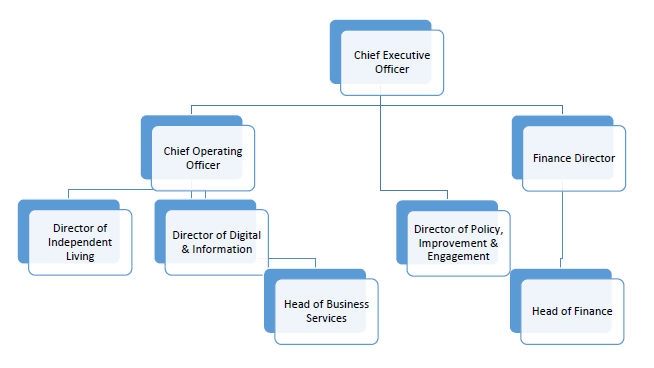
A hierarchical chart showing Chief Executive Officer at the top with Chief Operating Officer (COO), Director of Policy, Improvement and Engagement, and Finance Director coming off that box. The COO has Director of Independent Living and Director of Digital & Information coming from that box. Head of Buisness Services comes from Director of Digital & Information. The Finance Director oversees the Head of Finance.
Overall, against our three Strategic Priorities and 12 Strategic Outcomes we have achieved 10 of them to a high level, the exceptions being our objective to grow the Transition Fund numbers and our workforce objectives both of which were not met due to current spending constraints. In the Transition Fund, demand continues to be excessively high, requiring careful management to ensure we maximise the impact of our limited resource. With regard to our workforce plans we had to delay certain initiatives due to the spending controls in place.
Other than as noted above, progress remains strong and on track to complete by the end of this current strategic cycle/business plan. Performance against our key strategic objectives is set out in the Analysis section which follows on page 13.
Target Outcome: ILF Scotland enables disabled people to lead their fullest lives.
Key Performance Indicators:
Activity Update:
Status: Green
Target Outcome:
The reach and impact of ILF Scotland funding is extended to enable more disabled people to live independently.
Key Performance Indicators:
Activity Update:
Status: Red
Target Outcome:
The policy framework by which the re-opened 2015 Fund will accept new applications are determined by the process of co-production and fully tested across a wide stakeholder audience prior to being recommended to Scottish Ministers.
Key Performance Indicators:
Activity update:
Status: Green
Target Outcome:
Capacity and capability are increased across the sector for enabling better independent living outcomes.
Key Performance Indicators:
Activity Update:
Status: Green
Target Outcome:
ILF Scotland is fully prepared and able to deliver a key role in Scotland’s Social Care System.
Key Performance Indicators:
Activity Update:
Status: Amber
Target Outcome:
ILF Scotland is prepared for and able to respond and recover from a critical incident in a smooth and controlled manner with minimum disruption to its operation.
Key Performance Indicators:
Activity Update:
Status: Green
Efficiencies:
We constantly carry out improvement and efficiency work where possible and over the years this has enabled the organisation to deliver more. Over the year we have carried out improvements that have saved approximately 500 (2023-24 – 4,872) hours of staff time. This works out at less than one (2023 to 2024 - three) Full Time Equivalent (FTE) member of staff saving. This equates to an approximate overall saving of only 0.3% of our cost base (2023 to 2024 – 3%) compared to the Scottish Government target of 3%.
Our efficiencies are mainly driven by IT initiatives and this year are less than we would normally achieve due to our concentration being on re-opening our main Fund and replacing our main client database. Only small efficiency gains can be realised until our IT infrastructure has been replaced.
ILF Fund - This year we made major progress through all backlogs in the review cycle caused by the pandemic, getting back to the bi-annual timescales for Scotland and Northern Ireland whilst prioritising new applications.
ILF Fund (Re-opened) - In April 2024 we re-opened the Independent Living Fund to new applications for the first time since 2010. By the end of the financial year we had received 801 completed applications, 168 partially completed applications and 283 had gone into payment.
Over 200 engagement events have taken place across Scotland. In large geographical areas more than one event was required and some Local Authorities needed follow-up events.
We have now introduced an unpaid care component to the application process ensuring those disabled people with high levels of resident unpaid care are not disadvantaged. It is believed this is the first such element to any scheme implemented in Scotland making this highly innovative and unique. The aim over the coming year is to increase applications and those in payment to 1,400.
Transition Fund - Applications have decreased from 4,057 in 2023 to 2024 to 3,191 this year, a reduction of 21%. Linked to funding constraints, this is mainly as a consequence of the actions we undertook to manage demand in 2024 to 2025 by limiting disabled people to one application per person coupled with only limited engagement work. Indeed, we believe had we carried out engagement work, demand for the Fund could have actually been much greater.
Feedback continues to be enormously positive on the Transition Fund’s impact. Regular reviews of policy in 2025-26 are planned to manage demand within budget. For example, a proposal has just been drafted to bring in-house support to the most complex situations, which in turn creates efficiency savings which will mean that more grants can be paid out.
Externally, our profile has never been higher e.g. the National Self-Directed Support Standards we helped co-produce reference ILF repeatedly. This is significant: re-opening has cemented our place in the Scottish social care landscape and we are included and consulted on national policy and at national conferences. The operational environment remains both exciting due to re-opening but challenging for staff supporting recipients with reduced support due to funding pressures and pressures in Local Authority and Trust areas. Successful applications to the ILF Fund have already generated significant praise for the impact on people’s lives. Provider and Personal Assistant costs continue to increase significantly, which requires intervention by casework or assessor teams to assist with sustainability on a more frequent basis than the traditional ILF model of a bi-annual review. The extent of the ILF intervention will be reviewed next year as there are requests that ILF Scotland provides new support to Award Managers on an ongoing basis. Co-production will clarify what is required, affordable and sustainable.
Reporting - We published our third Equality Outcomes and Mainstreaming report and highlighted progress made against our previous report along with planned actions for the coming year. In addition, we published our second Corporate Parenting Plan, reporting on progress against the previous plan and priority actions for the coming year. We also published an update on progress to date towards achieving our Charter for Involvement Standards and worked on actions prioritised by the Advisory Groups. In year, we started developing our Customer Feedback Strategy and our Customer Service Charter.
Re-Opening Co-Production Working Group - We continued to meet with the Co-Production Working Group established to support the reopening of the ILF to new applications, working with members and our Scottish Government colleagues to further develop the policy framework for the re-opened fund based on stakeholder feedback. We implemented a revised policy to allow greater access to funding from people who receive a significant amount of unpaid care from someone who resides with them. We also began discussions on alternative access routes to the Fund including direct citizen led applications as well as looking at alternatives to a fixed financial threshold sum as part of the access principles to applying for funding.
Legislative Changes - In 2024 to 2025, we undertook work to understand and prepare for the introduction of three areas of legislative and resultant policy changes in relation to the new Protecting Vulnerable Groups scheme, the new UN Convention on the Rights of the Child requirements and the revised Employer National Insurance legislation, all of which came into force in April 2025. We prepared awareness with briefings and communications internally and externally.
Advisory Groups - We continued to meet regularly with the Scotland and Northern Ireland Advisory Groups. Members are consulted on and influence key policy, practice, and decisions as appropriate. The Minister of Mental Health, Social Care and Sport met with the Scotland Advisory Group to discuss a number of key policy areas including the planned abolition of available income charges in Scotland, originally planned for May 2026. The groups will continue to advocate for this charge to be eradicated as they believe strongly that it is a tax on being disabled.
Young Ambassadors - In tandem with the above, we continue to engage with our Young Ambassadors Group and are attempting to increase the number of members. The Transition Fund engagement activity resulted in staff attendance at 67 events with around 1,870 attendees. As a consequence of the exceptional level of demand, we have had no option other than cut back on our promotion engagements in order to help manage demand.
Overview - 2024 to 2025 has been the most demanding and testing period since ILF Scotland was created in 2015. Alongside our business as usual we are nearing completion of Phase 1 of the workforce implementation plan whilst adhering strictly to the Scottish Government emergency spending controls which have curtailed numerous strands of activity in year. Despite these restrictions, we have continued to introduce exciting, innovative support to our workforce, researching and introducing new measures that support staff through the year. As we move to Phase 2 of our Workforce Implementation Plan we expect to see further staff growth during 2025 to 2026.
We consider ourselves to be an open and supportive employer which is welcomed and acknowledged across our workforce. We held one full staff development day and regular online All Staff Meetings during 2024 to 2025 which help embed our culture and to re-connect with colleagues as we continue to grow. Our staff health and wellbeing programme remains front and centre of decision making and we will continue to offer a varied and changing programme including our regular ‘mental health & resilience refreshers’.
We successfully implemented our 35 hour week at the beginning of the reporting period and this has supported the overall wellbeing of colleagues in our busiest year, whilst having no detrimental impact on delivery. Hybrid principles have now been in place for three years and they continue to offer our staff choice and control with ongoing consideration to the business needs of the organisation. Lastly, we are extremely proud to have again been awarded Best Small Employer at the Best Practice Awards and a Top 10 Employer in the annual Working Families event in September 2024.
Organisational Demography – At the end of the year our staff employed was 79 plus 6 non-executive Directors: 80%:20% female: male, with 30.5% of staff self-identified as disabled or having underlying health conditions, 2.53% ethnic minorities and 1.26% LGBT.
Employment status – Our accessible suite of whole-life friendly policies have been key to supporting our colleagues offering vital guidance and signposting as appropriate. During 2024 to 2025 we have closely monitored feedback and listened to colleagues using our Staff Survey, TRICKLE, and meeting feedback and where appropriate offering positive change. All ILF Scotland staff have employed status (with two fixed term colleagues); both full time and part time with many different flexible working patterns to suit individual and organisational need. This model has offered stability and continuity for both the organisation and individuals during the last year as we continued to grow. During 2024 to 2025 all staff have worked flexibly, and we will continue to ensure staff can have a work/family-friendly/ life balance which suits their individual circumstances offering choice and control. We are committed to good employee relations and ILF Scotland Human Resources policies have been regularly reviewed and developed from best practice to ensure full compliance with employment and equalities legislation.
Mentoring – For the second year we committed to the ambition to ensure that every young person, regardless of background, gains access to opportunities to enable them to fulfil their potential and achieve upward mobility. We partnered with the social mobility programme Career Ready Scotland during 2024-25 to provide real-world work experience and mentoring to five young people from our local community schools. In addition to providing new networking opportunities and career advancement pathways, the internship equips the young person with essential soft skills such as communication, teamwork and problem solving. Thanks goes in particular to our Finance Manager in being the driving force in this excellent initiative.
Records Management - Overall this has been a good year and the efficiencies of using a new file plan are being seen by everyone. We have now entered into a new phase of maturity in this area with annual and regular data protection and information governance self-assessment activities being undertaken by each team via their own Information Management Support Officer and the results feed into the Information Governance Officer for review and capture for organisational learning.
Digital and System Developments - Much has been achieved in the last year under challenging circumstances and in the context of the newly re-opened Fund. The first phase of the client data base replacement was substantially completed. A full business case was submitted to Scottish Government to run two development teams during 2025 to ensure a full system replacement by February 2026 and this was approved.
Risk and Resilience - Over the year we have onboarded our new Risk and Resilience Management Tool and as we approached the year end, all current risks on the risk register had been reviewed, rationalised and uploaded into the new system ready for first use. During the year, the Resilience Hub has met to discuss ways of embedding resilience across the organisation and we are now poised to introduce resilience self-assessment tools and a competency framework for resilience. Our resilience exercise programme continues and the foundations have been laid to work up to a full scale disaster simulation early in the new financial year.
Cyber Security – The year has been busy with a concurrent upgrade to our main applications portal to meet security requirements and development of a new front end system. We have elected for a further level of security for the new technology by adopting a tool which will act as an independent security monitoring and observation centre for us in addition to the inbuilt security of our new front end system. Training and awareness around cyber and data security remain high and this is reflected in the low number of data and cyber incidents we have had over the year. Of note, we have adopted a report fast, no blame, approach to incident reporting and we believe this has paid off as culturally people feel safe to report what could potentially be a disciplinary matter. The new risk in this area comes from sophisticated and targeted attacks generated using Artificial Intelligence. We have retained our Cyber Essentials status and are audited against the National Cyber Security Centre 10 Steps model and assess our current status as robust but not complacent.
The company procurement policy ensures fair competition and value for money, with specific arrangements to encourage tenders from employers of disabled people in procurement exercises.
ILF Scotland is committed to prompt payment of bills for goods and services received. Payments are normally made within the period specified in the contract. Where there is no contractual or other understanding, we endeavour to pay within 10 days of the receipt of the goods or services, or the presentation of a valid invoice or similar demand, whichever is later.
In 2024 to 2025 ILF Scotland paid 95% of invoices (by volume) within 10 calendar days of receipt (2023 to 2024 99%). The number of creditor days outstanding at the end of 2024 to 2025 was 17 days (2023 to 2024 23 days).
Our Grant in Aid funding allocation and actual expenditure is set out below:
2024 to 2025
| Initial Grant in Aid Allocation | Funding not drawn down in year | Final Grant in Aid Allocation | Actual Expenditure | Net Underspend | |
| £m | £m | £m | £m | £m | |
| Resource Expenditure | 69.5 | (5.5) | 64.0 | 61.8 | 2.2 |
| Capital Expenditure | - | - | - | 0.7 | (0.7) |
| Non-cash | 0.1 | - | 0.1 | 0.1 | - |
| Total Fiscal Resource | 69.6 | (5.5) | 64.1 | 62.6 | 1.5 |
Resource expenditure
Initial Grant in Aid Allocation £m: 69.5
Funding not drawn down in year £m: (5.5)
Final Grant in Aid Allocation £m: 64.0
Actual Expenditure £m: 61.8
Net Underspend £m: 2.2
Capital expenditure
Initial Grant in Aid Allocation £m: -
Funding not drawn down in year £m: -
Final Grant in Aid Allocation £m: -
Actual Expenditure £m: 0.7
Net Underspend £m: (0.7)
Non-cash
Initial Grant in Aid Allocation £m: 0.1
Funding not drawn down in year £m: -
Final Grant in Aid Allocation £m: 0.1
Actual Expenditure £m: 0.1
Net Underspend £m: -
Total Fiscal Resource
Initial Grant in Aid Allocation £m: 69.6
Funding not drawn down in year £m: (5.5)
Final Grant in Aid Allocation £m: 64.1
Actual Expenditure £m: 62.6
Net Underspend £m: 1.5
Following on from discussions with our sponsor team at Scottish Government during the year, we drew down £6.8m less funding than originally allocated in order to balance our forecast funding requirements due in the main to slower than anticipated uptake of our re-opened Fund.
Our net resource underspend has resulted in a surplus for the year amounting to £920k which has been transferred to general reserve as set out on page 70 and the detail of which is set out on page 66.
Procurement policies are designed to secure goods and services for immediate consumption during the year with best value for money at current cost, and without setting up complex financial instruments. Company exposure to financial instrument risk is therefore low compared with non-public sector organisations. The policies on financial instruments are provided in the Notes to the financial statements, and appropriate disclosures are included.
Company law requires the Directors to prepare financial statements for each financial year. The financial statements comply with the Companies Act 2006 and the Directors have adopted to prepare them in accordance with International Financial Reporting Standards (IFRSs) and applicable law and to provide additional disclosures required by the Government Financial Reporting Manual 2024-25 where these go beyond the requirements of the Companies Act 2006.
There were no events after the end of the financial year that have any material effect on these Reports and Financial Statements.
Purpose
This ILF Scotland Climate Change and Sustainability Strategy outlines our commitment to tackle climate change and approach to achieving Net Zero Emissions by 2040.
Action on climate change is critical and this strategy aims to integrate the following activities in a proactive manner to achieve enduring change:
As our strategy evolves and our relationship with those who use our services develops, we will build capacity and awareness around climate action. We will act based on feedback from the people we support.
Outcomes of Stakeholder feedback will be clear and will lead to data informed business decisions and improvements. This is with the background of how Scotland as a nation addresses inequalities and digital disadvantages witnessed during the pandemic.
Vision
That ILF Scotland will achieve Net Zero in relevant areas by 2040 and work in partnership with the Scottish Government on areas outwith our control. We will have an educated workforce who will make an individual commitment to reducing their carbon footprint in the workplace and aspirationally into their personal lives as well.
Mission
To take a proactive approach to reducing our carbon footprint and maintain our quality-of-service delivery. This will help us to operate more efficiently, including:
Strategic Priorities
We have four strategic priorities in line with the Sustainable Scotland Network and the Climate Change Act 2009 (The Climate Change (Duties of Public Bodies: Reporting Requirements (Scotland) Amendment Order 2020)):
Boundary of carbon footprint
Establishing ILF Scotland’s baseline carbon footprint involves identifying areas where the organisation can control the reduction or prevention of carbon emissions. We do not own assets (buildings or fleet) that fall within Scope 1. Our carbon footprint does include Scope 2 (grid generated electricity) and Scope 3 (waste and business travel).
Scope of emissions
Out of scope
There are emissions sources that are not included in the baseline carbon footprint because ILF Scotland operates from a shared office space and procures services in line with our agreement with the Scottish Government.
As we do not own buildings or vehicles, Scope 1 emissions are reported by the property landlord and do not apply to us.
Relationships and the National Performance Framework
The Paris Agreement (12/12/2015) requires that all nations undertake ambitious efforts to combat climate change and to adapt to its effects. As a public body, we must increase our ability to accelerate change. This will require relationship development with Scottish Government, policy leads on national targets, subject matter experts on carbon reduction and colleagues in health and social care to develop new working practices, minimising carbon emissions.
These key relationships will help ILF Scotland to increase knowledge and also to work collaboratively to improve how social care services are delivered across Scotland and Northern Ireland.
This will address some of the inequalities and disadvantages witnessed during the pandemic and will enable ILF Scotland to learn from others (including those we support) on how best to focus service delivery and meet recipient needs. We will take on our operational activities in a sustainable manner and continue to deliver high quality public services in an environmentally friendly way. Done correctly recipients will get better services, ILF Scotland will use fewer resources to deliver those services, and by 2040 Net Zero will be achieved, protecting the planet and keeping global warming below 1.5 degrees.
Summary
The climate crisis is a reality and protecting global resources and our planet is everyone’s responsibility. By understanding our impact on carbon emissions, and what services people need from us, we can see how best to deliver those services as part of a sustainable Net Zero Action Plan. As with everything ILF Scotland does, this strategy will be based around the needs of those people we support and being our best in delivering our services to them.
ILF Scotland has been largely unaffected by Brexit. It did however affect the staffing situation for our disabled recipients. We are a Scottish Government and Northern Ireland Government funded organisation serving our recipients in Scotland and Northern Ireland. We will continue to monitor any potential impact of Brexit.
ILF Scotland is committed to equality of opportunity and has policies and procedures in place to ensure this is achieved to the best of our ability. It also fully recognises its legal responsibilities, particularly in respect of race relations, age, sex and disability discrimination and complies with all Scottish Government policies in relation to Human Rights and Equality.
ILF Scotland is subject to the Equality Act 2010 (General Duties) (Scotland) Regulations (see link below) and must also publish statements on equal pay and information about Board members.
Equality Act 2010: guidance - GOV.UK (www.gov.uk)
ILF Scotland is committed to the highest standards of ethical conduct and integrity and is committed to the prevention of bribery and corruption as we recognise the importance of maintaining our reputation and the confidence of our stakeholders.
We can report that no instances of corruption or bribery were recorded in 2024 to 2025 (2023 to 2024 nil).
Summary – This has been another strong year, delivering even further progress against our strategic plan.
Authorised for issue by the Board of Directors.
Signed by the Chair of the Board on behalf of the directors and also signed by the Accountable Officer.

Anne-Marie Monaghan, Chair of the Board
15 September 2025
Peter Scott OBE, Accountable Officer
15 September 2025
Consisting of: Corporate Governance Report; Remuneration and Staff Report; and Parliamentary Accountability Report
The Corporate Governance Report consists of three sections:
The Directors and the Accountable Officer are responsible for preparing the Annual Report and Financial Statements of the company in accordance with applicable law and regulations. Company law requires the Directors to prepare financial statements for each financial year. The financial statements comply with the Companies Act 2006 and the Directors have adopted to prepare them in accordance with IFRSs and applicable law and to provide additional disclosures required by the Government Financial Reporting Manual 2024-25 where these go beyond the requirements of the Companies Act 2006. Under company law Directors must not approve the financial statements until they are satisfied that they give a true and fair view of the state of affairs of the company and of the profit or loss of the company for that period. In preparing these financial statements the Directors are required to:
The Directors are responsible for keeping adequate accounting records that are sufficient to show and explain the company’s transactions and disclose with reasonable accuracy at any time the financial position of the company and enable them to ensure that the financial statements comply with the Companies Act 2006 and the Accounts Direction applicable to the year issued by the Scottish Ministers. They have general responsibility for taking such steps as are reasonably open to them to safeguard the assets of the company and detect fraud and other irregularities.
The Directors have prepared a Directors’ Remuneration Report in order to comply with the requirements of the Government Financial Reporting Manual 2024 to 2025 in accordance with Schedule 8 to the Large and Medium-sized Companies and Groups (Accounts and Reports) Regulations 2008 made under the Companies Act 2006, to the extent that they are relevant.
The Directors are responsible for the maintenance and integrity of the corporate and financial information included on the company’s website. Legislation in the UK governing the preparation and dissemination of financial statements may differ from legislation in other jurisdictions.
As Accountable Officer, as far as I am aware, there is no relevant audit information of which ILF Scotland’s auditor is unaware. I have taken all reasonable steps to make myself aware of any relevant audit information and to establish that ILF Scotland’s auditor is aware of the information.
As set out in the "Memorandum to Accountable Officers for Other Public Bodies", the accountable officer is personally responsible for the propriety and regularity of the body’s public finances and ensuring that its resources are used economically, efficiently and effectively. This includes compliance with relevant guidance issued by Scottish Ministers, in particular the Scottish Public Finance Manual, and the Framework Document defining the key roles and responsibilities which underpin the relationship between the body and the Scottish Government.
Accountable Officer Confirmation on the Annual Report and Financial Statements
As Accountable Officer I confirm that the annual report and financial statements as a whole are fair, balanced and understandable and I take personal responsibility for the annual report and financial statements and the judgements required for determining that it is fair, balanced and understandable.
Authorised for issue by the Board of Directors.
Anne-Marie Monaghan, Chair of the Board
15 September 2025
Peter Scott OBE, Accountable Officer
15 September 2025
Scope of responsibility
The Board of Directors have responsibility for maintaining sound corporate governance systems that support the achievement of our policies, aims and objectives and safeguard the public funds and assets for which we are personally responsible. Our responsibilities for managing public money and the duties assigned to us have been exercised with due diligence and the appropriate professional care.
The role of ILF Scotland is to deliver discretionary cash payments directly to disabled people, allowing them the choice and control to purchase personal support and live independent lives in their communities.
Director Attendance
Figures in brackets show attendance for 2023 to 2024 period.
| Name | Board Meetings | Audit and Risk Committee | Remuneration Committee |
|---|---|---|---|
| Anne-Marie Monaghan | 4/4 (3/4) | N/A (N/A) | 2/2 (1/1) |
| Elizabeth Humphreys | 2/2 (4/4) | 2/2 (4/4) | N/A (N/A) |
| Elizabeth McAtear | 2/2 (3/4) | N/A (N/A) | 1/1 (1/1) |
| Mark Adderley | 2/4 (4/4) | N/A (N/A) | 2/2 (1/1) |
| Etienne d'Aboville | 3/3 (4/4) | 3/3 (3/4) | N/A (N/A) |
| Alison Nicholson | 4/4 (1/1) | 4/4 (1/1) | N/A (N/A) |
| Stephanie Hayle | 3/4 (1/1) | N/A (N/A) | N/A (N/A) |
| Kirsty Aird | 4/4 (0/1) | 3/4 (0/1) | N/A (N/A) |
| Marion MacDonald | 1/1 (N/A) | N/A (N/A) | N/A (N/A) |
Sound Corporate Governance
Our corporate governance systems continue to be drawn up from best practice recommendations and are being strengthened through internal scrutiny, legislative and process compliance and through collaborative working with both internal and external auditors and with Scottish Government.
These systems address individual and corporate accountabilities, the roles and effectiveness of our boards and our capacity to identify and effectively manage and report risk.
The company strategic aims and objectives have been developed by the Directors along with our sponsor team at Scottish Government. Our Chief Executive meets with Scottish Government officials to discuss significant business and programme risks and review ongoing progress against plan.
The programme meetings with Scottish Government officials are supported by regular operational meetings with the sponsor team, members of specialist teams and other Scottish Government colleagues to ensure clarity of purpose, sound communication and effective reporting.
As set out in the "Memorandum to Accountable Officers for Other Public Bodies", our Chief Executive as Accountable Officer is personally responsible for the propriety and regularity of the body’s public finances and ensuring that its resources are used economically, efficiently and effectively. This includes compliance with relevant guidance issued by Scottish Ministers, in particular the Scottish Public Finance Manual and the Framework Document defining the key roles and responsibilities which underpin the relationship between the body and the Scottish Government. In line with Scottish Government guidance, ILF Scotland’s Framework Document was reviewed and updated this year.
The Board met four times in formal session this period. There were also various ad hoc meetings, board development days and committee meetings. All meetings have a pre-agreed agenda, are minuted and produced clear actions and matters arising. Meetings are attended by Directors and appropriate members of the SMT.
The Directors have a responsibility for maintaining sound systems of control to address key financial and other risks, ensuring that the requirements of the ILF Scotland founding documents are met, that high standards of corporate governance are demonstrated, and for reviewing the effectiveness of the systems of internal control.
Capacity to handle risk
The Chief Executive acts as the Risk Champion for the company, whilst lead responsibility for ensuring that appropriate mechanisms are in place for identifying, monitoring and controlling risk, and advising SMT on the actions needed in order to comply with our corporate governance requirements rests with the Chief Operating Officer, who is supported by the Director of Digital and Information in the capacity of the ILF Scotland Senior Information Risk Officer (SIRO).
Our systems and processes are designed to manage risk to a reasonable and appropriate level rather than to eliminate all risk; therefore, it can only provide reasonable and not absolute assurance of effectiveness.
Whilst every member of staff has a responsibility to ensure that exposure to risk is minimised, overall leadership of the risk management processes rests with members of the SMT. The SMT meets fortnightly.
Reviewing our strategic risks is a standing item at Board meetings, supported by the work of the Audit & Risk Committee, which provides a high-level resource to test the adequacy of assurance on our risk management framework and internal control environment. The Audit & Risk Committee is attended by representatives of internal audit and, when appropriate, external audit.
Managing risks
The Risk Management Framework sets out the organisation’s attitude to risk and provides a consistent basis to capture, monitor and report risks and to progress strategies to mitigate these. In assigning lead risk owners at SMT level and in the management control processes, we identify clear lines of responsibility throughout the organisation.
Our overall risk appetite is risk averse. This does not mean that we avoid opportunities to improve. However, it does mean that we are rightly cautious when challenges may hinder or put at risk our core business and service provision to our users. Our risk management processes enable us to identify operational, business and financial risks, customer focus and delivery risks as well as identifying and assessing potential reputational risks and other contingent issues.
Principal risks
All bodies subject to the requirements of the Scottish Public Finance Manual (SPFM) must operate a risk management strategy in accordance with relevant guidance issued by the Scottish Ministers.
ILF Scotland maintains a strategic and operational risk register which records internal and external risks and identify the mitigating actions required to reduce the threat of these risks occurring and their impact. The Risk Management Strategy and Operational Risk Register are regularly updated and reviewed as a standing item by senior staff and the Audit and Risk Committee. Each individual risk is allocated an owner who ensures that mitigating action is carried out.
This year our principal risks and uncertainties were mainly in connection with managing the project to re-open our main Fund to new applications; the continued growth in demand for the Transition Fund; the management of resources; the movement of personal and sensitive information; managing the project to replace our main client database as part of our Information Technology (IT) infrastructure; IT security; dealing with the current social care crisis and our core long standing risks in relation to funding and policy changes. The risk and control processes applied within ILF Scotland accord with guidance given in the SPFM and have been in place for the year ended 31 March 2025 and up to the date of the approval of the annual report and financial statements.
A key part of our risk management process is the involvement of all staff in the discussion and identification of risks and their management. Together, we develop mitigating action, supported by management information and identify a specific manager to oversee progress.
The managers’ role is to monitor, report on and manage these issues and risks.
Information Assurance
Within our programme we have a significant challenge and risk involved in transferring sensitive user and confidential corporate data to our partners and client departments. This has required close liaison with relevant partners to ensure that we meet our legal responsibilities under the Data Protection Act. Data and information security has been managed as a high priority item.
In terms of data and information security breaches there have been no reportable incidents.
Review of effectiveness
The Directors have responsibility for reviewing the effectiveness of the system of corporate governance, including systems of internal control which have been in place for the year under review and up to the date of approval of this Annual Report and Financial Statements. The Accountable Officer seeks written assurances from SMT in relation to their responsibilities for reviewing the effectiveness of the systems of risk management and internal control.
We also have in place independent internal auditors and they have provided their opinion that ILF Scotland has adequate and effective arrangements for risk management, control and governance. They also report that proper arrangements are in place to promote and secure Value for Money. They did not identify any downward trends in relation to risk management, control or governance however they did highlight a number of risks that are above risk tolerance levels.
Directors take assurance from these sources that effective systems of corporate governance are in place throughout the organisation. The internal control systems SMT have put in place include:
Board effectiveness and structures that support decisions
The Board has set up its governance arrangements to ensure compliance with best practice and relevant legislation.
The Board has developed terms of reference for all boards and committees, including their purpose, membership, and the election of the lead Director as well as defining the management and reporting requirements for each internal function.
Our governance processes and mechanisms to manage our boards are consistently applied to capture discussions, actions, risks and progress. These provide a basis for consistent reporting and ease of read-across to inform recommendations, actions and outcomes, our boards include the SMT, the Audit & Risk Committee and the Remuneration Committee.
The SMT meets regularly and is responsible for ensuring that corporate risks are identified as early as possible, are properly managed, that cross-functional issues are considered, and that risk management receives a high profile in planning and delivery of our plans. The SMT along with some of our senior managers meets fortnightly to ensure that all attendees understand both the priorities of the week and any emerging issues.
Senior Committees
The Audit & Risk Committee met four times during the period and is responsible for ensuring, as far as possible, that appropriate systems are in place within the company for the assessment and management of risk and advising the Board on the effectiveness of the systems of governance and control, leading to signing off the Annual Governance Statement. The Audit & Risk Committee reviews Strategic Risks as a standing item, it routinely considers the effectiveness of payment security, fraud management and recovered and unspent monies, it reviews the internal audit plans to ensure sufficient rigor and detail and undertakes to provide a questioning and challenging role to obtain assurance.
The Remuneration Committee met twice during the year. It oversees and reports to the Directors on the salaries, rewards and conditions of service in place at the company. It also makes sure that ILF Scotland conducts its employee relations fairly, efficiently and effectively.
Significant internal control issues
Internal controls and procedures are strengthened with a formal partnership with NHS Counter Fraud Services and we run a continuous improvement plan.
During the course of the year we have become aware of and have investigated twelve (2023 to 2024 eleven) instances of alleged misuse of funds in relation to Fund recipients. Total funds involved are estimated to be around £92,000 (2023 to 2024 £71,000). At 31 March 2025 seven of these cases had been closed as either no case to answer or repayment plans have been put in place. As these payments were recorded as costs when originally advanced they do not represent a further cost if deemed to be irrecoverable.
All cases have been reported to NHS Counter Fraud Services.
Over the course of the year there have been no significant control weaknesses reported, nor has any report been made externally, independently nor via the company Whistle-blower policy. This policy encourages staff to report suspected wrongdoing as soon as possible, in the knowledge that their concerns will be taken seriously and investigated as appropriate, and that their confidentiality will be respected.
Our audit and internal management reporting remains vigilant to ensure early identification of issues within normal day-to-day business and no significant issues have emerged. We have managed our risks and highlighted issues with foresight and taken decisions as required; we have forecast and reported our financial position in a timely accurate manner and maintained our budget within expected parameters.
We continue to develop and improve our internal control and governance systems and in conclusion we believe that they were fit for purpose during the reporting period.
Information and Data Security
ILF Scotland has in place a range of systems and measures which ensure that information held by the organisation, and held by third parties on behalf of the organisation, is secure. ILF Scotland monitors compliance concerning the release of data from the organisation. In addition, ILF Scotland has implemented Scottish Government guidance on data security and information risk through the creation of an information asset register, which includes assessment of risk and awareness training for staff.
During 2024 to 2025, we have been closely monitoring the requirements of the General Data Protection Regulations (GDPR) and engaged with all staff regularly. Direct GDPR training has been rolled out to all staff, this is mandatory training and an annual refresher is provided with data protection updates. Physical data security is monitored by office checks, on a quarterly basis.
ILF Scotland continues to focus upon Cyber Security and Resilience and we have Cyber Essentials PLUS accreditation.
There are no significant lapses in data security to report in 2024 to 2025 (2023 to 2024: none).
Authorised for issue by the Board of Directors.
Signed by the Chair of the Board on behalf of the Directors and also signed by the Accountable Officer.
Anne-Marie Monaghan, Chair of the Board
15 September 2025
Peter Scott OBE, Accountable Officer
15 September 2025
Company Number SC500075
The Directors submit their annual report for the year ended 31 March 2025.
The financial statements comply with the Companies Act 2006 and the Directors have adopted to prepare them in accordance with IFRSs and applicable law and to provide additional disclosures required by the Government Financial Reporting Manual 2024 to 2025 where these go beyond the requirements of the Companies Act 2006.
Principal activities
The principal activities are described on page 5. The organisation became an NDPB in June 2018, having previously been an Other Significant Public Body.
Directors
All Directors are non-executive. For further information, please see the Annual Governance Statement on pages 33 to 40. All non-executive Directors are considered to be independent.
Beneficial Interests
None of the directors had any beneficial interest in the ownership of the company throughout the period. The company is guaranteed by the Scottish Ministers.
Non-current assets
The company is now accounting for right-of-use assets in accordance with IFRS 16 and these were re-assessed during the year. The only other movement during the year was an addition to IT intangible assets in the course of construction.
Employees
It is ILF Scotland’s aim to keep employees informed about its affairs and in particular those matters that affect them directly. The company regularly issues all-staff emails and together with a monthly newsletter.
ILF Scotland is an Equal Opportunities Employer and actively encourages applications from disabled people.
Pension Scheme
Most of our staff are members of the Civil Service Pension defined benefit scheme known as alpha.
Corporate governance
The Board is charged with maintaining a sound system of internal control that supports the achievement of the ILF Scotland policies, aims and objectives and regularly reviewing the effectiveness of that system. The Board is also responsible for the Annual Governance Statement.
The Board’s Annual Governance Statement is provided on pages 33 to 40.
The Board & SMT
The Board is responsible for ensuring that effective corporate governance arrangements are in place that set out how ILF Scotland is directed and controlled and how the assurance on risk management and internal control is provided.
The Board is required to demonstrate high standards of corporate governance at all times and to ensure that best practice is followed consistent with the UK Corporate Governance Code and appropriate adaptations of Corporate Governance in the Central Government Departments Code of Good Practice. The responsibilities of the Board are set out in the Governance Statement.
A link to the company website giving more details about the Board of Directors and the SMT can be found on page 5. The Board of Directors is also listed on page 41.
Non-Executive Directors
The non-executive directors are appointed by The Scottish Ministers for a fixed term appointment of four years which can be extended at the discretion of The Scottish Ministers.
Register Of Interests
Full details of ILF Scotland’s Register of Interests can be found on our website at:
Board Register of Declared Interests - 2025 | ILF Scotland
Remuneration Committee
Members of the committee are appointed by the Board. The Board determines the membership and terms of reference. The Chair of the committee will report back to the Board after each meeting as required and the minutes of Committee meetings will be provided to Directors for information. Remuneration Committee meetings will normally be attended by the Chief Executive and the Chief Operating Officer.
For further information, please see the Annual Governance Statement on pages 33 to 40 and the Remuneration and Staff Report on pages 45 to 57.
Audit & Risk Committee
Members of the committee are appointed by the Board. The Board determines the membership and terms of reference. The Chair of the committee will report back to the Board after each meeting as required and the minutes of committee meetings will be provided to Directors for information. Audit Committee meetings will normally be attended by the Chief Executive, the Finance Director and the Chief Operating Officer.
Both external and internal audit have the right to independent access to the Chair and members of the committee.
Further details regarding the Audit & Risk Committee can be found in the Annual Governance Statement on pages 33 to 40.
Statement of disclosure of information to external auditor
The Directors who held office at the date of approval of the Directors’ Report confirm that, so far as they are each aware, there is no relevant audit information of which the external auditor is unaware; and each director has taken all steps that they ought to have taken as a director to make themselves aware of any relevant audit information and to establish that the external auditor is aware of that information.
External Auditor
Details of all fees earned by the external auditor are provided in note 5 of the annual financial statements.
Under the Companies Act 2006 (Scottish public sector companies to be audited by the Auditor General for Scotland) Order 2008, Audit Scotland was appointed as the auditor of the company by the Auditor General for Scotland for financial years 2022 to 2023 to 2026 to 2027.
Authorised for issue by the Board of Directors.
Signed: James A Maguire
Company Secretary
15 September 2025
Directors and SMT
Directors are appointed by Scottish Ministers for a period of four years which can be extended to a maximum of eight years at the discretion of Scottish Ministers.
The Directors are appointed from a variety of backgrounds on the basis of relevant experience gained and skills required.
The Chief Executive together with the SMT are responsible for day-to-day operations and activities.
The Remuneration Policy
This report for the year ended 31 March 2025 deals with the remuneration of the Chief Executive, SMT and Directors of ILF Scotland.
ILF Scotland is managed by a Board of Directors appointed by Scottish Ministers. The Directors receive remuneration as post-holders and are reimbursed for incidental expenses in line with the company travel and subsistence policy. There are no unpaid persons or volunteers upon whose services the company is dependent.
The Remuneration Committee
The Remuneration Committee is appointed by the Board of Directors and is established to independently review the salary of the Chief Executive. The Chief Executive informs the committee of any annual pay discussions to agree the salary levels for employees and SMT, in accordance with Scottish Government pay remit guidelines.
Members of the committee for the period of this report were:
The terms of reference of the Remuneration Committee in relation to salary, rewards and conditions of service are:
Remuneration (including salary) and pension entitlements
The figures below form part of the Remuneration Report to be audited as referred to in the Auditor’s Report.
Directors
For the year ended 31 March 2025 the total remuneration paid to Directors was:
2024 to 2025 in £'000
2023 to 2024 in £'000
Directors’ salary is non-pensionable. All FTE remuneration above sits in the same bandings noted above.
The Chief Executive and SMT
The Chief Executive and the SMT are employed on ILF Scotland terms and conditions.
The directors apply the policy regarding senior management remuneration as follows:
The Chief Executive’s and SMT performance will be reviewed annually with the overall assessment informed by quarterly one-to-one meetings.
In the event of early severance, compensation would be payable in accordance with company terms and conditions.
This table represents the part of the Remuneration Report to be audited as referred to in the Auditor’s Report.
Salaries include gross salary, overtime and any other allowance to the extent that it is subject to UK taxation. This report is based on payments made within the year by ILF Scotland. There were no bonus payments or benefits in kind.
Figures for 2024 to 2025. (Figures for previous year, 2023 to 2024, in brackets).
Peter Scott, Chief Executive Officer
Harvey Tilley, Chief Operating Officer
James Maguire, Director of Finance
Linda Scott, Director of Policy, Improvement & Engagement
Paul Hayllor, Director of Digital & Information Services
Robert White, Director of Self-Directed Support
The company is part of the Civil Service Pension Scheme and most of our staff are members of the defined benefit offering (alpha). All of the ELT noted below are in alpha.
Peter Scott, Chief Executive Officer
Harvey Tilley, Chief Operating, Officer
James Maguire, Finance Director
Linda Scott, Director of Policy, Improvement & Engagement
Paul Hayllor, Director of Digital & Information Services
Robert White, Director of Self-Directed Support
Cash Equivalent Transfer Value (CETV) is fully explained on page 52.
Prior year figures for the ELT were as follows:
Peter Scott, Chief Executive Officer
Harvey Tilley, Chief Operating, Officer
James Maguire, Finance Director
Linda Scott, Director of Policy, Improvement & Engagement
Paul Hayllor, Director of Digital & Information Services
Robert White, Director of Self-Directed Support
Accrued pension benefits included in this table for any individual affected by the Public Service Pensions Remedy have been calculated based on their inclusion in the legacy scheme for the period between 1 April 2015 and 31 March 2022, following the McCloud judgement. The Public Service Pensions Remedy applies to individuals that were members, or eligible to be members, of a public service pension scheme on 31 March 2012 and were members of a public service pension scheme between 1 April 2015 and 31 March 2022.
The basis for the calculation reflects the legal position that impacted members have been rolled back into the relevant legacy scheme for the remedy period and that this will apply unless the member actively exercises their entitlement on retirement to decide instead to receive benefits calculated under the terms of the alpha scheme for the period from 1 April 2015 to 31 March 2022.
Pension Schemes
The company joined the Civil Service Pension Scheme on 1 September 2019. Most staff members chose to join the scheme known as alpha which provides benefits on a career average basis with a normal pension age equal to the member’s State Pension Age. This statutory pension arrangement is unfunded with the cost of benefits met by monies voted by Parliament each year.
Employee contributions are salary related and range between 4.60% and 7.35% of pensionable earnings. At the end of the scheme year the member’s earned pension account is credited with 2.32% of their pensionable earnings in that scheme year. Employer contributions are salary-related and can be up to 30.30% of pensionable earnings.
The accrued pension quoted is the pension the member is entitled to receive when they reach pension age, or immediately on ceasing to be an active member of the scheme if they are already at or over pension age. Pension age is the higher of 65 or State Pension Age for members of alpha.
A few staff members have chosen to participate in the partnership pensions account which is a stakeholder pension arrangement. The employer makes a basic contribution of between 8% and 14.75% (depending on the age of the member) into a stakeholder pension product chosen by the employee from a panel of providers. The employee does not have to contribute, but where they do make contributions, the employer will match these up to a limit of 3% of pensionable salary (in addition to the employer basic contribution).
Employers also contribute a further 0.50% of pensionable salary in both schemes above to cover the cost of centrally-provided risk benefit cover (death in service and ill health retirement).
Further details about the Civil Service pension arrangements can be found at the website http://www.civilservicepensionscheme.org.uk
Cash Equivalent Transfer Values (CETV)
A CETV is the actuarially assessed capitalised value of the pension scheme benefits accrued by a member at a particular point in time. The benefits valued are the member’s accrued benefits and any contingent partner’s benefits payable from the scheme. A CETV is a payment made by a pension scheme or arrangement to secure pension benefits in another pension scheme or arrangement when the member leaves the scheme and chooses to transfer the benefits accrued in their former scheme. The pension figures shown relate to the benefits that the individual has accrued as a consequence of their total membership of the scheme, not just as their service in a senior capacity to which the disclosure applies.
The figures include the value of any pension benefit in another scheme or arrangement which the member has transferred to the civil service pension arrangements. They also include any additional pension benefit accrued to the member as a result of their buying additional pension benefits at their own cost.
CETVs are worked out in accordance with The Occupational Pension Schemes (Transfer Values) (Amendment) Regulations 2008 and do not take account of any actual or potential reduction to benefits resulting from Lifetime Allowance Tax which may be due when pension benefits are taken.
Real Increase in CETV
This reflects the increase in CETV that is funded by the employer. It does not include the increase in accrued pension due to inflation, contributions paid by the employee (including the value of any benefits transferred from another pension scheme or arrangement) and uses common market valuation factors for the start and end of the period.
Compensation for loss of office - Audited
There were no ILF Scotland Directors or staff that left on Voluntary Exit, Voluntary Redundancy or Compulsory Redundancy terms.
Pay multiples – Subject to Audit
Year 2024 to 2025
Year 2023-24
The banded remuneration of the highest paid employee in the company in the financial year 2024 to 2025 was £95 to £100k (2023 to 2024 £85 to £90k). The table above sets out how the various percentiles compare against the mid-point of the band of the highest paid employee. The remuneration above reflects pay and benefits other than pension benefits. We believe that the median pay ratios set out above are consistent with the pay, reward and progression policies for our employees taken as a whole. We adhere to Scottish Government pay policy.
Movement in the ratios are reflective of the consistent application of ILF pay and reward policies in year to all staff, including the remuneration of the highest paid employee.
Total remuneration includes salary only. There were no bonus payments or benefits in kind. It does not include employer pension contributions.
The table above represents the part of the Remuneration Report to be audited as referred to in the Auditor’s Report.
In 2024 to 2025 the Chief Executive was the highest paid member of staff. In 2023 to 2024 three employees received remuneration in excess of the Chief Executive. Remuneration in the year ranged from £28,131 to £96,110 (2023 to 2024 £26,631 to £88,251).
The increase in the banded remuneration of the highest paid employee year on year was 11.4% (2023 to 2024 0%). The increase in 2024 to 2025 reflects a full review and job evaluation exercise.
Year on year annualised average staff FTE remuneration increased by 4.18% (2023 to 2024 increase of 6.79%). This increase is in line with the overall Scottish Government pay settlement implemented during the year alongside staff pay progression.
The table below shows the gender analysis of ILF employees during the year.
Directors - 2024 to 2025: One Male, Five Female
Directors - 2023 to 2024: Two Male, Six Female
Senior Management Team - 2024 to 2025: 6 Male, Two Female
Senior Management Team - 2023 to 2024: Six Male, Two Female
Staff - 2024 to 2025: 10 Male, 68 Female
Staff - 2023 to 2024: 11 Male, 61 Female
Total - 2024 to 2025: 17 Male, 68 Female
Total - 2023 to 2024: 19 Male, 69 Female
The table below shows the staff absence analysis of ILF employees for the year.
Absence rate 2024 to 2025: 4.06%
Absence rate 2023-24: 3.43%
Short term absences were 3.12% (2.71% in 2023-24). Long term absence was 0.94% (0.72% in 2023-24). We continue to offer mental health awareness, personal resilience and suicide prevention workshops to all staff on an annual basis with mental health first aiders being trained and now in post to support our workforce. Our whole-life friendly suite of policies also continues to support the workforce in a positive manner.
In addition to the costs noted in the table there was also £113,669 paid to agencies for temporary staff (2023 to 2024 £89,948).
2024 to 2025
Directly Employed: Permanent Contract: 82
Directly Employed: Fixed Term Contract: 2
Temporary Staff Contract: 0
Total: 84
2023 to 2024
Directly Employed: Permanent Contract: 80
Directly Employed: Fixed Term Contract: 0
Temporary Staff Contract: 3
Total: 83
Note that the numbers above exclude non-executive Directors. The numbers show staff employed during the year.
Consultancy Costs
Amounts paid in the year
2024 to 2025: £72,317
2023 to 2024: £34,143
Our policy framework enables the delivery of our strategy and also supports the wishes, needs and aspirations of a modern workforce which is underpinned by a strong culture of trust, dignity and respect. This has helped ILF Scotland to be a beacon of independent living and innovative thinking for disabled people and also an award-winning employer of choice. For us there is no such thing as a normal employee and the framework had to take into account values, equality, diversity, young and more mature employees, families, caring responsibilities and make-up of modern society. By doing this, we know we attract and retain the best team possible to achieve our inclusive organisational aspirations.
To support the way we aspire to work, we have co-produced with colleagues a comprehensive approach that supports our collective health and wellbeing alongside delivering our organisational strategy. This methodology is solidly based on organisational development, tailored to support the culture of inclusiveness, diversity, outcomes focus, trust, coaching and continuous improvement.
We have put in place an award-winning suite of whole-life-friendly policies, procedures, benefits and systems that can be tailored to meet individual circumstances. This includes working flexibly, compressed hours, being sympathetic to individual / family emergencies or remote working and providing the right technology to do the job.
Staff turnover was 7.5% during the year (3.4% in 2023 to 2024).The 7.5% is made up of six employees and includes one of whom was on a fixed term contract and one retiral. It also includes two special members of staff, Karen Lee Bain and Trisha Beveridge, both of whom sadly passed away during the year.
Overall, the results of the survey showed an increase in satisfaction from the previous year, with 93% sharing that they greatly valued the culture and values of the organisation and 86% highlighting they were very satisfied with life balance opportunities that working at ILF Scotland offered them. There was an increase in wellbeing initiatives being utilised with 73% of respondents sharing that these had made them feel happier, and over half making them feel physically healthier alongside 75% feeling more mentally healthier as well as a consistent number of respondents feeling more productive as well as having improved mental resilience.
We value comments calling ILF Scotland caring, professional, values based, hardworking, high achieving and an absolute pleasure to work for as well as not knowing of any other organisation that lives to its core values the way we do.
We, as an organisation, are happy to recognise trade unions and we make a point of engaging trade unions on important matters affecting staff. An example of this was when we changed the pension scheme offering to staff. Relevant trade unions were actively consulted and involved.
The Trade Union (Facility Time Publication Requirements) Regulations 2017 require public sector employers to publish information relating to facility time. At year end 31 March 2025, ILF Scotland did not have any trade union facility time (2023 to 2024 nil).
What was the total number of your employees who were relevant union officials during the relevant period?
How many of your employees who were relevant union officials employed during the relevant period spent a) 0%, b) 1%-50%, c) 51%-99% or d) 100% of their working hours on facility time?
Percentage of time / Number of Employees:
Provide the figures requested in the first column of the table below to determine the percentage of your total pay bill spent on paying employees who were relevant union officials for facility time during the relevant period.
As a percentage of total paid facility time hours, how many hours were spent by employees who were relevant union officials during the relevant period on paid trade union activities?
Signed: Mark Adderley, Remuneration Committee Chair, 15 September 2025
Signed: Peter Scott OBE, Accountable Officer, 15 September 2025
Losses and special payments
In accordance with the SPFM, we are required to disclose losses and special payments above £300,000. During 2024 to 2025 there were no losses or special payments within this criteria (2023 to 2024: £nil).
Gifts and Charitable Donations
There were gifts made during the year amounting to £652 (2023 to 2024: £921). There were no charitable donations made during the year (2023 to 2024: nil).
Remote Contingent Liabilities
ILF Scotland are required to report any liabilities for which the likelihood of a transfer of economic benefit in settlement is too remote to meet the definition of contingent liability under IAS37. There are currently no remote contingent liabilities.
Anne-Marie Monaghan, Chair of the Board
15 September 2025
Peter Scott OBE, Accountable Officer
15 September 2025
I have audited the financial statements in the annual report and financial statements of Independent Living Fund Scotland for the year ended 31 March 2025 under The Companies Act 2006 (Scottish public sector companies to be audited by the Auditor General for Scotland) Order 2008. The financial statements comprise the Statement of Comprehensive Net Income and Expenditure, the Statement of Financial Position, the Statement of Cash Flows, the Statement of Changes in Taxpayers’ Equity and notes to the financial statements, including material accounting policy information. The financial reporting framework that has been applied in their preparation is applicable law and UK adopted international accounting standards, as interpreted and adapted by the 2024/25 Government Financial Reporting Manual (the 2024/25 FReM).
In my opinion the accompanying financial statements:
I conducted my audit in accordance with applicable law and International Standards on Auditing (UK) (ISAs (UK)), as required by the Code of Audit Practice approved by the Auditor General for Scotland. My responsibilities under those standards are further described in the auditor’s responsibilities for the audit of the financial statements section of my report. I was appointed by the Auditor General on 2 December 2022. My period of appointment is five years, covering 2022/23 to 2026/27.
I am independent of the company in accordance with the ethical requirements that are relevant to my audit of the financial statements in the UK including the Financial Reporting Council’s Ethical Standard, and I have fulfilled my other ethical responsibilities in accordance with these requirements. Non-audit services prohibited by the Ethical Standard were not provided to the company. I believe that the audit evidence I have obtained is sufficient and appropriate to provide a basis for my opinion.
I have concluded that the use of the going concern basis of accounting in the preparation of the financial statements is appropriate.
Based on the work I have performed, I have not identified any material uncertainties relating to events or conditions that, individually or collectively, may cast significant doubt on the company’s ability to continue to adopt the going concern basis of accounting for a period of at least twelve months from when the financial statements are authorised for issue.
These conclusions are not intended to, nor do they, provide assurance on the company’s current or future financial sustainability. However, I report on the company’s arrangements for financial sustainability in a separate Annual Audit Report available from the Audit Scotland website.
I report in my Annual Audit Report the most significant assessed risks of material misstatement that I identified and my judgements thereon.
As explained more fully in the Statement of the Directors' and Accountable Officer’s Responsibilities, the Accountable Officer and directors are responsible for the preparation of financial statements that give a true and fair view in accordance with the financial reporting framework, and for such internal control as the Accountable Officer and directors determine is necessary to enable the preparation of financial statements that are free from material misstatement, whether due to fraud or error.
In preparing the financial statements, the Accountable Officer and directors are responsible for assessing the company's ability to continue as a going concern, disclosing, as applicable, matters related to going concern and using the going concern basis of accounting unless there is an intention to discontinue the company’s operations.
My objectives are to obtain reasonable assurance about whether the financial statements as a whole are free from material misstatement, whether due to fraud or error, and to issue an auditor’s report that includes my opinion. Reasonable assurance is a high level of assurance, but is not a guarantee that an audit conducted in accordance with ISAs (UK) will always detect a material misstatement when it exists. Misstatements can arise from fraud or error and are considered material if, individually or in the aggregate, they could reasonably be expected to influence the decisions of users taken on the basis of these financial statements.
Irregularities, including fraud, are instances of non-compliance with laws and regulations. I design procedures in line with my responsibilities outlined above to detect material misstatements in respect of irregularities, including fraud. Procedures include:
The extent to which my procedures are capable of detecting irregularities, including fraud, is affected by the inherent difficulty in detecting irregularities, the effectiveness of the company’s controls, and the nature, timing and extent of the audit procedures performed.
Irregularities that result from fraud are inherently more difficult to detect than irregularities that result from error as fraud may involve collusion, intentional omissions, misrepresentations, or the override of internal control. The capability of the audit to detect fraud and other irregularities depends on factors such as the skilfulness of the perpetrator, the frequency and extent of manipulation, the degree of collusion involved, the relative size of individual amounts manipulated, and the seniority of those individuals involved. A further description of the auditor’s responsibilities for the audit of the financial statements is located on the Financial Reporting Council's website www.frc.org.uk/auditorsresponsibilities. This description forms part of my auditor’s report.
In my opinion in all material respects the expenditure and income in the financial statements were incurred or applied in accordance with any applicable enactments and guidance issued by the Scottish Ministers.
The Accountable Officer is responsible for ensuring the regularity of expenditure and income. In addition to my responsibilities in respect of irregularities explained in the audit of the financial statements section of my report, I am responsible for expressing an opinion on the regularity of expenditure and income in accordance with the Public Finance and Accountability (Scotland) Act 2000.
I have audited the parts of the Remuneration and Staff Report described as audited. In my opinion, the audited parts of the Remuneration and Staff Report have been properly prepared in accordance with directions made under the Public Finance and Accountability (Scotland) Act 2000 by the Scottish Ministers and the Companies Act 2006.
The Accountable Officer and directors are responsible for the other information in the annual report and financial statements. The other information comprises the Performance Report and the Accountability Report excluding the audited parts of the Remuneration and Staff Report.
My responsibility is to read all the other information and, in doing so, consider whether the other information is materially inconsistent with the financial statements or my knowledge obtained in the course of the audit or otherwise appears to be materially misstated.
If I identify such material inconsistencies or apparent material misstatements, I am required to determine whether this gives rise to a material misstatement in the financial statements themselves.
If, based on the work I have performed, I conclude that there is a material misstatement of this other information, I am required to report that fact. I have nothing to report in this regard.
My opinion on the financial statements does not cover the other information and I do not express any form of assurance conclusion thereon except on the Performance Report and Annual Governance Statement to the extent explicitly stated in the following opinions prescribed by the Auditor General for Scotland.
In my opinion, based on the work undertaken in the course of the audit:
I am required by the Auditor General for Scotland to report to you if, in my opinion:
I have nothing to report in respect of these matters.
Conclusions on wider scope responsibilities
In addition to my responsibilities for the annual report and financial statements, my conclusions on the wider scope responsibilities specified in the Code of Audit Practice are set out in my Annual Audit Report.
This report is made solely to the parties to whom it is addressed in accordance with the Public Finance and Accountability (Scotland) Act 2000 and for no other purpose. In accordance with paragraph 108 of the Code of Audit Practice, I do not undertake to have responsibilities to members or officers, in their individual capacities, or to third parties.
Signed: Kyle McAuley CA
Audit Scotland
4th Floor
8 Nelson Mandela Place
Glasgow
G2 1BT
15 September 2025
| Notes | 2024 to 2025 (£) | (As Re-stated) 2023 to 2024 (£) | |
|---|---|---|---|
| Income | |||
| Grant in aid | 1 | 62,720,000 | 57,519,996 |
| Expenditure | |||
| Grants to individuals | 3 | 55,765,743 | 52,092,383 |
| Staff costs | 4 | 4,818,385 | 3,945,393 |
| Other operating income and expenditure | 5 | 1,149,540 | 1,178,641 |
| Interest payable | 2,590 | 5,617 | |
| Depreciation | 6 | 63,308 | 75,558 |
| Total comprehensive net expenditure for the year | 57,297,592 | 55,757,276 | |
| Net surplus for year | 920,434 | 222,404 |
See note 16 regarding re-statement of figures for 2023 to 2024.
All income and expenditure relates to continuing operations.
The notes on pages 71 to 88 form part of these financial statements.
| Notes | 31 March 2025 (£) | 31 March 2024 (£) | |
|---|---|---|---|
| Non-current assets | |||
| Property, plant and equipment - right-of-use | 6 | 52,756 | 116,064 |
| Intangible assets | 7 | 709,268 | 37,260 |
| Total non-current assets | 762,024 | 153,324 | |
| Current assets | |||
| Trade and other receivables | 9 | 458,820 | 406,663 |
| Cash and cash equivalents | 10 | 6,915,006 | 6,280,494 |
| Total current assets | 7,373,826 | 6,687,157 | |
| Total assets | 8,135,850 | 6,840,481 | |
| Current liabilities | 11 | (2,707,423) | (2,206,273) |
| Total assets less current liabilities | 5,428,427 | 4,634,208 | |
| Non-current liabilities | 12 | - | (126,215) |
| Net assets | 5,428,427 | 4,507,993 | |
| Taxpayers’ equity | |||
| General reserve | 5,428,427 | 4,507,993 | |
| Total taxpayers’ equity | 5,428,427 | 4,507,993 |
For the year ending 31 March 2025 the company was exempt under s482 of the Companies Act 2006 (non-profit making companies subject to public sector audit) from the audit requirements of Part 16 of that Act. The company is, instead, subject to audit by an auditor chosen selected by the Auditor General for Scotland by virtue of the Companies Act 2006 (Scottish public sector companies to be audited by the Auditor General for Scotland) Order 2019, an order made under s483 of the Act.
The Directors authorised these financial statements for issue on 15 September 2025.
Anne-Marie Monaghan, Chair of the Board
15 September 2025
Peter Scott OBE, Accountable Officer
15 September 2025
The notes on pages 71 to 88 form part of these financial statements.
| Notes | 2024 to 2025 (£) | (As Re-stated) 2023 to 2024 (£) | |
|---|---|---|---|
| Cash flows from operating activities | |||
| Net surplus for year | 920,434 | 222,404 | |
| Depreciation | 6 | 63,308 | 75,558 |
| Interest Payable | 2,590 | 5,617 | |
| Decrease/(Increase) in trade and other receivables | 9 | (52,157) | 131,656 |
| (Decrease)/Increase in trade and other payables and other liabilities | 11 | 428,441 | (1,412,360) |
| Net cash inflow/(outflow) from operating activities | 1,362,616 | (1,412,125) | |
| Acquisition of assets | 7 | (672,008) | (37,260) |
| Re-assessment of right of use asset | - | 329,476 | |
| Net cash (outflow)/inflow from investing activities | (672,008) | 292,216 | |
| Cash outflows from financing activities | |||
| Leasing finance re-assessed | - | (326,434) | |
| Net cash outflow from financing activities | - | (326,434) | |
| Cash outflows from financing activities | |||
| Finance lease payments | (53,506) | (38,046) | |
| Interest payable | (2,590) | (5,617) | |
| Net cash flows from financing activities | (56,096) | (370,097) | |
| Net (Decrease)/Increase in cash and cash equivalents in the period | 634,512 | (1,490,006) | |
| Cash and cash equivalents at the beginning of the period | 6,280,494 | 7,770,500 | |
| Cash and cash equivalents at the end of the period | 10 | 6,915,006 | 6,280,494 |
See note 16 regarding re-statement of figures for 2023 to 2024.
The notes on pages 71 to 88 form part of these financial statements.
| General Reserve | |
|---|---|
| £ | |
| Balance at 1 April 2024 | 4,507,993 |
| Changes in Taxpayers’ equity 2024 to 2025 | |
| Net surplus for year | 920,434 |
| Balance at 31 March 2025 | 5,428,427 |
| Balance at 1 April 2023 (As Re-stated) | 4,285,589 |
| Changes in Taxpayers’ equity 2023 to 2024 | |
| Net surplus for year | 222,404 |
| Balance at 31 March 2023 | 4,507,993 |
General reserve – relates to the ongoing operation of regular payments to individuals and the associated administration costs, financed by Grant in Aid.
See note 16 regarding re-statement of figures for 2023 to 2024.
The notes on pages 71 to 88 form part of these financial statements.
ILF Scotland is financed by Grant in Aid from to provide assistance with the cost of qualifying support and services to disabled applicants and to meet the operating costs of the company. The Grant in Aid amount is approved annually and confirmed in a letter of delegation.
Grant in Aid is treated in line with the requirements contained within the Companies Act 2006 and International Accounting Standards. It is transacted through the Statement of Comprehensive Net Income and Expenditure.
The financial statements have been prepared in accordance with a direction given by the Scottish Ministers in pursuance of Section 19(4) of the Public Finance and Accountability (Scotland) Act 2000. They also comply with the Companies Act 2006.
The financial statements are prepared on a ‘going concern’ basis. Grant in Aid is received on a cash basis to meet immediate need. Scottish Government has provided a letter to the Chief Executive to confirm that Grant in Aid will be made available to cover the financial obligations of the company for the financial year 2025-26. The Directors are not aware of any reason why the required Grant in Aid will not be made available in subsequent years.
These financial statements have been prepared under the historical cost convention.
Property, plant and equipment consists of leased property (right-of-use assets) and IT equipment (owned assets). ILF Scotland believes that the useful economic life is a realistic reflection of the life of its assets, and the depreciated historical cost method provides a realistic reflection of the consumption of those assets. The company therefore carries assets at cost less accumulated depreciation and any recognised impairment in value.
With regard to right-of-use assets, value is assessed as the net present value of future lease payments plus any associated dilapidations provisions. Adjustments to asset valuation will be made if there are any material variations to lease terms.
Depreciation on property, plant and equipment is charged on a straight-line basis to write off the cost less residual values over the useful life of the asset: incepting at the purchase date, or when the asset is available for use, whichever is the later. IT hardware and equipment is depreciated over a three-year life span. Right-of-use assets are depreciated over the term of the lease. No depreciation is charged on assets in the course of construction. Depreciation will commence when the asset is brought into use.
Intangible assets consist of bespoke software developed for the company and software licences held only for the purpose of managing the company. All intangible assets are carried at historic cost less amortisation.
Bespoke software assets are capitalised in the year of implementation. Amortisation is on a straight line basis over the estimated useful life of three years once the asset is brought into use.
Amortisation periods and methods are reviewed annually and adjusted if appropriate.
The company procurement policy is to enter into contracts and framework agreements for services and supplies at current agreed costs with annual price reviews, rather than create complex financial instruments.
Financial assets and financial liabilities are recognised in the Statement of Financial Position when ILF Scotland becomes party to the contractual provisions of the instrument.
Financial assets and liabilities are recognised at fair value (the transaction price plus any directly attributable transaction costs, assessed for recoverability where relevant). Subsequent measurement is at amortised cost, although no adjustment for the time value of money is made where the settlement period is short so there would be no significant effect.
Financial assets comprise loans and receivables, which are non-derivative financial assets with fixed or determinable payments that are not quoted in an active market. Loans and receivables comprise cash at bank, accrued bank interest, prepayments and other receivables.
Financial liabilities comprise grant liabilities, trade payables, accruals, deferred income, leasing and provisions.
Grant in Aid is not drawn in full in advance but requested each calendar month to meet estimated cash outflow. The company does not hold strategic reserves as it is dependent on public funding. It does however have general reserves that can be utilised as required.
Funding to cover grants to individuals and administrative expenditure is provided through Grant in Aid. Grant in Aid is received on the basis of the ILF Scotland estimated cash payments during the financial year. Grant in Aid received forms part of the Departmental Expenditure Limits for the respective Departments.
Grants to individuals are discretionary grants made within Scottish Government rules and regulations. 2015 Fund grants (including the re-opened Fund) are paid four weekly in arrears on the basis of authorised awards. Transition Fund grants are paid once applications have been approved and processed. Amounts due but unpaid at the end of the financial year are accrued.
Unused grants returned by individuals in the normal course of business are recognised on an accruals basis. An assessment is made of fair value recoverable.
Although grants to individuals are discretionary payments, formal recovery will be sought where the provision of incorrect information has led to incorrect payment or where the grants have not been used for the intended purpose. The company will seek to recover all amounts where it is cost-effective to do so unless it will cause hardship to the individual. Recovery procedures appropriate to the value and circumstances of the case will be used, in accordance with the ILF Scotland guidelines and procedures.
In accounting for recoveries we have adhered to the Conceptual Framework for Financial Reporting which gives guidance that an asset should not be recognised in the statement of financial position when the expenditure has been incurred for which it is considered improbable that economic benefits will flow. Therefore, a receivable is only recognised when it has been agreed with the individual and there is considered to be a definite prospect of recovery. Any grant recovery recognised will be disclosed as a reduction to expenditure in the year in which it is recognised.
Receivables will be assessed at the end of each accounting period and reduced to the estimated recoverable amount where there are circumstances that indicate full recovery is uncertain.
Amounts potentially recoverable in respect of Transition Fund grants are not treated as debt. All Transition Fund grant payments potentially remain payable until all evidence supporting the initial grant application has been received. We do not recognise any contingent assets in the financial statements.
The company recognises a right-of-use asset and corresponding liability at the date at which a leased asset is made available, except for short term leases of less than 12 months and leases of low-value assets. For these leases, the company recognises the lease payments as an operating expense on a straight-line basis over the term of the lease.
Lease liabilities are measured at the present value of the future lease payments. Subsequent to initial recognition, the lease liability is reduced for payments made and increased to reflect interest on the lease liability. The related right-of-use asset is depreciated over the term of the lease or, if shorter, the useful economic life of the leased asset. The lease term shall include the period of an extension option where it is reasonably certain that the option will be exercised.
The company joined the Civil Service Pension Scheme on 1 September 2019. Most staff choose to join the defined benefit offering.
The Civil Service Pension Scheme is an unfunded multi-employer defined benefit scheme in which ILF Scotland is unable to identify its share of the underlying assets and liabilities. The scheme is accounted for as a defined contribution scheme under the multi-employer exemption permitted in IAS 19 Employee Benefits. A full actuarial valuation was carried out as at 31 March 2020. Details can be found in the resource accounts of the Cabinet Office: Civil Superannuation (www.civilservicepensionscheme.org.uk)
Further pension details can be found in the remuneration and staff report on pages 45 to 57.
In applying the company’s accounting policies, which are described in note 2, the Directors are required to make judgements (other than those involving estimations) that have a significant impact on the amounts recognised and to make estimates and assumptions about the carrying amounts of assets and liabilities that are not readily apparent from other sources. The estimates and associated assumptions are based on historical experience and other factors that are considered to be relevant. Actual results may differ from these estimates.
the preparation of financial statements requires management to make estimates and assumptions in certain circumstances that affect reported amounts, and for this organisation such estimates are principally in assessing amounts due to recipients. There are no estimates which give rise to a significant risk of a material misstatement in the year ended 31 March 2025 (2023 to 2024 none).
The estimates and underlying assumptions are reviewed on an ongoing basis. Revisions to accounting estimates are recognised in the period in which the estimate is revised if the revision affects only that period, or in the period of the revision and future periods if the revision affects both current and future periods.
The following are the critical judgements, apart from those involving estimations (which are presented separately above), that the Directors have made in the process of applying the company’s accounting policies and that have the most significant effect on the amounts recognised in financial statements.
Recipient Accruals - we pay our 2015 Fund recipients four weeks in arrears, therefore we accrue based on the previous months payment information, this being a reliable measure. With regard to the Transition Fund we recognise a liability when applications are approved by management.
Recipient Payments Receivable – funding unused by recipients is repayable under our terms and conditions. In order to assess fair value of amounts deemed potentially receivable we use historic experience to determine recoverability. Our most recent experience tells us that once a debt is more than six months old there is little chance of recovery. We have therefore only recognised debts less than six months old to determine the fair value amounts deemed recoverable from unused funding at the year end.
Our experience also tells us that charges from care providers to our recipients can take some time to come through. We therefore factor this in when assessing the net amount recoverable from the recipient. Recoverability factors are kept under review.
In making their judgement, the Directors considered the detailed criteria for the recognition of assets and liabilities and are satisfied with the above methodology.
In terms of IFRS 8 a segmental financial analysis is not considered necessary for the company, as no separate components are used for operating decisions made by the Senior Management Team.
Provisions are recognised when there is a present obligation (legal or constructive) as a result of an event that occurred in the past and where it is probable that the settlement of that obligation will result in an outflow of resources, but the timing or amount of the settlement is uncertain. The amount recognised as a provision is the best estimate of the consideration which will be required to settle the obligation.
1. Standards, amendments and interpretations effective in the current year
In the current year, ILF Scotland has applied a number of amendments to IFRS Standards and Interpretations that are effective for an annual period that begins on or after 1 January 2024. Their adoption has not had any material impact on the disclosures or on the amounts reported in these financial statements:
2. Standards, amendments and interpretations early adopted this year
There are no new standards, amendments or interpretations adopted early this year.
3. Standards, amendments and interpretations issued but not adopted this year
At the date of authorisation of these financial statements, ILF Scotland has not applied the following new and revised IFRS Standards that have been issued but are not yet effective:
ILF Scotland does not expect that the adoption of the Standards listed above will have a material impact on the financial statements in future periods.
| 2024 to 2025 | 2023 to 2024 | |
|---|---|---|
| £ | £ | |
| Payments made in year | 60,658,742 | 59,540,826 |
| Grant liabilities at start of year | (1,726,942) | (3,708,496) |
| Grant liabilities at end of year | 2,108,640 | 1,726,942 |
| Grant returns received in year | (5,289,278) | (5,607,939) |
| Grants receivable at start of year | 304,528 | 445,578 |
| Grants receivable at end of year | 289,947 | (304,528) |
| 55,765,743 | 52,092,383 |
Grants to individuals are paid four-weekly in arrears. Grant liabilities consist of the accrued amounts from awards made by the end of the financial year but not fully paid up to the end of the financial year.
Returns received comprised £5,289,278 (2023-24 £5,607,939) in respect of unused funds returned by individuals. Grants receivable of £289,947 (2023-24 £304,528) consist of amounts deemed to be repayable by recipients but not received by the end of the financial year.
| 2024 to 2025 | 2023 to 2024 | |
|---|---|---|
| £ | £ | |
| Wages and salaries | 3,498,113 | 2,884,385 |
| Social security costs | 356,212 | 301,902 |
| Other pension costs (see note 4b below) | 964,060 | 759,106 |
| Total staff costs | 4,818,385 | 3,945,393 |
| Average number of persons directly employed | 2024 to 2025 Number | 2023 to 2024 Number |
|---|---|---|
| Directors (part-time non-executives) | 7 | 8 |
| Staff | 80 | 73 |
| 87 | 81 |
The company joined the Civil Service Pension Scheme on 1 September 2019 and most staff chose to join the defined benefit offering (alpha). Employee contributions are salary-related and range between 4.6% and 7.35% of pensionable earnings. Employer contributions are salary-related and can be up to 29% of pensionable earnings.
Contributions due to the current pension providers were £nil at 31 March 2025 (31 March 2024 £80,885). Contributions prepaid were nil at 31 March 2025 (31 March 2024 nil).
The Civil Service Pension Scheme known as alpha is an unfunded multi-employer defined benefit scheme. ILF Scotland is unable to identify its share of the underlying assets and liabilities. You can find details in the resource accounts of the Cabinet Office:Civil Superannuation.
http://www.civilservicepensionscheme.org.uk/about-us/resource-accounts/
For 2024 to 2025, employers’ contributions of £936,557 were paid in respect of alpha (2023 to 2024 £732,188). Expected contributions in 2025 to 2026 are approximately £1.2m.
Employees can opt to open a partnership pension account, a stakeholder pension with an employer contribution. Employers’ contributions of £27,503 were paid in 2024 to 2025 (2023 to 2024 £26,918) to one or more of the panel of three appointed stakeholder pension providers. Employer contributions are age related and ranged between 8% to 14.75%. In addition, the employer will match any employee contribution by way of an equivalent top-up percentage up to 3% of pensionable earnings. Expected contributions in 2025 to 2026 are approximately £15,000.
| 2024 to 2025 | 2023 to 2024 | |
|---|---|---|
| £ | £ | |
| IT and information security costs | 316,959 | 361,959 |
| Agency costs for temporary staff | 113,669 | 89,948 |
| Utilities and other estate costs | 32,070 | 33,522 |
| Legal and professional costs | 104,932 | 108,960 |
| Services, training, recruitment, travel and subsistence | 346,339 | 323,185 |
| Auditors remuneration (external audit) | 29,336 | 27,990 |
| Communication and engagement and subscriptions | 184,070 | 205,539 |
| Postage costs | 18,869 | 16,384 |
| Research costs | 0 | 7,750 |
| Printing and stationery costs | 3,296 | 3,404 |
| Total other expenditure | 1,149,540 | 1,178,641 |
The expected auditors remuneration for 2024 to 2025 is £29,810. The figure shown above of £29,336 is after deducting a £474 rebate in relation to prior years.
Subscriptions costs last year were included in the category “Legal and professional costs”. They have now been re-classified in the category “Communication, engagement and subscriptions”.
| Property | Total | |
|---|---|---|
| Cost or valuation | £ | £ |
| At 1 April 2024 and 31 March 2025 | 253,231 | 253,231 |
| Depreciation | ||
| At 1 April 2024 | 137,167 | 137,167 |
| Charge for year | 63,308 | 63,308 |
| At 31 March 2025 | 200,475 | 200,475 |
| Net Book Value | ||
| At 31 March 2025 | 52,756 | 52,756 |
| At 31 March 2024 | 116,064 | 116,064 |
| Property | Total | |
|---|---|---|
| Cost or valuation | £ | £ |
| At 1 April 2023 | 589,922 | 589,922 |
| Adjustment | (336,691) | (336,691) |
| At 31 March 2024 | 253,231 | 253,231 |
| Depreciation | ||
| At 1 April 2023 | 68,824 | 68,824 |
| Adjustment | (7,215) | (7,215) |
| Charge for year | 75,558 | 75,558 |
| At 31 March 2024 | 137,167 | 137,167 |
| Net Book Value | ||
| At 31 March 2024 | 116,064 | 116,064 |
| At 31 March 2023 | 521,098 | 521,098 |
The right of use assets relate to the property occupied by ILF Scotland which under government accounting regulations have been treated in accordance with IFRS 16 with effect from 1 April 2022.
IFRS 16 Leases supersedes IAS 17 Leases and is being applied by HM Treasury in the Government Financial Reporting Manual (FReM) from 1 April 2022. IFRS 16 introduces a single lessee accounting model that results in a more faithful representation of a lessee’s assets and liabilities, and provides enhanced disclosures to improve transparency of reporting on capital employed.
The adjustments shown in the previous year relate to a property lease in existence at 1 April 2022 and now treated in accordance with IFRS 16. It was previously envisaged that this would be a 10 year lease. It has now been established that it will in fact be a three year arrangement with terms set out within a Memorandum of Terms of Occupation (MOTO). The MOTO ends on 31 January 2026.
Asset valuations and brought forward aggregate depreciation were therefore adjusted accordingly to reflect the revision to terms.
Any lease modification adjustment was reflected within the Statement of Comprehensive Net Expenditure.
| Information Technology | Information Technology Under construction | Total | |
|---|---|---|---|
| Cost or valuation | £ | £ | |
| At 1 April 2024 | 281,028 | 37,260 | 318,288 |
| Additions | - | 672,008 | 672,008 |
| At 31 March 2025 | 281,028 | 709,268 | 990,296 |
| Amortisation | |||
| At 1 April 2024 | 281,028 | - | 281,028 |
| Charge for year | - | - | - |
| At 31 March 2025 | 281,028 | - | 281,028 |
| Net Book Value | |||
| At 31 March 2025 | - | 709,268 | 709,268 |
| At 31 March 2024 | - | 37,260 | 37,260 |
| Information Technology | Information Technology Under construction | Total | |
|---|---|---|---|
| Cost or valuation | £ | £ | |
| At 1 April 2023 | 281,028 | - | 281,028 |
| Additions | - | 37,260 | 37,260 |
| At 31 March 2024 | 281,028 | 37,260 | 318,288 |
| Amortisation | |||
| At 1 April 2023 | 281,028 | - | 281,028 |
| Charge for year | - | - | |
| At 31 March 2024 | 281,028 | - | 281,028 |
| Net Book Value | |||
| At 31 March 2024 | - | 37,260 | 37,260 |
| At 31 March 2023 | - | - |
As all of the of the company’s cash requirements are met through Grant in Aid, financial instruments play a more limited role in creating and managing risk than would apply to a non-public sector body. The majority of financial instruments relate to contracts to purchase non-financial items in line with the company’s expected usage requirements, so the company is exposed to little credit, liquidity or market risk. The value of financial instruments are considered to be a proxy of their fair value.
| Financial Assets | 31 March 2025 | 31 March 2024 |
|---|---|---|
| £ | £ | |
| Cash and cash equivalents | 6,915,006 | 6,280,494 |
Cash and cash equivalents: represents money with a UK bank held in current accounts to minimise risk.
| Financial liabilities | 31 March 2025 | 31 March 2024 |
|---|---|---|
| £ | £ | |
| Grant liabilities | 2,108,640 | 1,726,942 |
| Trade payables and accruals | 453,410 | 406,666 |
| Deferred income | 19,445 | 19,445 |
| Leasing | 55,928 | 109,435 |
| Provisions | 70,000 | 70,000 |
| 2,707,423 | 2,332,488 |
Grant liabilities: Represents awards authorised but unpaid at the year end.
Trade payables and accruals: Represents amounts payable in the short term, to be met out of cash held at the year-end.
Deferred income: Represents amounts received to meet liabilities due in the next financial year.
Leasing: Represents amounts payable in respect of right of use assets.
Provisions: Represents amounts potentially payable in respect of property dilapidations.
| 31 March 2025 | 31 March 2024 | |
|---|---|---|
| £ | £ | |
| Due within one year | ||
| Trade and other receivables (see below) | 314,335 | 330,690 |
| Prepayments | 114,485 | 75,973 |
| 458,820 | 406,663 |
Trade and other receivables include amounts deemed recoverable in respect of unused grant funding and grant overpayments. A gross amount potentially recoverable of £473,255 has been reduced to fair value of £289,947 (2024 - £700,198 reduced to £304,529) and is included above. The movement in the fair value provision is shown below and includes an adjustment in the previous year’s figures to show that £3,696 was irrecoverable:
| Fair value provision | 31 March 2025 | 31 March 2024 |
| £ | £ | |
| At 1 April | 395,669 | 100,370 |
| Provision no longer required | (186,770) | (4,775) |
| Recovered in year | (135,547) | (4,618) |
| Provided in year | 156,085 | 308,388 |
| At 31 March | 183,308 | 399,365 |
| 2024 to 2025 | 2023 to 2024 | |
|---|---|---|
| £ | £ | |
| Balance at 1 April | 6,280,494 | 7,770,500 |
| Net cash (outflow)/inflow | 634,512 | (1,490,006) |
| Balance at 31 March | 6,915,006 | 6,280,494 |
| 31 March 2025 | 31 March 2024 | |
| £ | £ | |
| Benefit accounts | 6,278,985 | 5,934,691 |
| Administration account | 636,021 | 345,803 |
| 6,915,006 | 6,280,494 |
Cash and equivalents comprise bank balances which are held in current accounts in a UK commercial bank.
| 31 March 2025 | 31 March 2024 | |
|---|---|---|
| Trade and other payables | 453,410 | 406,666 |
| Other liabilities - grant liabilities | 2,108,640 | 1,726,942 |
| Other liabilities - deferred income | 19,445 | 19,445 |
| Leasing | 55,928 | 53,220 |
| Provisions | 70,000 | - |
| 2,707,423 | 2,206,273 |
| 31 March 2025 | 31 March 2024 | |
|---|---|---|
| £ | £ | |
| Leasing | - | 56,215 |
| Provisions | - | 70,000 |
| - | 126,215 |
In relation to notes 11 and 12, the leasing balance relates to the liability associated with right-of-use assets and is due in up to one year (two years in 2023 to 2024). The provisions balance relates to dilapidations associated with the lease.
There is a sub-lease for accommodation and facilities with Scottish Government.
The charges to the company are set in the head lease between Scottish Government and its accommodation supplier.
The building rental element of the lease is now reflected in right-of-use assets in accordance with IFRS 16.
Total future minimum lease payments under for services contained within finance leases for each of the following periods were:
| 31 March 2025 | 31 March 2024 | |
|---|---|---|
| Land and buildings (Denholm House) | ||
| Within one year | 26,053 | 30,454 |
| Within two to five years | - | 23,983 |
| Total | 26,053 | 54,437 |
| Lease payments charged in year | 31,461 | 29,169 |
The Directors receive remuneration from the company. The total remuneration paid to the Directors was £16,715 (2023 to 2024 £19,474) for the year and further information is provided in the Remuneration Report. Directors received reimbursement for travel and subsistence expenses amounting to £545 (2023 to 2024 £24) for the year. No Directors were a beneficiary of the company and received payments in accordance with the objects of ILF Scotland; a procedure is in place to manage actual or perceived conflicts of interest.
No other transactions were undertaken in which any Director or person connected with any Director had a material interest.
Scottish Government provides that Directors are not personally liable for any loss to ILF Scotland other than that arising from wilful and individual fraud, wrongdoing or omission on the part of a director who is found to be liable.
Related parties are the Directors and Scottish Government. ILF Scotland received Grant in Aid from Scottish Government of £62.7m (2023-24 £57.5m). Scottish Government makes payments to ILF Scotland on a monthly basis.
The Company’s ultimate controlling party is the Scottish Ministers.
During the year no Directors were a beneficiary of ILF Scotland and received discretionary grants in accordance with the objects of the company.
No other related parties, including the Directors and key management staff, have undertaken any transactions with the company during the period.
In prior years, Grant in Aid was transacted through the Statement of Changes in Taxpayers’ Equity in line with FReM requirements. It is now being transacted through the Statement of Comprehensive Net Income and Expenditure in line with Companies Act requirements and with International Accounting Standards, in particular IAS 20.
Prior year figures have been amended to reflect this change.
There were capital commitments amounting to £434k at 31 March 2025 (£449k at 31 March 2024) in relation to IT improvements.
There were no contingent liabilities.
There are no events after the reporting period which would have an effect on the Annual Report and Financial Statements or which would require disclosure.

ILF Scotland
DIRECTION BY THE SCOTTISH MINISTERS
Signed by the authority of the Scottish Ministers
Dated 27 May 2020