Freedom of Information (FOI) Request
FOI-060226
17/02/2026
The fulfilment of ILF Scotland’s legal obligations according to the Equality Act (2010) and Public Sector Equality Duty, the use of terminology in ILF Scotland publications and the capturing of data relating to sex and gender.
1) How is your organisation able to carry out its duties under the Equality Act to women as you state your organisation ‘has no formal definition of the word’? Specifically, how does your organisation meet its legal requirements to the Public Sector Equality Duty (PSED)?
2) How is your organisation meeting its legal duty to those of the protected characteristics of sex and sexual orientation, both in the general and Scottish specific duties (SSD) including a duty to assess the equality impact of proposed and revised policies and practices, and to publish the assessment if it ‘has no formal definition of the word “woman” and it ‘has no formal definition of the terms “lesbian”, “bisexual” and “gay’’’?
Please note specifically the following EQIA: Policy 24 - Statutory Input to ILF Scotland Funding on page 3:
‘Sex: Yes
Comments: The vast majority of unpaid carers are women so this policy change helps to address the disproportionate expectations placed by social pressures on women, which can impact on their ability to secure paid employment or enjoy retirement/social lives/personal wellbeing.’
3) Please can you explain what the word ‘women’ denotes, given your organisation has no formal definition of the word? Please note specifically the following from your Annual-Report-and-Accounts-Year-Ended-31-March-2025:
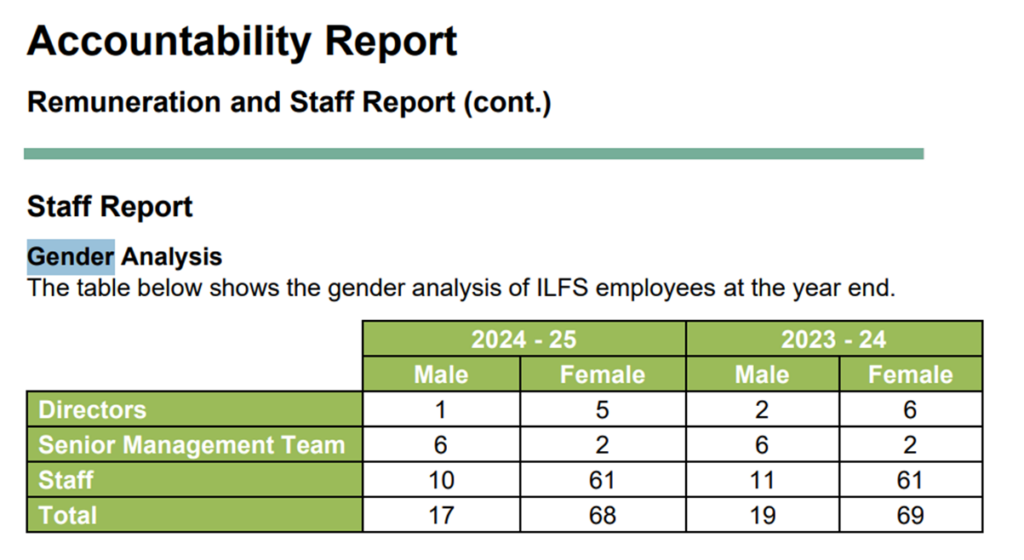
4) What does the term ‘gender’ denote here?
5) How does your organisation propose to capture data about the number of men and women it employs if it ‘has no formal definition of the word “woman’’’?
6) How was this information captured?
7) How was a conflation of sex and gender avoided in the construction of the question?
ILF Scotland does not create or use its own definition of protected characteristics. In line with other Scottish public authorities, ILF Scotland applies the statutory definitions set out in the Equality Act (2010), together with any relevant Scottish Government guidance that interprets those definitions. There is no requirement that ILF create or adopt their own ‘formal’ definition or interpretation of the word ‘woman’ and as is consistent with all other public bodies, ILF have adopted the statutory definition as set out in the Equality Act (2010).
ILF Scotland’s position is as follows:
• ILF Scotland does not issue internal, alternative, or supplementary definitions for statutory terms such as sex, woman, or man.
• ILF Scotland operates on the basis that protected characteristics are defined solely by the Equality Act (2010) and any legally binding judgments that clarify those definitions.
• Where staff provide information relating to their sex or sexual orientation—for example through HR, payroll, or equality monitoring forms—ILF Scotland records this as self-identified data, unless a statutory requirement specifies that another approach must be taken.
This reflects the standard practice across public bodies in Scotland when applying equality legislation.
ILF Scotland meets its Public Sector Equality Duty (PSED) by:
• applying the statutory definitions contained in the Equality Act (2010).
• completing Equality Impact Assessments (EQIAs).
• monitoring outcomes for people with protected characteristics using self-reported information (eHR system).
• ensuring that staff and managers follow ILF Scotland’s equality policies and complete mandatory equality training.
2) ILF Scotland does not create or use its own definition of protected characteristics. In line with other Scottish public authorities, ILF Scotland applies the statutory definitions set out in the Equality Act (2010), together with any relevant Scottish Government guidance that interprets those definitions. There is no requirement that ILF create or adopt their own ‘formal’ definition or interpretation of the words ‘woman’, ‘lesbian’, ‘bisexual’ or ‘gay’, and as consistent with all other public bodies, ILF have adopted the statutory definition as set out in the Equality Act (2010).
ILF Scotland meets both the general duty and the Scottish specific duties through the following approach:
Equality Impact Assessments (EQIAs)
• Completing EQIAs for proposed and revised policies.
• Publishing EQIAs as required under the Specific Duties Scotland (SDS).
• Using the statutory list of protected characteristics as defined in the Equality Act (2010).
• Considering potential impacts on sex and sexual orientation using self-identified information from staff and applicants.
Policies and Practices
• Reviewing new or updated policies for any potential impacts on protected groups.
• Including sex and sexual orientation as standard categories within the EQIA template.
Monitoring
• Using workforce monitoring categories that are consistent with those used across Scottish public authorities.
• Recording sex exactly as provided by the individual where this is required for payroll, HMRC or other statutory purposes.
• Recording gender based on the person’s self-identified gender, if stated. ILF Scotland does not apply any internal definition of gender beyond self-identification for monitoring purposes.
The EQIA for Policy 24 uses the term ‘women’ in line with the statutory protected characteristic of ‘sex’ as listed in the Equality Act (2010).
3) ILF Scotland does not create or use its own definition of protected characteristics. In line with other Scottish public authorities, ILF Scotland applies the statutory definitions set out in the Equality Act (2010), together with any relevant Scottish Government guidance that interprets those definitions.
Following the UK Supreme Court judgment in For Women Scotland v Scottish Ministers, the Court confirmed that under the Equality Act (2010), the terms ‘woman’, ‘man’, and ‘sex’ all refer to biological sex. The Supreme Court unanimously held that:
• The words ‘woman’ and ‘sex’ in the Equality Act (2010) must be interpreted as referring to a biological woman and biological sex.
4) ILF Scotland does not create or use its own legal definition of gender, and uses the term in line with the Scottish Government National Performance Framework interpretation and definition of sex and gender. This information can be viewed online at National Indicators by sex and gender | National Performance Framework.
5) HR and payroll data are collected in the following way:
• The category ‘sex’ is taken directly from the standard HMRC employee starter forms. These forms require individuals to provide their sex for payroll and tax purposes, and ILF Scotland records this information exactly as it is supplied by the employee.
• ILF Scotland does not apply any organisational definition of ‘woman’ or ‘man’; the information is accepted as stated by the individual. This approach ensures ILF Scotland meets its statutory payroll obligations while also supporting reporting requirements under the Equality Act.
6) Sex and gender information is captured through:
• HMRC starter forms, which require disclosure of sex for payroll and taxation (e.g., Starter Checklist).
• eHR forms, where individuals self-identify their gender and other protected characteristics.
7) ILF Scotland manages these categories separately to avoid any unintended conflation. Where relevant, two distinct fields are used:
• ‘Sex’ – recorded exactly as stated by the employee and used only where required for statutory or payroll purposes.
• ‘Gender’ – the individual’s self-identified gender, used for internal monitoring purposes.
• Within Equality Impact Assessments and equality duty reporting, ILF Scotland applies the statutory protected characteristic of sex.