Type of document: Board Reporting
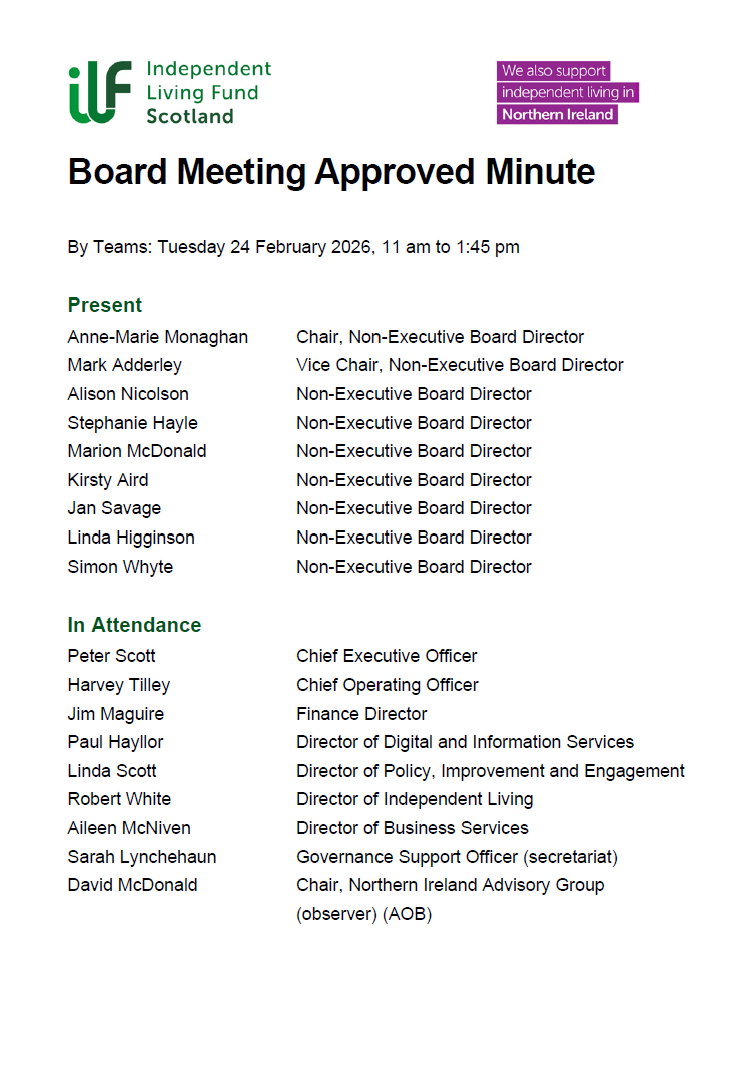
By Teams: Tuesday 24 February 2026, 11 am to 1:45 pm
Anne-Marie Monaghan - Chair, Non-Executive Board Director
Mark Adderley - Vice Chair, Non-Executive Board Director
Alison Nicolson - Non-Executive Board Director
Stephanie Hayle - Non-Executive Board Director
Marion McDonald - Non-Executive Board Director
Kirsty Aird - Non-Executive Board Director
Jan Savage - Non-Executive Board Director
Linda Higginson - Non-Executive Board Director
Simon Whyte - Non-Executive Board Director
Peter Scott - Chief Executive Officer
Harvey Tilley - Chief Operating Officer
Jim Maguire - Finance Director
Paul Hayllor - Director of Digital and Information Services
Linda Scott - Director of Policy, Improvement and Engagement
Robert White - Director of Independent Living
Aileen McNiven - Director of Business Services
Sarah Lynchehaun - Governance Support Officer (secretariat)
David McDonald - Chair, Northern Ireland Advisory Group (observer) (AOB)
The Chair welcomed everyone to the 42nd ILF Scotland Board Meeting and requested that the Executive Team and staff of ILF Scotland re-introduce themselves so that the newly appointed board directors could familiarise themselves with the staff and their respective responsibilities.
David McDonald (David), Chair of the Northern Ireland Advisory Group was also welcomed to the meeting partway through as an observer.
Robert White (Robert), Director of Independent Living tendered his apologies.
The Chair reminded Board Directors to declare any conflicts of interest. Marion McDonald (Marion) noted her new appointment to the Consumer Scotland Board. The meeting acknowledged this and confirmed that the Declarations of Interest Register would be approved later. Marion was also reminded that she would be excluded from the agenda item on Consumer Duty due to this conflict.
The Board noted the Declarations of Interest.
The Chair provided an update on her key activities since the previous Board meeting, encompassing work both directly and indirectly related to ILF Scotland. These included:
The Board noted the extensive list of activities.
The Board reviewed the minutes of both the previous meeting (24 November 2025), and the Special Board meeting (10 February 2026).
The Chair took the Board through each page of the minutes inviting comments. Minor adjustments noted in written comments were incorporated.
The Board approved both sets of minutes.
Peter Scott (Peter), Chief Executive updated the Board on the Coming Home initiative, following the Special Board meeting on 10 February. Although no formal decision had been made, it was announced that COSLA and the Scottish Government had agreed an action plan to be published in March. The plan includes an action to explore a national top up scheme and potential ILF Scotland involvement; however, it is clear that ILF Scotland will not be asked to take a lead role at this stage.
The Board noted concern but remained hopeful about future opportunities, stressing the need for continued advocacy, planning and engagement. It was suggested that ILF Scotland should continue risk framing and preparatory work in case the initiative progresses quickly. Peter confirmed that the Project Management Office is already engaged.
The Chair provided an update on the appointment of new directors to the Audit and Risk Committee and the Remuneration Committee. She noted that the Board Effectiveness Day on 23 February had given Board Directors the opportunity to reflect on skills, strengths and contributions.
The Chair confirmed that further discussions with individual Board Directors would take place to finalise committee appointments.
The Board reviewed the action log. It was noted that all actions had been dealt with and could be closed.
The Board sought an update in relation to the Emergency Spending Controls imposed by the Scottish Government. It was confirmed that these remained in place.
It was noted that the Coming Home initiative had been discussed. There were no additional urgent matters raised.
Chair of the Audit and Risk Committee, Alison Nicolson (Alison), provided an update from the ARC meeting (17 February).
The Board noted the Audit & Risk Committee update.
Mark Adderley (Mark), Chair of the Remuneration Committee, provided a verbal update on the 5 February meeting.
The Committee had approved the recent staff pay award, reviewed the Board diversity and succession plan and discussed employee statistics noting risks associated with several long serving senior staff approaching retirement.
The Mental Health and Wellbeing Week was highlighted as a major success, and the Employee Engagement Report confirmed continued high staff engagement. Minor adjustments were suggested for the 2026 staff survey questions.
The Board also discussed the potential value of introducing short “pulse” surveys during periods of transition.
It was confirmed that Marion McDonald will succeed Mark as Chair in January 2027.
A Board question was raised about using short, frequent pulse surveys to gather timely feedback during periods of transition. It was confirmed that this had been considered, and the Director of Business Services noted that plans are in place to use the Viva Engage online portal to run these surveys.
The Board noted the Remuneration Committee update.
The Finance Director presented the Draft Budget for 2026 to 2027, confirming alignment with the medium-term Financial Plan and the Strategic Plan. The Board noted a strong settlement, including a £12.8 m year on year increase: £7.7 m for the re-opened Fund and £4.6 m for the 2015 Fund to meet Scottish Living Wage and other commitments. The re-opened Fund will receive up to £26.3 m, enabling the recruitment of around 600 new recipients.
Despite the positive settlement, there remains a £300 k shortfall in administration funding, requiring efficiency measures. The Transition Fund allocation remains unchanged at £5 m since 2017, despite demand exceeding available resources.
The Board discussed delays in drawing down re-opened Fund allocations and the relationship between administrative capacity and fund distribution. Operational challenges, including multi agency processes, applicant delays, and setup requirements, were explained. Measures such as Docusign and additional operational support are being implemented. Direct online applications remain 18 months away, subject to funding, while the forthcoming DPO Supported Application Pilot will inform future citizen led models.
Finally, it was noted that £100 k of the £300 k administration shortfall relates to an SG requested Transition Fund research project, for which no additional funding has been provided.
The Board approved the Draft Budget 2026 to 2027 and associated paper.
Jim Maguire (Jim), Finance Director presented to the Board the Management Accounts to December 2025. The purpose of the report was to present the financial position and salient points to note regarding ILF Scotland’s Budgetary Control report for December 2025.
Jim summarised the financial position as of December 2025 and noted a regular pattern of surpluses in the 2015 Fund and tightness in the Transition Fund. It was noted that the surplus in the 2015 Fund was used to cover deficits in the Transition Fund, allowing for more grants to be paid.
It was also highlighted that Northern Ireland had a planned deficit due to increased rates not covered by funding, but reserves from prior years mitigated this issue. It was noted that administration savings had been generated primarily due to spending constraints which resulted in a healthy financial position with reserves around £5 million.
Jim also mentioned a recent change where SG Sponsor Team requested the return of £300,000 in administration savings achieved in 2025 to 2026.
It was noted that the outlook was positive and that there were no issues presented.
The Board noted the report and thanked the Finance Team for their efforts in keeping the organisation financially sound.
Paul Hayllor (Paul), Director of Digital and Information Services presented a request for £250 k in additional capital funding for the MyLife system, to act as a contingency and ensure safe delivery in 2026. A four-month delay had occurred due to SG IT requiring ILF Scotland to leave the DMZ and complete additional data migration and reconciliation testing.
Jim noted that £1.575 m had already been invested in the project and that the £250 k formed part of a wider £600 k IT budget. It was highlighted that ILF Scotland receives no capital funding from the Scottish Government and relies on reserves generated through efficiencies.
The Board queried whether the long-term risk to reserves and capital investment was captured on the risk register; it was confirmed that a risk relating to adequacy of SG funding existed, and the Chair asked the Audit & Risk Committee to consider this further (Action 1).
The Board approved the funding request and thanked the team for managing the project effectively despite the challenges.
Paul presented the Summary Risk Report to the Board. The purpose of the report was to highlight the current risk landscape and note the proactive management of risks and the dynamic systems in place by the organisation to manage risk.
The report indicated that the top three risks remain unchanged, reflecting the ongoing crisis in social care, funding model issues and reputational harm. The thematic analysis showed that compliance, legal and regulatory, strategic and reputational risks were significant.
A Board Director provided an update on the impact of staff cuts at the Nursing and Midwifery Council. The social care recruitment crisis was discussed and delays in fitness to practice hearings with the potential risk of unfit individuals working as carers. Linda Scott (Linda), Director of Policy, Improvement and Engagement added that assessors were discussing how to address this risk and confirmed that the issue has been flagged with Disclosure Scotland.
The Board noted the report.
The Board noted that this was a nil return as there had been no MiCase or PQs during this period.
Harvey Tilley (Harvey), Chief Operating Officer, presented the Board with the Q3 2025 to 2026 Executive Summary and Operational Report. The purpose of the report was to provide a summary of all operational activities over the period 1 September 2025 to 31 December 2025.
It was noted that there had been no change in the complexity of the operating environment since the previous reporting period, insofar as social care and support pressures have had significant knock-on implications for the organisation.
One significant highlight noted was the reduction in the Transition Fund backlog, which decreased from 23 to 24 weeks to around 14 to 15 weeks by the end of quarter three, and further down to 8 to 9 weeks in quarter four. The reduction was attributed to the utilisation of unspent money from other business areas, allowing for the transfer of up to £1 million into the Transition Fund.
The Board asked about the update against strategy and whether the citizen led applications should be reflected as amber as noting what had been mentioned earlier, the organisation was 18 months away from citizens being able to apply directly.
Peter confirmed that the reason it was green was that the timeline had not been changed, so although the activity was some time away it was still within the planned longer-term timeline.
There was a request to bring to the Board information and clarity on how the activities were being rated to ensure understanding for the RAG rationale.
Action 2: Information to the Board on RAG rationale.
The Board noted the report.
The Cyber Security update was provided by Paul Hayllor as the Board Champion was not available. It was noted that ILF Scotland was moving into the new core database system MyLife and would therefore no longer be within the Scottish Government Secure Environment. Assurance was provided that the organisation had gone to considerable efforts to ensure as robust a system as possible. It was also confirmed that ILF Scotland had utilised Sentry, an independent external security operation centre, which monitored all email / technological traffic and flags issues and alerts.
The Board asked whether there was sufficient staff resource in place for the management of such a significant risk. It was confirmed that there was and detail about the internal and external support in place was provided.
The Net Zero Champion, Mark Adderley, provided an update to the meeting. It was confirmed that there was progress made against short term objectives. It was noted that these objectives were evidenced in the KPIs which showed that targets were being met.
The Programmes, New Projects and Change Management Champion, Marion McDonald, provided an update to the meeting. It was noted that there had been the sharing of practical assistance in models and tools. It was also confirmed that the team had received assistance with prioritisation model with the main improvement being the visibility of the totality of projects across the organisation.
Owing to the conflict of interest highlighted at the start of the meeting the Chair requested that Marion leave the meeting for the duration of the agenda item.
The Director of Policy, Improvement and Engagement presented the Board with the Consumer Duty Requirements report for approval. The purpose of the paper was to set out that as a public authority under the Consumer Act, ILF Scotland was required to report from April 2025 until the end of March 2026, and every three years thereafter. It was confirmed that the duty involved considering the impact of strategic decisions on consumers in Scotland and the desirability of reducing harm to those consumers.
Linda outlined the need for an impact assessment and suggested incorporating an assessment into the range of existing impact assessments. In addition to this, several recommendations including ensuring compliance with the consumer duty, nominating a consumer duty champion, demonstrating that all decisions had undergone a consumer duty impact assessment and publishing the steps taken in the annual accounts was also raised.
The Board questioned the training being offered to staff and the policy reviewing process to capture the new requirement. It was confirmed that arrangements for staff awareness training were being made and there was a robust BAU review as part of the many feedback avenues for consumers / applicants.
The Board approved the Consumer Duty Requirements and nominated Alison Nicolson as the Consumer Duty Champion.
Linda provided a verbal update on the following external policies.
The Protection of Vulnerable Groups (PVG) scheme was introduced for Personal Assistants last year and so far, the role of ILF had been to promote the scheme through the website and newsletters. Public bodies have now been asked to report back confidentially to SG on the number of people complying with the requirements of the scheme.
The United Nations Convention on the Rights of the Child (UNCRC) came into effect in July 2024 and the aim of the legislation was to ensure that the rights of children were upheld and that their views were taken into account in decisions that affect them including policy, practice and budget-making decisions.
ILF Scotland has to report on the implementation and progress towards compliance as at the end of March 2026 and every 3 years thereafter. It was confirmed that this was in hand and that the implementation plan being developed is proportionate, given the numbers of young people who interact with the organisation, over 1,200 Transition Fund grant recipients in the last year and 60 recipients of the re-opened Fund. The plan will cover training and commitment to the UNCRC from Board level throughout the organisation, child friendly complaints process and other relevant material, participation from young people and the inclusion of Wellbeing Impact Assessments (CRWIA).
It was agreed that the report would be sent electronically to the Board as the deadline for the report fell outwith the standard cycle of meetings.
It was confirmed that the Human Rights Bill had been delayed.
It was also noted that the Mainstreaming and Equality Outcomes report would also be due out with the cycle of meetings so this too would be sent to the Board by correspondence.
Action 3: send UNCRC report and Mainstreaming and Equality Outcomes Report to the Board in April.
There was an update in relation to SDS Reductions. The Board was informed of the issues where budgets were being reduced. It was noted that this was wider than ILF, with problems including the potential loss of PAs and subsequent redundancy.
Other causes for concern noticed were cuts to transport to attend day services, which was causing a particular issue in rural areas.
In addition to the above, respite services were also being curtailed in other areas too, for example, 10 days maximum per annum regardless of need.
The Board was provided with an update on how the issues impacted on ILF specifically related to the suspensions of awards or eligibility to apply.
The Board was concerned that individuals most in need could fall below the threshold due to the cuts even though their needs had not changed.
Linda acknowledged the concerns and noted that the co-production working group had discussed the possibility of adjusting the threshold to capture more people however, it was decided to maintain the current threshold to balance the budget while maximising the number and values of awards and places available.
Linda brought to the Board’s attention the current issue with the Department of Work and Pensions where in four cases, they had treated ILF awards as capital or income. It was confirmed that this had been raised with the Sponsor Team at SG who were raising with other SG departments to resolve the issue.
The Board was updated in relation to the National Social Work Agency, which is due to launch on 17 March. It was noted that this agency would be a partner in the new Scottish Social Work Partnership.
The Board also received an update regarding The Public Bodies (Joint Working) (Integration Joint Boards) (Scotland) Amendment Order 2025. It was confirmed that Minister Tom Arthur tabled an Order to give service users, disabled people, carers and third sector organisations a vote on integration joint board decision-making. It was noted that until now only members appointed by the NHS Health Board and local councils could vote.
It was noted that the Scottish Parliament’s Health, Social Care and Sport Committee’s scrutiny of the legislation concluded last week and the draft regulations were due to come into force in September 2026.
The Board was advised that following the Scottish Parliament’s inquiry into the statutory review of the National Outcomes, the SG NPF reform team had worked with stakeholders to develop a new National Performance Framework (NPF) that includes an updated purpose and a streamlined set of six wellbeing outcomes. SG are holding engagement sessions through Sponsor Teams, which relevant ILF Scotland staff will attend to ensure alignment with the revised outcomes.
The Board thanked Linda for the update noting how useful the update was in providing a wider context of the current landscape owing to the impacts on a lot of what the organisation does.
The Board noted the update.
The Chair presented the Board Diversity and Succession Plan. The purpose of the plan was to help the organisation ensure the board has the right mix of skills, experience, perspectives and continuity over time. It ensured that the board was as diverse as possible and remained effective.
It was noted that the paper had been presented and discussed at the recent Remuneration Committee and it was to be formally noted at the Board.
The Chair highlighted that in terms of diversity, the role of disabled people on the Board was critical and very much at the heart of the organisation and linked to the slogan nothing about us, without us.
The Board noted the plan.
The Chair introduced the Board of Directors Register of Interests 2026 and reminded the Board that it was their responsibility to ensure the register was maintained as the register was a live document which was published on the website.
A Board Director confirmed that they hold a public appointment with the Department of Education and advised that the register will be updated accordingly as soon as possible.
The Board noted the register.
Aileen McNiven (Aileen) presented the Health and Safety Report to the Board. The Purpose of the report was to provide assurance that the organisation had robust Health and Safety interventions and mitigation measures in place. It was noted that there was a continued focus on improvement across all aspects of Health and Safety.
The Board noted that there had been zero near-misses reported in the quarter which caused the Board to mention the importance of staff reporting. It was confirmed that the organisation was open, and staff understood the importance of reporting incidents. It was confirmed that staff regularly report issues, the example of data breaches was provided. The Board was also reassured that the staff were routinely reminded about reporting near misses.
The Board noted the report.
The Board was provided with the Feedback Report by Linda Scott. The Board was reminded that ILF Scotland’s first Feedback Strategy, which incorporated the Service Charter was approved in November 2025. In line with the commitments outlined in the Feedback Strategy, the report provided a summary of all the feedback gathered or received from April 2025 to January 2026, from the following projects: the re-opened fund; complaints; compliments; support calls, and; ILF Scotland’s 10-year celebrations in both Scotland and Northern Ireland.
It was confirmed that the feedback received was very positive. Assurance was provided to the Board that any negative comments were followed up and thoroughly investigated.
The paper confirmed that other feedback mechanisms would be developed and reported on in future.
The Board was delighted with such a positive report and encouraged the Executive Team to feed back to the organisation their appreciation for the positive results.
The Board noted the report.
Stephanie Hayle (Steph) was asked to provide an update to the Board regarding the Equality Committee. She confirmed that the next committee meeting was to take place in March. One of the matters she wanted to discuss was the continued use of X (formerly Twitter) owing to the potential reputational risk.
Linda confirmed that following the paper from Holly Child (Holly), Communications Lead that went to the last meeting, it was agreed that this subject would be kept under review and further discussions on the continued use of X will take place at the next Equalities meeting.
The Board noted the update.
The meeting then turned to hear the feedback from the meeting which had taken place on Thursday 5 February between the Northern Ireland Minister of Health and the Northern Ireland ILF Advisory Group.
David McDonald (David), Chair of the Northern Ireland ILF Advisory Group, provided feedback noting that it was a challenging meeting, with concerns raised by those who attended.
The Board received an update from David on the current context of care and support in Northern Ireland and what the government legally had to provide.
There was a suggestion that the Advisory Group should approach all parties as well as the Health Committee.
It was confirmed that the Chair and others would be travelling to Belfast in March for the Advisory Group meeting and that the discussion should be continued there.
Jan Savage (Jan), Board Director, offered to meet with Linda / David and the Northern Ireland Advisory Group to explore human rights-based advocacy strategies prior to the next Northern Ireland Advisory Group meeting. This was agreed.
Action 4: Human rights-based discussion to take place before 10 March.
Close of Meeting: 1:30 pm
Next Board Development Day: 28 April 2026 :10 am to 4 pm (Denholm House) (in-person)
Next Board meeting Tuesday 2 June 2026 11 am to 3 pm (Denholm House) (in-person)
The Board queried whether the longer-term risk to the reserves / capital investment was on the risk register. It was confirmed that there was a risk around the adequacy of funding from Scottish Government specifically in relation to capital funding. Reserves / capital risk to be considered by ARC
Action by: Risk register, ARC Committee
Timescale: Next ARC meeting is 12 May 2026
Action: Completed – ARC – 12 May 2026
Information to the Board on RAG rational
Action by: HT
Timescale: Next Board is 2 June 2026
Action: Complete
Send UNCRC Report and Mainstreaming and Equality Outcomes report to the Board in April. Mainstreaming report sent to Board on 23 April
Action by: LS
Timescale: April
Action: UNCRC report due in August so will go to next Board meeting.
Arrange a meeting between Jan Savage, Linda Scott, and Northern Ireland Advisory Group members to explore human rights-based advocacy strategies.
Action by: LS
Timescale: Before 10 March
Action: This has been completed