Company Number SC500075
Reporting on the audit of the financial statements
Reporting on regularity of expenditure and income
Reporting on other requirements
Statement of Comprehensive Net Income and Expenditure for the year ended 31 March 2026
Statement of Financial Position as at 31 March 2026
Statement of Cash Flows for the year ended 31 March 2026
Statement of Changes in Taxpayers’ Equity for the year ended 31 March 2026
Notes to the Financial Statements for the year ended 31 March 2026
Appendix to the Financial Statements for the year ended 31 March 2026
ILF Scotland is a Non-Departmental Public Body (NDPB) of the Scottish Government. Our role is to provide a high-quality service to, currently, around 7,000 disabled people in Scotland and Northern Ireland, supporting them to achieve positive independent living outcomes, and to have greater choice and control over their lives.
ILF Scotland commenced operations in July 2015. We work in partnership with 37 Health and Social Care Partnerships / Trusts (HSCP/Ts) across Scotland and Northern Ireland by jointly assessing and funding person centered care and support.
Operating from our central office in Livingston we employ (at 31 March 2026) 80 dedicated people including our social care professionals. Our assessors visit our Recipients in their own homes every two years to identify their needs, often in conjunction with Local Authority or Trust social services departments.
In what is now our 11th year of operation, we are pleased to present our Annual Report and Financial Statements for the year ended 31 March 2026.
Office address
ILF Scotland Denholm House
Almondvale Business Park Almondvale Way Livingston EH54 6GA
Registered in Scotland
Tel: 0300 200 2022
Email: enquiries@ILF.scot
Website: www.ilf.scot
Principal activities and historical context
ILF Scotland was set up in 2015 and carries out the functions previously undertaken by the Independent Living Fund (2006) within Scotland and Northern Ireland. Its aim is to deliver discretionary cash payments to disabled people, allowing them the choice and control to purchase personal support and live independent lives in their communities. The organisation is an NDPB of the Scottish Government and receives funding in the form of Grant in Aid. There is also an agreement between the Scottish Government and the Department of Health in Northern Ireland (DOH) for ILF Scotland to administer ILF payments to ILF Recipients based in Northern Ireland.
Details of the Directors can be found here via the link below or directly on the company website: Board of Directors
Details of the Senior Leadership Team (SLT) can be found at: Senior Leadership Team
Important external contacts are noted below:
Statutory Auditor
Audit Scotland
8 Nelson Mandela Place Glasgow, G2 1BT
Solicitor
Central Legal Office
Breadalbane Street Edinburgh, EH6 5JR
Internal Auditor
MHA Henderson Loggie
29 Greenmarket Dundee, DD1 4QB
Banker
Royal Bank of Scotland
36 St. Andrew Square Edinburgh, EH2 2AD
The Performance Report contains an Overview section summarising the whole report, explaining our purpose and strategy, our business model, our activities, our operational risks and summarises our performance. It also has an Analysis section which sets out our progress against this year’s performance measures and our financial performance.
2025 to 2026 has been another pivotal and significant year for ILF Scotland. Building on the re‑opening of the Independent Living Fund in the previous reporting period, we have continued to strengthen and expand the support we provide to disabled people across Scotland - and, where possible, in Northern Ireland. Our work this year again demonstrates what can be achieved through shared purpose, strong collaboration and an unwavering commitment to independent living.
The re‑opened Fund is continuing to have a profound impact on the lives of those we support. By the year end, we had received over 1,400 cumulative applications, in line with expectations for the second year of operation. We are already hearing many stories of lives being changed and opportunities unlocked through modest but meaningful ILF funding. Early feedback from over 100 support calls to new Recipients shows that 95% reported a significant positive impact, and in 85% of cases all intended independent living outcomes were achieved. We are considering how we can support the wider system to meet those goals that haven't yet been met. The positive impact achieved reinforces earlier Social Return on Investment findings that every £1 invested through ILF Scotland generates around £13 of wider social value.
Demand for the Transition Fund has remained exceptionally high. Preventative by design and transformative in practice, the Fund continues to be a lifeline for many young disabled people. This year we operated at around 20% above our original funding allocation, with internal resources reallocated to maintain award levels.
Despite sustained pressure, we reduced waiting times from over 20 weeks to within our target of 12 weeks, positioning us well for the year ahead. The level of demand continues to underline the importance of early intervention as young disabled people move into adulthood.
Across the organisation, operational activity remains high, with ILF Scotland supporting around 7,000 active cases across all Funds. Our Assessors and Caseworkers work within increasingly complex circumstances, often requiring close engagement with Local Authorities and Health and Social Care Trusts to ensure safe, sustainable support. A continued priority is ensuring that our funding provides genuine additionality of outcomes, over and above statutory provision.
None of this work would be possible without our partners. I am extremely grateful to our Scottish Government colleagues, particularly our Sponsor Team, whose support continues to be central to our stability and progress. I also wish to thank our Northern Ireland Sponsor Team for their constructive engagement and ongoing support. I am equally thankful to members of our Co-production Working Group, whose ongoing commitment, expertise and lived experience continue to shape policy and delivery.
I also want to recognise local authority Social Work colleagues across Scotland. Since re-opening the Fund we held over 200 engagement sessions with Local Authorities, reflecting the scale of joint working that underpins the re‑opened Fund. Their contribution has been essential to the Fund’s success.
To our staff, I offer my sincere thanks. The challenges of the year - including sustained demand, wider social care pressures and emergency spending controls - have required exceptional resilience. Throughout, our teams have demonstrated professionalism, commitment and a deep belief in the rights of disabled people to live independently. I am also grateful to the Board of Directors, whose skills, experience and lived experience continue to ground our work in the realities of people’s lives.
This year we also remember Etienne D’Aboville. His lifelong commitment to independent living played a key role in the establishment of ILF Scotland, and as a Board Director he brought wisdom, integrity and deep respect for lived experience. His influence continues to shape our values, culture and approach.
In Northern Ireland, we continue constructive engagement with their officials and partners. While the Minister in Northern Ireland has advised that there are currently insufficient funds to re‑open the ILF, we welcome the commitment to review this position should circumstances change, and we remain focused on protecting the existing funding allocation for those with the highest level of need.
Our Advisory Groups in Scotland and Northern Ireland have once again provided invaluable insight, challenge and accountability. Chaired by Jim Elder‑Woodward and David McDonald respectively, they help ensure that our work remains firmly aligned with our mission and values.
Looking ahead, our priorities are clear: further embedding the re‑opened Fund, delivering our digital transformation programme, supporting our workforce, strengthening our preventative impact, and enabling more disabled people to live the independent lives they choose. As referenced in our Future Plans on page 13, we also look forward to contributing to the Coming Home agenda alongside our partners. Despite ongoing pressures across the social care landscape, our commitment to rights, dignity and co‑production continues to guide everything we do.
Peter Scott OBE
Chief Executive Officer
30 September 2026
The key priorities from our Strategic Plan are listed below:-
Further information on the above priorities is set out on pages 16 to 22, together with the Key Performance Indicators (KPI’s) and metrics against which we monitor performance.
This year our principal risks and uncertainties were mainly in connection with: managing the project to re-open our main Fund to new applications; the continued growth in demand for the Transition Fund; the management of resources; the movement of personal and sensitive information; managing the project to replace our main client database as part of our Information Technology (IT) infrastructure; IT security; dealing with the current social care crisis; and our core long standing risks in relation to funding and policy changes. We believe that we responded well to all risk areas and this is explored further in the Analysis section of this report.
Risk is further addressed in the Annual Governance Statement on pages 46 to 51.
In what was our 11th year of operation, we continued to have a strong and positive impact on the independent living aspirations of disabled people across Scotland and Northern Ireland. This was achieved despite significant pressures arising from the cost of living, wider health and social care challenges and emergency spending controls. We disbursed a record £66.5m, up from £55.8m in the previous year, which directly funded over 5,000 disabled people. In addition, we proactively engaged with over 2,000 additional disabled people through funding applications, active processes or closing completed grants.
Our impact was enabled by strong delivery against our annual business plan and the first year of our new three-year strategy. Progress was achieved through close co-production and collaboration with the Scottish and Northern Irish Governments, Health and Social Care Partnerships and Trusts, Disabled People’s Organisations, key stakeholders and most importantly, disabled people themselves. We value these partnerships highly and are grateful to everyone involved in supporting independent living across Scotland and Northern Ireland.
We received almost 700 applications for the re-opened ILF in 2025 to 2026, exceeding the cumulative target of 1,400 applications by 31 March 2026. Over the year we completed some feedback research on how the re-opened fund is working for disabled people. 95% indicated the funding had a significant impact on their lives and 94% were very satisfied with the service received. What these statistics do not fully capture is the profoundly positive human impact on those accessing the fund. Not only for the disabled people directly funded, but their families, friends and wider communities.
During the year we reviewed and updated all of our award policies and strengthened equality and involvement frameworks, with several statutory and strategic reports published in April 2026. Work also progressed on corporate parenting, the United Nations Convention on the Rights of the Child (UNCRC) and Consumer Duty compliance, along with feedback systems and implementation of updated Personal Assistant pay rates. Communications campaigns raised awareness of key priorities while engagement focused on increasing access to funds in our most deprived communities. The year also included successful events celebrating ILF Scotland’s 10th anniversary in Scotland and Northern Ireland, highlighting the impact of independent living support.
During the reporting period, we made strong progress in strengthening systems, governance and organisational capability. Our client database replacement project is nearing completion, with development and testing now completed. Our Project Management Office (PMO) has become a fully established support function, providing leadership on strategy, business planning, performance reporting and climate change activity and introducing structured project prioritisation to support organisational transformation. Information governance and cyber security remained robust throughout the year, underpinned by strong controls, proactive risk management, resilience testing and a positive organisational reporting culture.
As has been demonstrated in the aforementioned narrative, 2025 to 2026 has been a demanding but fulfilling year for colleagues. This has included the successful implementation of our workforce plan and Gold Standard Kinship Care accreditation, becoming the first organisation in Scotland to do so. We also became Age and Dyslexia Friendly Employers by signing up to their respective pledges. We signed up to the Mental Health Commitment run by Mind, the mental health charity, to promote wellbeing for our staff. We were delighted to congratulate our Director of Business Services, Aileen McNiven, on winning the highly prestigious UK wide Flexible Working Champion of the Year at the Working Families Special Awards whilst also retaining our Working Families Top 10 Employer status for 2025 to 2026.
In conclusion, 2025 to 2026 has been a year full of achievement and making a really positive difference for disabled people across Scotland and Northern Ireland. The organisation has delivered unprecedented levels of funding and support, strengthened its policy, governance and delivery frameworks and continued to place disabled people at the centre of everything it does. Strong financial stewardship, high-quality service delivery, meaningful engagement and co-production and continued investment in systems, people and organisational capability have all positioned ILF Scotland well for the future.
Future Plans
As we move into the next phase of our three-year strategy, we remain firmly committed to enabling independent living, responding to challenge with creativity and collaboration and ensuring that ILF Scotland continues to make a lasting, positive difference to disabled people, their families and communities across Scotland and Northern Ireland.
We are also very excited to have been included in the plans for the Coming Home initiative announced by the Scottish Government during the year. They advised of a £20m investment to deliver the Coming Home Action Plan supporting up to 400 people with learning disabilities and complex support needs. We will work closely with the Scottish Government and the Convention of Scottish Local Authorities (COSLA), together with other national and local partners to remove barriers ensuring that people can return to or remain at home. We have started initial planning to further define our role and deliver bespoke support to enable people to return to their communities, rather than spending longer periods in hospital than necessary or living in inappropriate out-of-area placements.
This concludes the operational update.
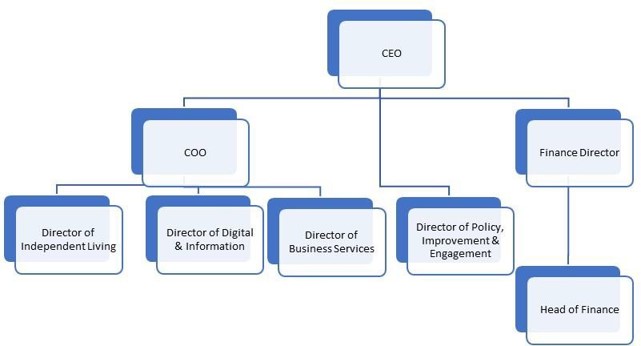
The organisational structure is set out below and shows core roles / departments.
This has been another successful year with solid progress towards delivering our 3 year strategic plan. Our primary ambition of more people accessing our funds has been achieved, with the target of 1,400 applications to the re-opened Fund being exceeded alongside new Transition Fund applications. The successful implementation of our workforce plan was completed and major progress has been made towards replacing our core case management system.
Overall, progress has been strong in all areas.
Performance against our key strategic objectives is set out in the Analysis section which follows on page 16.
Enable more disabled people to access our funds to live independently.
Key Performance Indicators
▪️Target Outcome: Play a key role in delivering independent living support in Scotland and Northern Ireland.
Activity Update: A key strategic indicator this year we can measure is in the personal outcomes people have achieved. The feedback from our calls to new Recipients has been overwhelmingly positive with reports so far of all intended outcomes achieved where support could be obtained and 85% of all outcomes were met. For 15% of people, they were unable to source all or part of their Personal Assistant or agency support to meet their outcomes, which may be due to reductions in services and wider recruitment challenges.
Status: Green
▪️Target Outcome: Identify and support those in greatest need.
Activity Update: As part of the co-production of the re-opened fund we developed guidance for local authorities (LAs) to support them to identify those with the greatest need and we widened access to include those with the greatest unmet need who had live-in unpaid carers in recognition of the contributions carers make in sustaining those they support.
Status: Green
▪️Target Outcome: Prioritise the rights of disabled people to live independently.
Activity Update: We received over 1,400 cumulative applications to the re-opened fund resulting in more disabled people supported to achieve the independent living outcomes important to them.
Status: Green
The Success Outcome is that by 2028, more disabled people have accessed our funds to enable them to live independently, increasing year on year.
Key Metrics
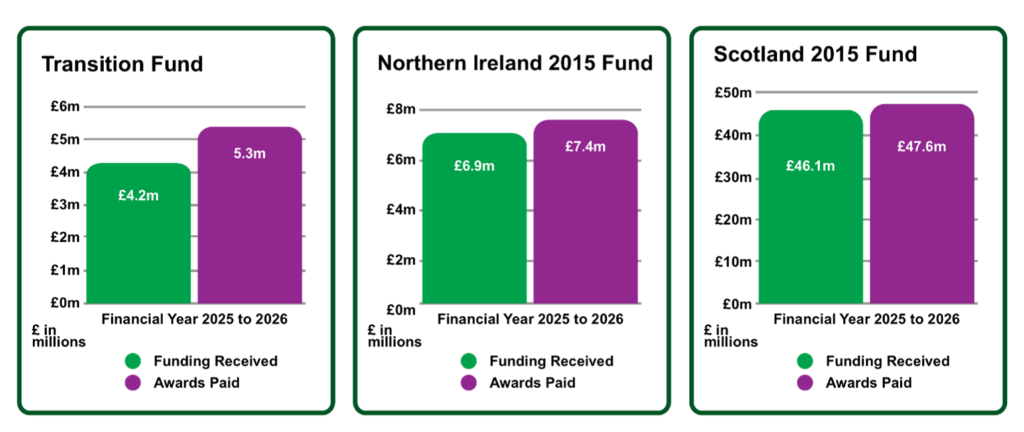
The key messages from above include that within Scotland we managed to pay out more than our funding allocation due to the effective recycling of returned unspent monies.
We also managed to direct surplus funds from the 2015 Fund towards the much needed Transition Fund, where demand very much exceeds our core funding awarded so therefore a great overall result.
With regard to Northern Ireland we managed to pay out more than the in-year awards received through the effective recycling of returned unspent monies and the use of existing reserves to pay for an in-year increase to rates payable to Recipients. Again a great result for our Recipients.
Support cultural change and capability across the sector through leadership and knowledge sharing.
Key Performance Indicators
▪️Target Outcome: Raise awareness of and promote independent living to influence national groups / policy.
Activity Update: We promoted the 10 year anniversary of the re-opening of ILF Scotland to showcase how the Fund is enabling new Recipients to live independently and raise awareness of how they can achieve their independent living outcomes. Senior colleagues continue to sit on strategic groups to influence national policy development at every opportunity.
Status: Green
▪️Target Outcome: Work with our partners in social care to ensure better outcomes for disabled people.
Activity Update: This year we were invited to nominate an ILF Scotland representative to the National Care Service Advisory Board and our Chair has taken up this role as a disabled user of social care support. We also regularly hosted partner collaborative meetings with important input to SDS National Standards.
Status: Green
▪️Target Outcome: Support Disabled People’s Organisations (DPOs) to support disabled people in local communities.
Activity Update: We continue to build strong relationships with our key DPOs. Operational Teams engage with DPOs / Centre of Inclusive Living (CILs) on a weekly basis, with formal meetings hosted by us every six months, to promote best practice in supporting disabled people with SDS and ILF funding.
Status: Green
The Success Outcome is that by 2028, ILF Scotland has assisted in the delivery of the United Nations Convention on the Rights of Persons with Disabilities and played an enabling role in increasing the support available to disabled people and their carers to live independently.
Key Metrics
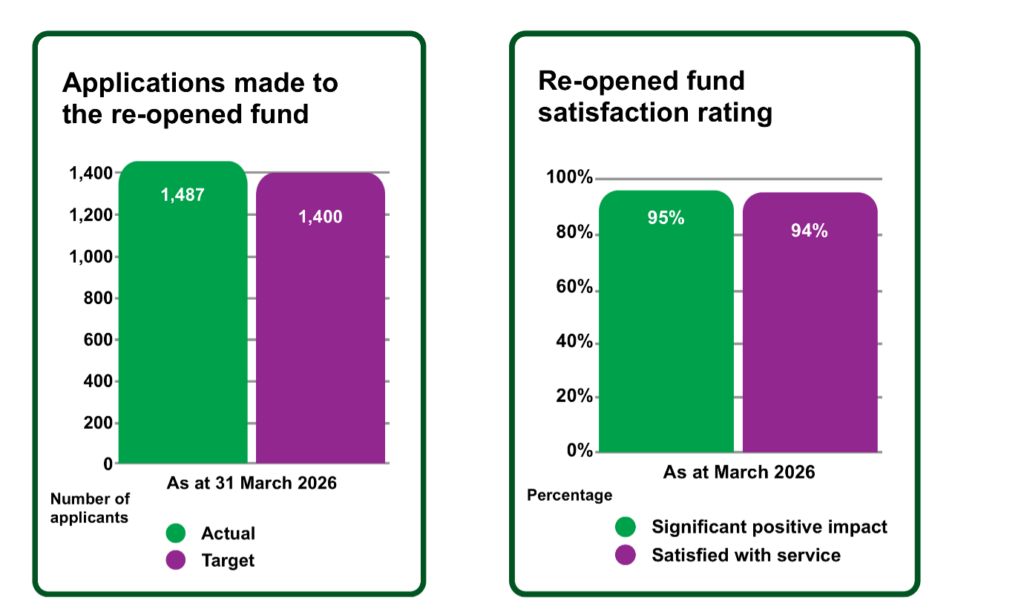
The Scottish Government set a target for us to recruit 1,400 new Recipients to the re-opened Fund by 31 March 2026 and the above demonstrates that we managed to hit the applications target. A very pleasing result.
Alongside this sits the results of our satisfaction survey which shows a significant positive impact on the lives of our Recipients and a high level of satisfaction with our service.
Positive results overall.
Deliver a high quality, inclusive and sustainable service.
Key Performance Indicators
▪️Target Outcome: Develop a sustainable operation and support climate change reductions to achieve Net Zero by 2040 by embracing digital technologies where appropriate.
Activity Update: We are in year 2 of our 15-year Climate Change action plan with a focus on ethical procurement and we have made contact with an expert Climate Change practitioner and plans are being formed to support Climate Week in October 2026 with staff engagement activities.
Status: Green
▪️Target Outcome: Ensure our operation and our people are resilient and capable of recovery in adverse circumstances.
Activity Update: We have carried out both resilience desktop exercises and simulation exercises. A post exercise report followed and was overall positive, highlighting the effective performance of our participating teams.
Status: Green
▪️Target Outcome: Provide high quality working life and job satisfaction for our staff to enable them to provide the best possible services.
Activity Update: For our staff, we continue to embed a strong focus on health and wellbeing across the organisation. The 2025 Staff Survey results demonstrated a positive year on year increase in overall satisfaction. Notably, 90% of respondents reported that they highly value the organisation’s culture and values, while 85% stated they were very satisfied with the work-life balance opportunities.
Status: Green
The Success Outcome is that by 2028, we are a fully sustainable and digitally enabled public service that is inclusive and accessible by all and offers a high quality of working life for all our staff.
Key Metrics
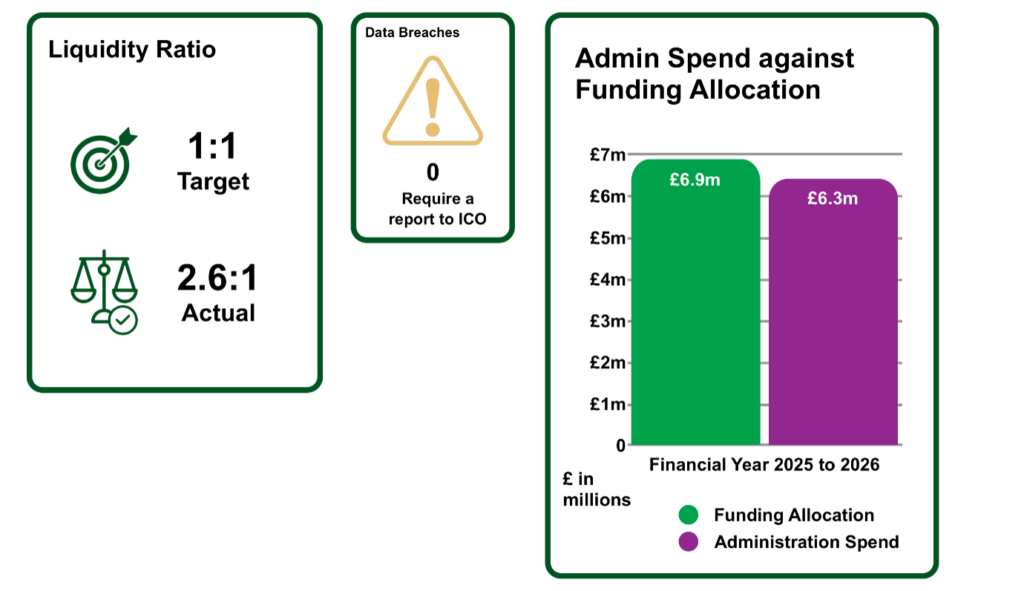
The above liquidity ratio, current assets divided by current liabilities, demonstrates that we are well placed to satisfy our short-term liabilities.
We can also confirm that no data breaches were reportable to the Information Commissioner’s Office.
We also report an underspend in our administration funding allocation which meant we could return £300,000 of savings to the Scottish Government before the year end.
All outcomes above are considered to be very satisfactory.
We constantly carry out improvement and efficiency work where possible and over the years this has enabled the organisation to deliver more. Over this year we have carried out improvements that have saved approximately 550 (2024 to 2025 – 500) hours of recurring staff time. Our efficiencies are mainly driven by IT initiatives. This year our efficiencies are less than we would normally achieve due to our concentration being focused upon re-opening our main Fund together with replacing our main client database. Only small operational efficiency gains can be realised until our IT infrastructure has been replaced.
However we made other in-year efficiency gains as part of the emergency spending controls and £300k of Grant in Aid was saved, which equates to a saving of 4.4% of our annual administrative budget, compared to the Scottish Government target of 3%.
Delivering Independent Living
During 2025 to 2026, we continued to deliver strong independent living outcomes for disabled people, despite a challenging social care landscape and increasing demand on services. The organisation maintained a similar operational tempo to the previous year while accommodating growth in Recipient numbers and managing the impact of local authority policy changes, workforce vacancies and wider system pressures.
Feedback gathered through support calls, review activity and complaints monitoring demonstrates that the Fund continues to play a critical role in enabling people to exercise choice and control, protecting independent living outcomes at a time when many statutory services remain under strain.
Those in Greatest Need
Ensuring that limited resources are targeted at those with the greatest need remained a core operational focus throughout the year. As Recipient numbers increased, so too did the complexity of need, particularly for individuals experiencing unmet support requirements, financial vulnerability, or caring breakdown.
Operational teams worked closely with local authorities to support consistent
interpretation of greatest need criteria and to manage the impact of changing eligibility thresholds across several areas. Particular attention was given to applicants with live-in unpaid carers, recognising the growing pressures on carers within the social care system.
Partnership Working
Strong partnership working remained essential to operational delivery. Throughout the year, we continued to engage intensively with local authorities, health and social care partnerships, Disabled People’s Organisations, and national partners in both Scotland and Northern Ireland.
These relationships were vital in navigating a complex and changing system, particularly where local authority eligibility criteria shifted or where funding pressures created delays or disputes in outcomes. Regular dialogue supported problem-solving at an individual case level while also informing strategic discussions around policy alignment, additionality and sustainability.
Supporting Others
Beyond direct funding activity, we continued to support Recipients, partners and staff through advice, guidance and responsive operational support.
Operational teams also played an important role in supporting local authorities and partner organisations to understand ILF policy, manage expectations and resolve disputes relating to outcomes, eligibility or funding interaction. This activity, while not always visible in headline statistics, remains critical to maintaining trust, safeguarding outcomes and ensuring effective use of public funds.
Policy
All ILF award policies were reviewed during 2025 to 2026 to ensure they remain fit for purpose and are as flexible as possible. In addition, we published two revised Transition Fund policies and comprehensively reviewed all remaining policies.
We continue to work towards mainstreaming equality fully across the whole organisation and further enhancing Equality Impact Assessments (EQIA) to include Poverty, Rurality and Consumer Duties. We assessed progress against our Mainstreaming Equality Action Plan as at 31 March 2026 and developed our new Mainstreaming Equality report for 2026 to 2028, which we published in April 2026.
We measured progress against our Corporate Parenting Action Plan as at 31 March 2026 and published this in April 2026. Alongside this activity, we continued to provide awareness throughout the year of Personal Assistant requirements to join the Protecting Vulnerable Groups (PVG) membership scheme. Also during the reporting period, we determined our compliance and new public reporting requirements for the UNCRC and Consumer Duty legislation and published statements / plans on our progress in April 2026.
Communications
We delivered a number of awareness campaigns to support the organisation’s strategic work. In September and October 2025, we supported Scottish Learning Disability Week and Care Experienced Week respectively. The team launched the organisation’s first ever Personal Assistant Awareness Week campaign in November and delivered a successful awareness campaign for the UN’s International Day of Persons with Disabilities in December in co-production with our Advisory Group members, Recipients, Award Managers and staff. We revised our Communication Strategy and Crisis Communications Strategy as part of this and published two external newsletters, which were distributed to Recipients across all funds.
Engagement
Due to the current demand on the Transition Fund the team has focused on specific engagement with professionals working in deprived areas to increase the number of applications from young disabled people from disadvantaged socio-economic backgrounds. The Independent Living Team have continued to work directly with Health and Social Care Partnerships to promote the re-opened ILF.
Events
As part of the 10th Anniversary of the formation of ILF Scotland, we ran celebration events in both Scotland and Northern Ireland. These events were exceptionally well attended and showcased the life enhancing role ILF Scotland funding has in enabling independent living.
Overview
2025 to 2026 was a demanding year for colleagues, shaped by ongoing business, the continuing work with the re-opened Fund and wider operational work across every facet of ILF Scotland. Despite this, ILF Scotland continued to prioritise being a positive, supportive and inclusive place to work. Workforce implementation and development plans were successfully progressed across the year, ensuring recruitment, training and workforce capacity aligned with organisational priorities and emergency spending controls. Monthly all-staff meetings and development events supported communication, engagement and organisational connection.
Planning continued throughout 2025 to 2026 in preparation for the Employee Rights Act 2025 implementation. The People & Culture Team worked with senior leaders and staff to ensure timely and compliant implementation.
Learning and development remained a priority within spending controls. Mandatory training was supplemented by specialist learning covering well-being, neurodiversity, health and safety, data protection and cyber-security.
Organisational Demography
At the end of the year we employed 80 staff plus 9 non-executive Directors: 78%:22% female: male, with 31.5% of staff self-identified as disabled or having underlying health conditions, with 3.37% from ethnic minorities and 1.12% LGBT.
Employment Status
All staff are employed on permanent or temporary contracts, providing organisational stability. Routine HR activity has included completion of policy reviews aligned to legislative changes (Employee Rights Act 2025) and Equality, Diversity and Inclusion (EDI) principles.
Mentoring
For the third year, we continued our commitment to social mobility by working with Career Ready Scotland during 2025 to 2026. The partnership provided paid internships and mentoring to two young people from local schools, offering meaningful work experience, professional networks and practical employability skills.
Recruitment
The 2025 to 2028 Workforce Plan underpinned recruitment activity. internal progression and external recruitment strengthened leadership, operational and corporate capacity.
Retention
Staff retention remained strong throughout the year, with low levels of turnover. Leavers largely reflected retirements or planned fixed-term contract completions. Internal progression opportunities supported career development and organisational continuity, reinforcing ILF Scotland’s commitment to developing and retaining talent.
Disabled Staff
The organisation is committed to giving full and fair consideration to applications for employment from disabled people, taking account of individual aptitudes, abilities, and potential. The organisation operates a guaranteed interview scheme for candidates who identify as disabled and who meet the essential criteria for the role, reinforcing its commitment to equitable access to employment.
The disclosure of a disability during employment is voluntary and handled sensitively and confidentially. Training, support, and reasonable adjustments are therefore guided by individual role requirements and employee needs where these are known.
All training, career development and promotion opportunities are actively promoted across the organisation and are equally accessible to disabled employees. The organisation is a Disability Confident Employer and, in 2025, also signed the Dyslexia Friendly Employer pledge, further demonstrating its commitment to inclusive employment practices.
IT Systems
The bulk of the development work on our new client database system was completed by the end of April 2026. As part of this, a comprehensive data migration strategy was created and this was the blueprint for the final move of our core database. An extension contract has been put in place to accelerate the remaining work and to cover the final modules and functionality required for a Day 1 release of the system. Of note, the project has always had the future service delivery model in mind and both the data model and technology are robust enough to be the foundations of our longer-term digital transformation. Training and upskilling of our IT team has commenced and we will aim to maintain the platform in-house with minimal long-term external support.
Project Management Office (PMO)
The PMO is almost one year old now and has become a fully functional new support to the organisation. Over the year it has led on strategy development, business planning, success measures, corporate reporting and climate change. It has also introduced a prioritisation and support model for on-boarding new projects and change activities. The next phase of development will aim to embed itself as a core support function and information resource for the whole organisation, including the reporting to board and Senior Leadership Team (SLT) on the totality of change activity to inform future on-boarding decisions. With the work around re-opening, Disabled People Organisations led applications, the Coming Home project and the wider organisational transformation, the PMO will become an essential go-to resource to ensure all activity is aligned and not duplicated or missed.
Risk & Resilience
This year has seen the on-boarding of a new risk and resilience management tool which has been a game changer for how risk is managed across the organisation. The risk management team is able to be much more proactive across the entire organisation and as well as being able to identify anomalies or scoring mismatches, is able to bring a consistency and standardisation to the process across all risks. Much of the reporting and updating is now automated and this allows all risk owners to spend time reviewing the effectiveness of the mitigation measures and updating the risk scores more accurately. Of note, a risk dashboard has been developed which in a single view can represent the totality of the risk exposure across the organisation and where the risk areas might be of concern for us. Alongside risk comes resilience and this year we completed a full crisis simulation exercise which was the culmination of a two year phased development of incident and exercise response planning. It has proved that our crisis response infrastructure and plans work well and that we are able to continue to operate even in the most challenging of circumstances.
Information, Governance and Cyber Security
Whilst there is nothing of note to report in year, our overall posture for Information Governance and Cyber Security remains robust but cautious. At the process level our use of Data Protection Impact Assessments (DPIA) has become a standard approach for all new uses of technology or data and we use a tool to assess the cyber security of any new software or service we are considering adopting. This is a very difficult area to be good in and we are very mindful that malicious actors see the public sector as a legitimate/good target to attempt to break into.
This year saw one highly sophisticated socially engineered attack via our email system. Well trained staff and segregation of duties spotted this but it was a good reminder of how vigilant and disciplined our staff team need to be. Of note, our culture of no blame reporting is excellent and our staff are to be commended on their promptness in reporting any incidents or breaches which gives the InfoSec (Information Security) team that essential time to assess and respond.
Going forward, cyber and data security will be of even greater priority to us as we move from the relative safety and security of being hosted within Scottish Government infrastructure to our own cloud operations. With the cyber landscape always changing, the threat of potential incidents is always there and ILF Scotland remains focused on keeping the infrastructure and data as secure as possible. We work with the Scottish Cyber Coordination Centre and receive daily threat intelligence briefings and in addition we continue with our vulnerability scanning and security patching regime. Utilising third party tools to monitor our sites and services helps the organisation stay informed about any potential issues. Bi-annual staff training on topics such as phishing, strong passwords, social engineering, etc, as well as monthly communications allows our staff to stay informed and protect the organisation as best we can.
Governance and Social Responsibility
The company procurement policy ensures fair competition and value for money, with specific arrangements to encourage tenders from employers of disabled people in procurement exercises.
ILF Scotland is committed to prompt payment of bills for goods and services received. Payments are normally made within the period specified in the contract. Where there is no contractual or other understanding, we endeavour to pay within 10 days of the receipt of the goods or services, or the presentation of a valid invoice or similar demand, whichever is later.
In 2025 to 2026 ILF Scotland paid 98% of invoices (by volume) within 10 calendar days of receipt (2024 to 2025 95%). The number of creditor days outstanding at the end of 2025 to 2026 was 5 days (2024 to 2025 17 days).
Our Grant in Aid funding allocation and actual expenditure is set out below:
| Grant in Aid Allocation £'000 | Actual Expenditure £'000 | Net Underspend £'000 | |
| Resource expenditure | 82,912 | 72,748 | 10,164 |
| Capital expenditure | - | 981 | (981) |
| Non-cash | 156 | 83 | 73 |
| Total Fiscal Resource | 83,068 | 73,812 | 9,256 |
Following on from discussions with our sponsor team at Scottish Government during the year, we drew down £8.9m less funding than originally allocated in order to balance our forecast funding requirements due in the main to slower than anticipated drawdown of our re-opened Fund due mainly to the extensive process involving third parties in order to firstly have applicants approved and secondly to get them into payment.
Our net resource underspend has resulted in a surplus for the year amounting to £1,181k which has been transferred to general reserve as set out on page 93 and the detail of which is set out on page 88.
Procurement policies are designed to secure goods and services for immediate consumption during the year with best value for money at current cost, and without setting up complex financial instruments. Company exposure to financial instrument risk is therefore low compared with non-public sector organisations. The policies on financial instruments are provided in the Notes to the financial statements, and appropriate disclosures are included.
Company law requires the Directors to prepare financial statements for each financial year. The financial statements comply with the Government Financial Reporting Manual (FReM) 2025 to 2026 and the Companies Act 2006. The Directors have also elected to prepare them in accordance with UK adopted international accounting standards and applicable law.
There were no events after the end of the financial year that have any material effect on this Annual Report and Financial Statements.
Purpose
This ILF Scotland Climate Change and Sustainability Strategy outlines our commitment to tackle climate change and our approach to achieving Net Zero Emissions by 2040.
Action on climate change is critical and this strategy aims to integrate the following activities in a proactive manner to achieve enduring change:
As our strategy evolves and our relationship with those who use our services develops, we will build capacity and awareness around climate action. We will act based on feedback from the people we support.
Outcomes of Stakeholder feedback will be clear and will lead to data informed business decisions and improvements. This is with the background of how Scotland as a nation addresses inequalities and digital disadvantages witnessed during the pandemic.
Vision
That ILF Scotland will achieve Net Zero in relevant areas by 2040 and work in partnership with the Scottish Government on areas outwith our control. We will have an educated workforce who will make an individual commitment to reducing their carbon footprint in the workplace and aspirationally into their personal lives as well.
Mission
To take a proactive approach to reducing our carbon footprint and maintain our quality-of-service delivery. This will help us to operate more efficiently, including:
Strategic Priorities
We have four strategic priorities in line with the Sustainable Scotland Network and the Climate Change Act 2009 (The Climate Change (Duties of Public Bodies: Reporting Requirements (Scotland) Amendment Order 2020)):
Boundary of Carbon Footprint
Establishing ILF Scotland’s baseline carbon footprint involves identifying areas where the organisation can control the reduction or prevention of carbon emissions. We do not own assets (buildings or fleet) that fall within Scope 1. Our carbon footprint does include Scope 2 (grid generated electricity) and Scope 3 (waste and business travel).
Scope of Emissions
Out of Scope
There are emissions sources that are not included in the baseline carbon footprint because ILF Scotland operates from a shared office space and procures services in line with our agreement with the Scottish Government.
Relationships and the National Performance Framework
The Paris Agreement (12/12/2015) requires that all nations undertake ambitious efforts to combat climate change and to adapt to its effects. As a public body, we must increase our ability to accelerate change. This will require relationship development with Scottish Government, policy leads on national targets, subject matter experts on carbon reduction and colleagues in health and social care to develop new working practices, minimising carbon emissions.
These key relationships will help ILF Scotland to increase knowledge and also to work collaboratively to improve how social care services are delivered across Scotland and Northern Ireland.
This will address some of the inequalities and disadvantages witnessed during the pandemic and will enable ILF Scotland to learn from others (including those we support) on how best to focus service delivery and meet Recipient needs. We will take on our operational activities in a sustainable manner and continue to deliver high quality public services in an environmentally friendly way. Done correctly, Recipients will get better services, ILF Scotland will use fewer resources to deliver those services, and by 2040 Net Zero will be achieved, protecting the planet and contributing to the objective of keeping global warming below 1.5 degrees.
Summary
The climate crisis is a reality and protecting global resources and our planet is everyone’s responsibility. By understanding our impact on carbon emissions, and what services people need from us, we can see how best to deliver those services as part of a sustainable Net Zero Action Plan. As with everything ILF Scotland does, this strategy will be based around the needs of those people we support and being our best in delivering our services to them.
ILF Scotland is committed to equality of opportunity and has policies and procedures in place to ensure this is achieved to the best of our ability. It also fully recognises its legal responsibilities, particularly in respect of race relations, age, sex and disability discrimination and complies with all Scottish Government policies in relation to Human Rights and Equality.
ILF Scotland is subject to the Equality Act 2010 (General Duties) (Scotland) Regulations (see link below) and must also publish statements on equal pay and information about Board members. Equality Act 2010: guidance
ILF Scotland is committed to the highest standards of ethical conduct and integrity and is committed to the prevention of bribery and corruption as we recognise the importance of maintaining our reputation and the confidence of our stakeholders.
We can report that no instances of corruption or bribery were recorded in 2025 to 2026 (2024 to 2025 nil).
ILF Scotland is considered a relevant public authority under the Consumer Scotland Act 2020 (relevant public authorities) Regulations 2024.
This means that we must meet the four requirements of the Consumer Scotland Act 2020:
We are publishing information about the steps we have taken to meet the duty for the first time. We have met some of the requirements of the 2020 Act during the financial year 2025 to 2026, specifically ensuring we actively consider the impact of our strategic decisions on consumers and having regard to the desirability of reducing harm. For example, we co-produced our 2025 to 2028 strategy with disabled people and their representative and supporting organisations resulting in a strategy that puts disabled people at the heart of everything we do, leading to improved independent living outcomes that are important to consumers - our Recipients.
Full compliance with the Act is an iterative process and we have not, as yet, met all of the requirements of the 2020 Act during this reporting period. We are currently broadening our Equality Impact Assessment process and we will now include the recommended Consumer Duty Impact Assessment as part of this, which should allow us to confirm full compliance in next year’s Annual Report.
This has been another strong year, delivering even further progress against our strategic plan.
Authorised for issue by the Board of Directors.
Signed by the Chair of the Board on behalf of the Directors and also signed by the Accountable Officer.
Anne-Marie Monaghan, Chair of the Board
30 September 2026
Peter Scott OBE, Accountable Officer
30 September 2026
Consisting of: Corporate Governance Report; Remuneration and Staff Report; and Parliamentary Accountability Report
The Corporate Governance Report consists of three sections:
The Directors and the Accountable Officer are responsible for preparing the Annual Report and Financial Statements of the company in accordance with applicable law and regulations. Company law requires the Directors to prepare financial statements for each financial year. The financial statements comply with the Government Financial Reporting Manual (FReM) 2025 to 2026 and the Companies Act 2006. The Directors have also elected to prepare them in accordance with UK adopted international accounting standards and applicable law.
Under company law Directors must not approve the financial statements until they are satisfied that they give a true and fair view of the state of affairs of the company and of the profit or loss of the company for that period. In preparing these financial statements the Directors are required to:
The Directors are responsible for keeping adequate accounting records that are sufficient to show and explain the company’s transactions and disclose with reasonable accuracy at any time the financial position of the company and enable them to ensure that the financial statements comply with the Companies Act 2006 and the Accounts Direction applicable to the year issued by the Scottish Ministers. They have general responsibility for taking such steps as are reasonably open to them to safeguard the assets of the company and detect fraud and other irregularities.
The Directors have prepared a Directors’ Remuneration Report in order to comply with the requirements of the Government Financial Reporting Manual (FReM) 2025 to 2026 and in accordance with Schedule 8 to the Large and Medium-sized Companies and Groups (Accounts and Reports) Regulations 2008 made under the Companies Act 2006, to the extent that they are relevant.
The Directors are responsible for the maintenance and integrity of the corporate and financial information included on the company’s website. Legislation in the UK governing the preparation and dissemination of financial statements may differ from legislation in other jurisdictions.
As Accountable Officer, as far as I am aware, there is no relevant audit information of which ILF Scotland’s auditor is unaware. I have taken all reasonable steps to make myself aware of any relevant audit information and to establish that ILF Scotland’s auditor is aware of the information.
As set out in the Memorandum to Accountable Officers for Other Public Bodies, the accountable officer is personally responsible for the propriety and regularity of the body’s public finances and ensuring that its resources are used economically, efficiently and effectively. This includes compliance with relevant guidance issued by Scottish Ministers, in particular the Scottish Public Finance Manual, and the Framework Document defining the key roles and responsibilities which underpin the relationship between the body and the Scottish Government.
Accountable Officer Confirmation on the Annual Report and Financial Statements
As Accountable Officer I confirm that the annual report and financial statements as a whole are fair, balanced and understandable and I take personal responsibility for the annual report and financial statements and the judgements required for determining that it is fair, balanced and understandable.
Authorised for issue by the Board of Directors.
Anne-Marie Monaghan, Chair of the Board
30 September 2026
Peter Scott OBE, Accountable Officer
30 September 2026
The Board of Directors have responsibility for maintaining sound corporate governance systems that support the achievement of our policies, aims and objectives and safeguard the public funds and assets for which we are personally responsible. Our responsibilities for managing public money and the duties assigned to us have been exercised with due diligence and the appropriate professional care.
The role of ILF Scotland is to deliver discretionary cash payments directly to disabled people, allowing them the choice and control to purchase personal support, goods and services and live independent lives in their communities.
| Name | Board Meetings | Audit & Risk Committee | Remuneration Committee | |||
| 2025 to 2026 | 2024 to 2025 | 2025 to 2026 | 2024 to 2025 | 2025 to 2026 | 2024 to 2025 | |
| Anne-Marie Monaghan | 4 / 4 | 4 / 4 | N/A | N/A | 3 / 3 | 2 / 2 |
| Mark Adderley | 4 / 4 | 2 / 4 | 3 / 3 | N/A | 3 / 3 | 2 / 2 |
| Alison Nicolson | 4 / 4 | 4 / 4 | 4 / 4 | 4 / 4 | N/A | N/A |
| Stephanie Hayle | 3 / 4 | 3 / 4 | N/A | N/A | N/A | N/A |
| Kirsty Aird | 2 / 4 | 4 / 4 | 4 / 4 | 3 / 4 | N/A | N/A |
| Marion MacDonald | 3 / 4 | 1 / 1 | N/A | N/A | 3 / 3 | N/A |
| Linda Higginson | 1 / 1 | N/A | N/A | N/A | N/A | N/A |
| Jan Savage | 1 / 1 | N/A | N/A | N/A | N/A | N/A |
| Simon Whyte | 1 / 1 | N/A | N/A | N/A | N/A | N/A |
Our corporate governance systems continue to be informed by best practice recommendations and are strengthened through internal scrutiny, legislative and process compliance and through collaborative working with both internal and external auditors and with Scottish Government.
These systems address individual and corporate accountabilities, the roles and effectiveness of our boards and our capacity to identify and effectively manage and report risk.
The company strategic aims and objectives have been developed by the Directors along with our sponsor team at the Scottish Government. Our Chief Executive meets with Scottish Government officials to discuss significant business and programme risks and review ongoing progress against plan.
The programme meetings with Scottish Government officials are supported by regular operational meetings with the sponsor team, members of specialist teams and other Scottish Government colleagues to ensure clarity of purpose, sound communication and effective reporting.
As set out in the Memorandum to Accountable Officers for Other Public Bodies, our Chief Executive as Accountable Officer is personally responsible for the propriety and regularity of the body’s public finances and ensuring that its resources are used economically, efficiently and effectively. This includes compliance with relevant guidance issued by Scottish Ministers, in particular the Scottish Public Finance Manual and the Framework Document defining the key roles and responsibilities which underpin the relationship between the body and the Scottish Government. In line with Scottish Government guidance, ILF Scotland’s Framework Document was reviewed and updated this financial year and will be updated again in three years’ time.
The Board met four times in formal session this period. There were also various ad hoc meetings, board development days and committee meetings. All meetings have a pre-agreed agenda, are minuted and produced clear actions and matters arising. Meetings are attended by Directors and appropriate members of the SLT.
The Directors have a responsibility for maintaining sound systems of control to address key financial and other risks, ensuring that the requirements of the ILF Scotland founding documents are met, that high standards of corporate governance are demonstrated, and for reviewing the effectiveness of the systems of internal control.
The Chief Executive acts as the Risk Champion for the company, whilst lead responsibility for ensuring that appropriate mechanisms are in place for identifying, monitoring and controlling risk, and advising the SLT on the actions needed in order to comply with our corporate governance requirements rests with the Chief Operating Officer, who is supported by the Director of Digital and Information in the capacity of the ILF Scotland Senior Information Risk Officer (SIRO).
Our systems and processes are designed to manage risk to a reasonable and appropriate level rather than to eliminate all risk; therefore, it can only provide reasonable and not absolute assurance of effectiveness.
Whilst every member of staff has a responsibility to ensure that exposure to risk is minimised, overall leadership of the risk management processes rests with members of the SLT which meets fortnightly.
Reviewing our strategic risks is a standing item at Board meetings, supported by the work of the Audit & Risk Committee, which provides a high-level resource to test the adequacy of assurance on our risk management framework and internal control environment. The Audit & Risk Committee is attended by representatives of internal audit and, when appropriate, external audit.
The Risk Management Framework sets out the organisation’s attitude to risk and provides a consistent basis to capture, monitor and report risks and to progress strategies to mitigate these. In assigning lead risk owners at SLT level and in the management control processes, we identify clear lines of responsibility throughout the organisation.
Our overall risk appetite is risk averse. This does not mean that we avoid opportunities to improve. However, it does mean that we are rightly cautious when challenges may hinder or put at risk our core business and service provision to our users. Our risk management processes enable us to identify operational, business and financial risks, customer focus and delivery risks as well as identifying and assessing potential reputational risks and other contingent issues.
All bodies subject to the requirements of the Scottish Public Finance Manual must operate a risk management strategy in accordance with relevant guidance issued by the Scottish Ministers.
ILF Scotland maintains a strategic and operational risk register which records internal and external risks and identifies the mitigating actions required to reduce the threat of these risks occurring and their impact. The Risk Management Strategy and Operational Risk Register are regularly updated and reviewed as a standing item by senior staff and the Audit and Risk Committee. Each individual risk is allocated an owner who ensures that mitigating action is carried out.
This year our principal risks and uncertainties were mainly in connection with: managing the project to re-open our main Fund to new applications; the continued growth in demand for the Transition Fund; the management of resources; the movement of personal and sensitive information; managing the project to replace our main client database as part of our Information Technology (IT) infrastructure; IT security; dealing with the current social care crisis; and our core long standing risks in relation to funding and policy changes. The risk and control processes applied within ILF Scotland accord with guidance given in the SPFM and have been in place for the year ended 31 March 2026 and up to the date of the approval of the annual report and financial statements.
A key part of our risk management process is the involvement of all staff in the discussion and identification of risks and their management. Together, we develop mitigating action, supported by management information and identify a specific manager to oversee progress.
The managers’ role is to monitor, report on and manage these issues and risks.
Within our programme we have a significant challenge and risk involved in transferring sensitive user and confidential corporate data to our partners and client departments. This has required close liaison with relevant partners to ensure that we meet our legal responsibilities under the Data Protection Act. Data and information security has been managed as a high priority item.
In terms of data and information security breaches there have been no reportable incidents.
The Directors have responsibility for reviewing the effectiveness of the system of corporate governance, including systems of internal control which have been in place for the year under review and up to the date of approval of this Annual Report and Financial Statements. The Accountable Officer seeks written assurances from the SLT in relation to their responsibilities for reviewing the effectiveness of the systems of risk management and internal control.
We also have in place independent internal auditors and they have provided their opinion that ILF Scotland has adequate and effective arrangements for risk management, control and governance. They also report that proper arrangements are in place to promote and secure Value for Money. They did not identify any downward trends in relation to risk management, control or governance however, they did highlight a number of risks that are above risk tolerance levels.
Directors take assurance from these sources that effective systems of corporate governance are in place throughout the organisation. The internal control systems SLT have put in place include:
The Board has set up its governance arrangements to ensure compliance with best practice and relevant legislation.
The Board has developed terms of reference for all boards and committees, including their purpose, membership, and the election of the lead Director as well as defining the management and reporting requirements for each internal function.
Our governance processes and mechanisms to manage our boards are consistently applied to capture discussions, actions, risks and progress. These provide a basis for consistent reporting and ease of read-across to inform recommendations, actions and outcomes. Our boards include the SLT, the Audit & Risk Committee and the Remuneration Committee.
The SLT meets regularly and is responsible for ensuring that corporate risks are identified as early as possible, are properly managed, that cross-functional issues are considered, and that risk management receives a high profile in planning and delivery of our plans. The SLT along with some of our senior managers meets fortnightly to ensure that all attendees understand both the priorities of the week and any emerging issues.
The Audit & Risk Committee met four times during the period and is responsible for ensuring, as far as possible, that appropriate systems are in place within the company for the assessment and management of risk and advising the Board on the effectiveness of the systems of governance and control, leading to signing off the Annual Governance Statement. The Audit & Risk Committee reviews Strategic Risks as a standing item, and it routinely considers the effectiveness of payment security, fraud management and recovered and unspent monies. It also reviews the internal audit plans to ensure sufficient rigor and detail and undertakes to provide a questioning and challenging role to obtain assurance.
The Remuneration Committee met three times during the year. It oversees and reports to the Directors on the salaries, rewards and conditions of service in place at the company. It also makes sure that ILF Scotland conducts its employee relations fairly, efficiently and effectively.
Internal controls and procedures are strengthened with a formal partnership with NHS Counter Fraud Services and we run a continuous improvement plan.
During the course of the year we have become aware of and have investigated eight (2024 to 2025 twelve) instances of alleged misuse of funds in relation to Fund Recipients. Total funds involved which may not be recovered are estimated to be £40,000 (2024 to 2025 £92,000). At 31 March 2026 six of these cases had been closed as either there is no case to answer or repayment plans have been put in place. As all payments were recorded as costs when originally advanced they do not represent a further cost if deemed to be irrecoverable.
All cases involving fraud are reported to NHS Counter Fraud Services.
Over the course of the year there have been no significant control weaknesses reported, nor has any report been made externally, independently nor via the company Whistle-blower policy. This policy encourages staff to report suspected wrongdoing as soon as possible, in the knowledge that their concerns will be taken seriously and investigated as appropriate, and that their confidentiality will be respected.
Our audit and internal management reporting remains vigilant to ensure early identification of issues within normal day-to-day business and no significant issues have emerged. We have managed our risks and highlighted issues with foresight and taken decisions as required; we have forecast and reported our financial position in a timely accurate manner and maintained our budget within expected parameters.
We continue to develop and improve our internal control and governance systems and in conclusion we believe that they were fit for purpose during the reporting period.
ILF Scotland has in place a range of systems and measures which ensure that information held by the organisation and held by third parties on behalf of the organisation, is secure. ILF Scotland monitors compliance concerning the release of data from the organisation. In addition, ILF Scotland has implemented Scottish Government guidance on data security and information risk through the creation of an information asset register, which includes assessment of risk and awareness training for staff.
During 2025 to 2026, we have been closely monitoring the requirements of the General Data Protection Regulations (GDPR) and engaged with all staff regularly. Direct GDPR training has been rolled out to all staff. This is mandatory training and an annual refresher is provided with data protection updates. Physical data security is monitored by office checks, on a quarterly basis.
ILF Scotland continues to focus upon Cyber Security and Resilience and we have Cyber Essentials PLUS accreditation.
There are no significant lapses in data security to report in 2025 to 2026 (2024 to 2025: none).
Authorised for issue by the Board of Directors.
Signed by the Chair of the Board on behalf of the Directors and also signed by the Accountable Officer.
Anne-Marie Monaghan, Chair of the Board
30 September 2026
Peter Scott OBE, Accountable Officer
30 September 2026
Company Number SC500075
The Directors submit their annual report for the year ended 31 March 2026.
The financial statements comply with the Government Financial Reporting Manual (FReM) 2025 to 2026 and the Companies Act 2006. The Directors have also elected to prepare them in accordance with UK adopted International Accounting Standards and applicable law.
The principal activities are described on page 4. The organisation is an NDPB of the Scottish Government.
Anne-Marie Monaghan Chair
Mark Adderley Vice Chair
Kirsty Aird
Stephanie Hayle
Linda Higginson (appointed 1 February 2026)
Marion MacDonald
Alison Nicolson
Jan Savage (appointed 1 February 2026)
Simon Whyte (appointed 1 February 2026)
All Directors are non-executive. For further information, please see the Annual Governance Statement on pages 46 to 56. All non-executive Directors are considered to be independent.
None of the Directors had any beneficial interest in the ownership of the company throughout the period. The company is guaranteed by the Scottish Ministers.
The company accounts for right-of-use assets in accordance with IFRS 16. The other movements during the year were additions to IT intangible assets in the course of construction and a transfer to IT intangible assets from assets in the course of construction.
It is ILF Scotland’s aim to keep employees informed about its affairs and in particular those matters that affect them directly. The company regularly issues all-staff emails together with a monthly newsletter.
ILF Scotland is an Equal Opportunities Employer and actively encourages applications from disabled people and other protected groups.
Most of our staff are members of the Civil Service Pension defined benefit scheme known as alpha.
The Board is charged with maintaining a sound system of internal control that supports the achievement of the ILF Scotland policies, aims and objectives and regularly reviewing the effectiveness of that system. The Board is also responsible for the Annual Governance Statement.
The Board’s Annual Governance Statement is provided on pages 46 to 56.
The Board is responsible for ensuring that effective corporate governance arrangements are in place that set out how ILF Scotland is directed and controlled and how the assurance on risk management and internal control is provided.
The Board is required to demonstrate high standards of corporate governance at all times and to ensure that best practice is followed consistent with the UK Corporate Governance Code and appropriate adaptations of Corporate Governance in the Central Government Departments Code of Good Practice. The responsibilities of the Board are set out in the Governance Statement.
A link to the company website giving more details about the Board of Directors and the SLT can be found on page 4. The Board of Directors is also listed on page 57.
The non-executive Directors are appointed by The Scottish Ministers for a fixed term appointment of four years which can be extended at the discretion of The Scottish Ministers.
Full details of ILF Scotland’s Register of Interests can be found on our website at: Board Register of Declared Interests 2026
Members of the committee are appointed by the Board. The Board determines the membership and terms of reference. The Chair of the committee will report back to the Board after each meeting as required and the minutes of Committee meetings will be provided to Directors for information. Remuneration Committee meetings will normally be attended by the Chief Executive and the Chief Operating Officer.
For further information, please see the Annual Governance Statement on pages 46 to 56 and the Remuneration and Staff Report on pages 62 to 77.
Members of the committee are appointed by the Board. The Board determines the membership and terms of reference. The Chair of the committee will report back to the Board after each meeting as required and the minutes of committee meetings will be provided to Directors for information. Audit & Risk Committee meetings will normally be attended by the Chief Executive, the Finance Director and the Chief Operating Officer.
Both external and internal audit have the right to independent access to the Chair and members of the committee.
Further details regarding the Audit & Risk Committee can be found in the Annual Governance Statement on pages 46 to 56.
The Directors who held office at the date of approval of the Directors’ Report confirm that, so far as they are each aware, there is no relevant audit information of which the external auditor is unaware; and each director has taken all steps that they ought to have taken as a director to make themselves aware of any relevant audit information and to establish that the external auditor is aware of that information.
Details of all fees earned by the external auditor are provided in note 5 of the annual financial statements.
Under the Companies Act 2006 (Scottish public sector companies to be audited by the Auditor General for Scotland) Order 2019, Audit Scotland was appointed as the auditor of the company by the Auditor General for Scotland for financial years 2022 to 2023 to 2026 to 2027.
Authorised for issue by the Board of Directors.
James A Maguire Company Secretary
30 September 2026
Directors are appointed by Scottish Ministers for a period of four years which can be extended to a maximum of eight years at the discretion of Scottish Ministers.
The Directors are appointed from a variety of backgrounds on the basis of relevant experience gained and skills required.
The Chief Executive together with the SLT are responsible for day-to-day operations and activities.
This report for the year ended 31 March 2026 deals with the remuneration of the Chief Executive, SLT and Directors of ILF Scotland.
ILF Scotland is managed by a Board of Directors appointed by Scottish Ministers. The Directors receive remuneration as post-holders and are reimbursed for incidental expenses in line with the company travel and subsistence policy. There are no unpaid persons or volunteers upon whose services the company is dependent.
The Remuneration Committee is appointed by the Board of Directors and is established to independently review the salary of the Chief Executive. The Chief Executive informs the committee of any annual pay discussions to agree the salary levels for employees and SLT, in accordance with Scottish Government pay remit guidelines.
Members of the committee for the period of this report were:
Mark Adderley, (Chair)
Anne-Marie Monaghan
Marion McDonald
The terms of reference of the Remuneration Committee in relation to salary, rewards and conditions of service are:
The figures below form part of the Remuneration Report to be audited as referred to in the Auditor’s Report. Directors’ salary is non-pensionable. All FTE remuneration sits in the same bandings noted below.
For the year ended 31 March 2026 the total remuneration paid to Directors was:
| 2025 to 2026 £'000 | 2024 to 2025 £'000 | |
| Anne-Marie Monaghan (Chair) see Note below | 10 to 15 | 5-10 |
| Mark Adderley (Vice Chair) | 0 to 5 | 0 to 5 |
| Alison Nicolson | 0 to 5 | 0 to 5 |
| Stephanie Hayle | 0 to 5 | 0 to 5 |
| Kirsty Aird | 0 to 5 | 0 to 5 |
| Marion MacDonald | 0 to 5 | 0 to 5 |
| Linda Higginson (appointed 1 February 2026) | 0 to 5 | N/A |
| Jan Savage (appointed 1 February 2026) | 0 to 5 | N/A |
| Simon Whyte (appointed 1 February 2026) | 0 to 5 | N/A |
Note that the remuneration paid by ILF Scotland to the Chair includes £5,346 in respect of their role on the interim National Care Service Advisory Board. This arrangement was agreed with Scottish Government.
The Chief Executive and the SLT are employed on ILF Scotland terms and conditions.
The Directors apply the policy regarding senior management remuneration as follows:
The Chief Executive’s and SLT performance will be reviewed annually with the overall assessment informed by quarterly one-to-one meetings.
In the event of early severance, compensation would be payable in accordance with company terms and conditions.
This table represents the part of the Remuneration Report to be audited as referred to in the Auditor’s Report.
Salaries include gross salary, overtime and any other allowance to the extent that it is subject to UK taxation. This report is based on payments made within the year by ILF Scotland. There were no bonus payments or benefits in kind.
| Salary 2025 to 2026 £'000 | Salary 2024 to 2025 £'000 | Pension benefits (to nearest £000) 2025 to 2026 £'000 | Total 2025 to 2026 £'000 | Total 2024 to 2025 £'000 | ||
| Peter Scott Chief Executive Officer | 95 to 100 | 95 to 100 | 39 | 38 | 135 to 140 | 130 to 135 |
| Harvey Tilley Chief Operating Officer | 90 to 95 | 85 to 90 | 35 | 34 | 125 to 130 | 120 to 125 |
| James Maguire Director of Finance | 75 to 80 | 65 to 70 | 29 | 26 | 105 to 110 | 95 to 100 |
| Linda Scott Director of Policy, Improvement & Engagement | 85 to 90 | 80 to 85 | 37 | 29 | 125 to 130 | 110 to 115 |
| Paul Hayllor Director of Digital & Information Services | 80 to 85 | 80 to 85 | 33 | 32 | 115 to 120 | 110 to 115 |
| Robert White Director of Independent Living | 85 to 90 | 85 to 90 | 35 | 33 | 120 to 125 | 120 to 125 |
The company is part of the Civil Service Pension Scheme and most of our staff are members of the defined benefit offering (alpha). All of the ELT noted below are in the alpha scheme.
| Accrued pension at pension age as at 31 March 2026 | Real increase in pension and related lump sum at pension age | CETV at 31 March 2026 | CETV at 31 March 2025 | Real increase in CETV | |
| £’000 | £’000 | £’000 | £’000 | £’000 | |
| Peter Scott Chief Executive Officer | 15 to 20 | 0 to 2.5 | 247 | 201 | 31 |
| Harvey Tilley Chief Operating Officer | 30 to 35 | 0 to 2.5 | 455 | 412 | 24 |
| James Maguire Finance Director | 10 to 15 | 0 to 2.5 | 217 | 179 | 26 |
| Linda Scott Director of Policy, Improvement & Engagement | 10 to 15 | 0 to 2.5 | 231 | 186 | 30 |
| Paul Hayllor Director of Digital & Information Services | 10 to 15 | 0 to 2.5 | 219 | 180 | 26 |
| Robert White Director of Independent Living | 10 to 15 | 0 to 2.5 | 207 | 168 | 26 |
Cash Equivalent Transfer Value (CETV) is fully explained on page 70.
Accrued pension benefits included in this table for any individual affected by the Public Service Pensions Remedy have been calculated based on their inclusion in the legacy scheme for the period between 1 April 2015 and 31 March 2022, following the McCloud judgment. The Public Service Pensions Remedy applies to individuals that were members, or eligible to be members, of a public service pension scheme on 31 March 2012 and were members of a public service pension scheme between 1 April 2015 and 31 March 2022.
The basis for the calculation reflects the legal position that impacted members have been rolled back into the relevant legacy scheme for the remedy period and that this will apply unless the member actively exercises their entitlement on retirement to decide instead to receive benefits calculated under the terms of the alpha scheme for the period from 1 April 2015 to 31 March 2022.
Prior year figures for the ELT were as follows:-
| Accrued pension at pension age as at 31 March 2025 | Real increase in pension and related lump sum at pension age | CETV at 31 March 2025 | CETV at 31 March 2024 | Real increase in CETV | |
| £’000 | £’000 | £’000 | £’000 | £’000 | |
| Peter Scott Chief Executive Officer | 10 to 15 | 0 to 2.5 | 201 | 153 | 29 |
| Harvey Tilley Chief Operating Officer | 25 to 30 | 0 to 2.5 | 412 | 352 | 23 |
| James Maguire Finance Director | 10 to 15 | 0 to 2.5 | 179 | 140 | 22 |
| Linda Scott Director of Policy, Improvement & Engagement | 10 to 15 | 0 to 2.5 | 186 | 142 | 23 |
| Paul Hayllor Director of Digital & Information Services | 10 to 15 | 0 to 2.5 | 180 | 139 | 24 |
| Robert White Director of Independent Living | 10 to 15 | 0 to 2.5 | 168 | 126 | 25 |
The company joined the Civil Service Pension Scheme on 1 September 2019. Most staff members chose to join the scheme known as alpha which provides benefits on a career average basis with a normal pension age equal to the member’s State Pension Age. This statutory pension arrangement is unfunded with the cost of benefits met by monies voted by Parliament each year.
Employee contributions are salary related and range between 4.60% and 7.35% of pensionable earnings. At the end of the scheme year the member’s earned pension account is credited with 2.32% of their pensionable earnings in that scheme year.
Employer contributions are salary-related and amount to 29% of pensionable earnings.
The accrued pension quoted is the pension the member is entitled to receive when they reach pension age, or immediately on ceasing to be an active member of the scheme if they are already at or over pension age. Pension age is the higher of 65 or State Pension Age for members of alpha.
A few staff members have chosen to participate in the partnership pensions account which is a stakeholder pension arrangement. The employer makes a contribution of between 8% and 14.75% (depending on the age of the member) into a stakeholder pension product chosen by the employee from a panel of providers. The employee does not have to contribute, but where they do make contributions, the employer will match these up to a limit of 3% of pensionable salary (in addition to the employer basic contribution).
Employers also contribute a further 0.50% of pensionable salary in the partnership scheme to cover the cost of centrally-provided risk benefit cover (death in service and ill health retirement).
Further details about the Civil Service pension arrangements can be found at the website http://www.civilservicepensionscheme.org.uk.
A CETV is the actuarially assessed capitalised value of the pension scheme benefits accrued by a member at a particular point in time. The benefits valued are the member’s accrued benefits and any contingent partner’s benefits payable from the scheme. A CETV is a payment made by a pension scheme or arrangement to secure pension benefits in another pension scheme or arrangement when the member leaves the scheme and chooses to transfer the benefits accrued in their former scheme. The pension figures shown relate to the benefits that the individual has accrued as a consequence of their total membership of the scheme, not just as their service in a senior capacity to which the disclosure applies.
The figures include the value of any pension benefit in another scheme or arrangement which the member has transferred to the civil service pension arrangements. They also include any additional pension benefit accrued to the member as a result of their buying additional pension benefits at their own cost.
CETVs are worked out in accordance with The Occupational Pension Schemes (Transfer Values) (Amendment) Regulations 2008 and do not take account of any actual or potential reduction to benefits resulting from Lifetime Allowance Tax which may be due when pension benefits are taken.
This reflects the increase in CETV that is funded by the employer. It does not include the increase in accrued pension due to inflation, contributions paid by the employee (including the value of any benefits transferred from another pension scheme or arrangement) and uses common market valuation factors for the start and end of the period.
There were no ILF Scotland Directors or staff that left on Voluntary Exit, Voluntary Redundancy or Compulsory Redundancy terms.
Fair Pay
| Year | 25th percentile pay ratio | median pay ratio | 75th percentile pay ratio |
| 2025 to 2026 | 2.66 | 2.22 | 1.98 |
| 2024 to 2025 | 2.77 | 2.18 | 2.12 |
| Year | 25th percentile pay | median pay | 75th percentile pay |
| 2025 to 2026 | £36,612 | £43,934 | £49,121 |
| 2024 to 2025 | £35,203 | £44,744 | £45,894 |
The banded remuneration of the highest paid employee in the company in the financial year 2025 to 2026 was £95-£100k (2024 to 2025 £95 to £100k). The table above sets out how the various percentiles compare against the mid-point of the band of the highest paid employee. The remuneration above reflects pay and benefits other than pension benefits. We believe that the median pay ratios set out above are consistent with the pay, reward and progression policies for our employees taken as a whole.
We adhere to Scottish Government pay policy.
Movement in the ratios are reflective of the consistent application of our pay and reward policies in year to all staff, including the remuneration of the highest paid employee.
Total remuneration includes salary only. There were no bonus payments or benefits in kind. It does not include employer pension contributions.
The table above represents the part of the Remuneration Report to be audited as referred to in the Auditor’s Report.
In 2025 to 2026 and in 2024 to 2025 the Chief Executive was the highest paid member of staff. FTE remuneration in the year ranged from £25,235 to £99,954 (2024 to 2025 £28,131 to £96,110).
The increase in the banded remuneration of the highest paid employee year on year was nil (2024 to 2025 11.4%). The increase in 2024 to 2025 reflected a full review and job evaluation exercise.
Year on year annualised average staff FTE remuneration increased by 3.75% (2024 to 2025 increase of 4.18%). This increase is in line with the overall Scottish Government pay settlement implemented during the year.
The table below shows the gender analysis of ILF Scotland employees at the year end.
| 2025 to 2026 | 2024 to 2025 | |||
| Male | Female | Male | Female | |
| Directors | 2 | 7 | 1 | 5 |
| Senior Management Team | 6 | 2 | 6 | 2 |
| Staff | 12 | 60 | 10 | 61 |
| Total | 20 | 69 | 17 | 68 |
The table below shows the staff absence analysis of ILF Scotland employees for the year.
| 2025 to 2026 | 2024 to 2025 | |
| Absence rate | 4.33% | 4.06% |
Short term absences were 2.63% (3.12% in 2024 to 2025). Long term absence was 1.70% (0.94% in 2024 to 2025). We continue to offer mental health awareness, personal resilience and suicide prevention workshops to all staff on an annual basis with mental health first aiders being trained and now in post to support our workforce. Our whole-life friendly suite of policies also continues to support the workforce in a positive manner.
| Permanently Employed Staff | Fixed Term Contract Staff | Board Members | Total 2025 to 2026 | Permanently Employed Staff | Fixed Term Contract Staff | Board Members | Total 2024 to 2025 | |
| Salaries | £3,615,266 | £96,045 | £21,421 | £3,732,732 | £3,438,146 | £43,252 | £16,715 | £3,498,113 |
| Social Security Costs | £451,854 | £12,286 | £927 | £465,067 | £351,708 | £4,504 | £ - | £356,212 |
| Other Pension Costs | £1,045,666 | £27,824 | £ - | £1,073,490 | £951,537 | £12,523 | £ - | £964,060 |
| Total | £5,112,786 | £136,155 | £22,348 | £5,271,289 | £4,741,391 | £60,279 | £16,715 | £4,818,385 |
In addition to the costs noted in the table there was also £23,633 paid to agencies for temporary staff (2024 to 2025 £113,669).
| 2025 to 2026 | 2024 to 2025 | |
| Directly Employed Staff | Directly Employed Staff | |
| Directly employed: Permanent contract | 81 | 82 |
| Directly employed: Fixed Term contract | 4 | 2 |
| Total | 85 | 84 |
Note that the numbers above exclude non-executive Directors. The numbers show staff employed during the year.
| 2025 to 2026 | 2024 to 2025 |
| £55,054 | £72,317 |
Amounts paid in the year
Our policy framework enables the delivery of our strategy and also supports the wishes, needs and aspirations of a modern workforce which is underpinned by a strong culture of trust, dignity and respect. This has helped ILF Scotland to be a beacon of independent living and innovative thinking for disabled people and also an award-winning employer of choice. For us there is no such thing as a normal employee and the framework had to take into account values, equality, diversity, young and more mature employees, families, caring responsibilities and make-up of modern society. By doing this, we know we attract and retain the best team possible to achieve our inclusive organisational aspirations.
To support the way we aspire to work, we have co-produced with colleagues a comprehensive approach that supports our collective health and wellbeing alongside delivering our organisational strategy. This methodology is solidly based on organisational development, tailored to support the culture of inclusiveness, diversity, outcomes focus, trust, coaching and continuous improvement.
We have put in place an award-winning suite of whole-life-friendly policies, procedures, benefits and systems that can be tailored to meet individual circumstances. This includes working flexibly, compressed hours, being sympathetic to individual/family emergencies or remote working and providing the right technology to do the job.
Staff turnover was 6.29% during the year (7.5% in 2024 to 2025). The 6.29% is made up of five employees and includes one of whom was on a fixed term contract and two retirals.
Overall, the results of the survey showed an increase in satisfaction from the previous year, with 90% sharing that they greatly valued the culture and values of the organisation and 85% highlighting they were very satisfied with life balance opportunities that working at ILF Scotland offered them. There was an increase in wellbeing initiatives being utilised with 77% of respondents sharing that these had made them feel happier, and over half making them feel physically healthier alongside 73% feeling more mentally healthier as well as a consistent number of respondents feeling more productive as well as having improved mental resilience.
The overall messages from our engagement survey are of positivity with staff continuing to appreciate the flexibility and support that we offer and that ILF Scotland continues to be an outstanding place to work.

Mark Adderley, Remuneration Committee Chair
30 September 2026
Peter Scott OBE, Accountable Officer
30 September 2026
In accordance with the SPFM, we are required to disclose losses and special payments above £300,000. During 2025 to 2026 there were no losses or special payments within this criterion (2024 to 2025: £nil).
There were gifts made during the year amounting to £1,378 (2024 to 2025: £652). There were no charitable donations made during the year (2024 to 2025: nil).
ILF Scotland are required to report any liabilities for which the likelihood of a transfer of economic benefit in settlement is too remote to meet the definition of contingent liability under IAS37. There are currently no remote contingent liabilities.
Anne-Marie Monaghan, Chair of the Board
30 September 2026
Peter Scott OBE, Accountable Officer
30 September 2026
I have audited the financial statements in the annual report and financial statements of Independent Living Fund Scotland for the year ended 31 March 2026 under The Companies Act 2006 (Scottish public sector companies to be audited by the Auditor General for Scotland) Order 2019. The financial statements comprise the Statement of Comprehensive Net Income and Expenditure, the Statement of Financial Position, the Statement of Cash Flows, the Statement of Changes in Taxpayers’ Equity and notes to the financial statements, including material accounting policy information. The financial reporting framework that has been applied in their preparation is applicable law and UK adopted international accounting standards, as interpreted and adapted by the 2025 to 2026 Government Financial Reporting Manual (the 2025 to 2026 FReM).
In my opinion the accompanying financial statements:
I conducted my audit in accordance with applicable law and International Standards on Auditing (UK) (ISAs (UK)), as required by the Code of Audit Practice approved by the Auditor General for Scotland. My responsibilities under those standards are further described in the auditor’s responsibilities for the audit of the financial statements section of my report. I was appointed by the Auditor General on 2 December 2022. My period of appointment is five years, covering 2022 to 2023 to 2026 to 2027.
I am independent of the company in accordance with the ethical requirements that are relevant to my audit of the financial statements in the UK including the Financial Reporting Council’s Ethical Standard, and I have fulfilled my other ethical responsibilities in accordance with these requirements. Non-audit services prohibited by the Ethical Standard were not provided to the company. I believe that the audit evidence I have obtained is sufficient and appropriate to provide a basis for my opinion.
I have concluded that the use of the going concern basis of accounting in the preparation of the financial statements is appropriate.
Based on the work I have performed, I have not identified any material uncertainties relating to events or conditions that, individually or collectively, may cast significant doubt on the company’s ability to continue to adopt the going concern basis of accounting for a period of at least twelve months from when the financial statements are authorised for issue.
These conclusions are not intended to, nor do they, provide assurance on the company’s current or future financial sustainability. However, I report on the company’s arrangements for financial sustainability in a separate Annual Audit Report available from the Audit Scotland website.
I report in my Annual Audit Report the most significant assessed risks of material misstatement that I identified and my judgements thereon.
As explained more fully in the Statement of the Directors' and Accountable Officer’s Responsibilities, the Accountable Officer and directors are responsible for the preparation of financial statements that give a true and fair view in accordance with the financial reporting framework, and for such internal control as the Accountable Officer and directors determine is necessary to enable the preparation of financial statements that are free from material misstatement, whether due to fraud or error.
In preparing the financial statements, the Accountable Officer and directors are responsible for assessing the company's ability to continue as a going concern, disclosing, as applicable, matters related to going concern and using the going concern basis of accounting unless there is an intention to discontinue the company’s operations.
My objectives are to obtain reasonable assurance about whether the financial statements as a whole are free from material misstatement, whether due to fraud or error, and to issue an auditor’s report that includes my opinion. Reasonable assurance is a high level of assurance, but is not a guarantee that an audit conducted in accordance with ISAs (UK) will always detect a material misstatement when it exists. Misstatements can arise from fraud or error and are considered material if, individually or in the aggregate, they could reasonably be expected to influence the decisions of users taken on the basis of these financial statements.
Irregularities, including fraud, are instances of non-compliance with laws and regulations. I design procedures in line with my responsibilities outlined above to detect material misstatements in respect of irregularities, including fraud. Procedures include:
The extent to which my procedures are capable of detecting irregularities, including fraud, is affected by the inherent difficulty in detecting irregularities, the effectiveness of the company’s controls, and the nature, timing and extent of the audit procedures performed.
Irregularities that result from fraud are inherently more difficult to detect than irregularities that result from error as fraud may involve collusion, intentional omissions, misrepresentations, or the override of internal control. The capability of the audit to detect fraud and other irregularities depends on factors such as the skilfulness of the perpetrator, the frequency and extent of manipulation, the degree of collusion involved, the relative size of individual amounts manipulated, and the seniority of those individuals involved.
A further description of the auditor’s responsibilities for the audit of the financial statements is located on the Financial Reporting Council's website www.frc.org.uk/auditorsresponsibilities. This description forms part of my auditor’s report.
In my opinion in all material respects the expenditure and income in the financial statements were incurred or applied in accordance with any applicable enactments and guidance issued by the Scottish Ministers.
The Accountable Officer is responsible for ensuring the regularity of expenditure and income. In addition to my responsibilities in respect of irregularities explained in the audit of the financial statements section of my report, I am responsible for expressing an opinion on the regularity of expenditure and income in accordance with the Public Finance and Accountability (Scotland) Act 2000.
I have audited the parts of the Remuneration and Staff Report described as audited. In my opinion, the audited parts of the Remuneration and Staff Report have been properly prepared in accordance with directions made under the Public Finance and Accountability (Scotland) Act 2000 by the Scottish Ministers and the Companies Act 2006.
The Accountable Officer and directors are responsible for the other information in the annual report and financial statements. The other information comprises the Performance Report and the Accountability Report excluding the audited parts of the Remuneration and Staff Report.
My responsibility is to read all the other information and, in doing so, consider whether the other information is materially inconsistent with the financial statements or my knowledge obtained in the course of the audit or otherwise appears to be materially misstated.
If I identify such material inconsistencies or apparent material misstatements, I am required to determine whether this gives rise to a material misstatement in the financial statements themselves. If, based on the work I have performed, I conclude that there is a material misstatement of this other information, I am required to report that fact. I have nothing to report in this regard.
My opinion on the financial statements does not cover the other information and I do not express any form of assurance conclusion thereon except on the Performance Report and Annual Governance Statement to the extent explicitly stated in the following opinions prescribed by the Auditor General for Scotland.
In my opinion, based on the work undertaken in the course of the audit:
I am required by the Auditor General for Scotland to report to you if, in my opinion:
I have nothing to report in respect of these matters.
In addition to my responsibilities for the annual report and financial statements, my conclusions on the wider scope responsibilities specified in the Code of Audit Practice are set out in my Annual Audit Report.
This report is made solely to the parties to whom it is addressed in accordance with the Public Finance and Accountability (Scotland) Act 2000 and for no other purpose. In accordance with paragraph 108 of the Code of Audit Practice, I do not undertake to have responsibilities to members or officers, in their individual capacities, or to third parties.
Kyle McAulay CA Audit Scotland 4th Floor
8 Nelson Mandela Place Glasgow
G2 1BT
30 September 2026
| Notes | 2025 to 2026 | 2024 to 2025 | |
| £ | £ | ||
| Income | |||
| Grant in aid | 1 | 74,012,000 | 62,720,000 |
| Expenditure | |||
| Grants to individuals | 3 | 66,481,755 | 55,765,743 |
| Staff costs | 4 | 5,271,289 | 4,818,385 |
| Other operating expenditure | 5 | 993,365 | 1,149,540 |
| Interest payable | 1,482 | 2,590 | |
| Depreciation | 6 / 7 | 83,484 | 63,308 |
| Total expenditure for the year | 72,831,375 | 61,799,566 | |
| Net surplus for year | 1,180,625 | 920,434 |
All income and expenditure relates to continuing operations.
The notes on pages 94 to 116 form part of these financial statements.
| Notes | 31 March 2026 | 31 March 2025 | |
| £ | £ | ||
| Non-current assets | |||
| Property, plant and equipment - right-of-use | 6 | 41,888 | 52,756 |
| Intangible assets | 7 | 1,657,457 | 709,268 |
| Total non-current assets | 1,699,345 | 762,024 | |
| Current assets | |||
| Trade and other receivables | 9 | 326,409 | 458,820 |
| Cash and cash equivalents | 10 | 7,677,980 | 6,915,006 |
| Total current assets | 8,004,389 | 7,373,826 | |
| Total assets | 9,703,734 | 8,135,850 | |
| Current liabilities | 11 | (3,094,682) | (2,707,423) |
| Total assets less current liabilities | 6,609,052 | 5,428,427 | |
| Taxpayers’ equity | |||
| General reserve | 6,609,052 | 5,428,427 | |
| Total taxpayers’ equity | 6,609,052 | 5,428,427 |
For the year ending 31 March 2026 the company was exempt under s482 of the Companies Act 2006 (non-profit making companies subject to public sector audit) from the audit requirements of Part 16 of that Act. The company is, instead, subject to audit by an auditor chosen selected by the Auditor General for Scotland by virtue of the Companies Act 2006 (Scottish public sector companies to be audited by the Auditor General for Scotland) Order 2019, an order made under s483 of the Act.
The Directors authorised these financial statements for issue on30 September 2026
Anne-Marie Monaghan, Chair of the Board
30 September 2026
Peter Scott OBE, Accountable Officer
30 September 2026
The notes on pages 94 to 116 form part of these financial statements.
| Notes | 2025 to 2026 | 2024 to 2025 | |
| Cash flows from operating activities | £ | £ | |
| Net surplus for year | 1,180,625 | 920,434 | |
| Depreciation | 6 / 7 | 83,484 | 63,308 |
| Interest payable | 1,482 | 2,590 | |
| Decrease / (Increase) in trade and other receivables | 9 | 132,411 | (52,157) |
| Increase in trade and other payables and other liabilities | 11 | 412,798 | 428,441 |
| Net cash inflow from operating activities | 1,810,800 | 1,362,616 | |
| Acquisition of assets | 7 | (981,408) | (672,008) |
| Re-assessment of right of use asset | (39,395) | - | |
| Net cash (outflow) from investing activities | (1,020,803) | (672,008) | |
| Cash outflow from financing activities | |||
| Leasing finance re-assessed | 7,072 | - | |
| Net cash outflow from financing activities | 7,072 | - | |
| Cash outflows from financing activities | |||
| Finance lease payments | (32,613) | (53,506) | |
| Interest payable | (1,482) | (2,590) | |
| Net cash flows from financing activities | (27,023) | (56,096) | |
| Net Increase in cash and cash equivalents in the period | 762,974 | 634,512 | |
| Cash and cash equivalents at the beginning of the period | 6,915,006 | 6,280,494 | |
| Cash and cash equivalents at the end of the period | 10 | 7,677,980 | 6,915,006 |
The notes on pages 94 to 116 form part of these financial statements.
| General Reserve | |
| £ | |
| Balance at 1 April 2025 | 5,428,427 |
| Changes in Taxpayers’ equity 2025 to 2026 | |
| Net surplus for year | 1,180,625 |
| Balance at 31 March 2026 | 6,609,052 |
| Balance at 1 April 2024 | 4,507,993 |
| Changes in Taxpayers’ equity 2024 to 2025 | |
| Net surplus for year | 920,434 |
| Balance at 31 March 2025 | 5,428,427 |
General Reserve: relates to the ongoing operation of regular payments to individuals and the associated administration costs, financed by Grant in Aid.
The notes on pages 94 to 116 form part of these financial statements.
ILF Scotland is financed by Grant in Aid from the Scottish Government to provide assistance with the cost of qualifying support and services to disabled applicants and to meet the operating costs of the company. The Grant in Aid amount is approved annually and confirmed in a letter of delegation.
Grant in Aid is treated in line with the requirements contained within the Companies Act 2006 and International Accounting Standards. It is transacted through the Statement of Comprehensive Net Income and Expenditure.
The financial statements have been prepared in accordance with a direction given by the Scottish Ministers in pursuance of Section 19(4) of the Public Finance and Accountability (Scotland) Act 2000. They also comply with the Companies Act 2006.
The financial statements are prepared on a ‘going concern’ basis. Grant in Aid is received on a cash basis to meet immediate need. Scottish Government has provided a letter to the Chief Executive to confirm that Grant in Aid will be made available to cover the financial obligations of the company for the financial year 2026 to 2027. The Directors are not aware of any reason why the required Grant in Aid will not be made available in subsequent years.
a) Accounting Convention
These financial statements have been prepared under the historical cost convention.
b) Property, Plant and Equipment
Property, plant and equipment consists of leased property (right-of-use assets) and IT equipment (owned assets). ILF Scotland believes that the useful economic life is a realistic reflection of the life of its assets, and the depreciated historical cost method provides a realistic reflection of the consumption of those assets. The company therefore carries assets at cost less accumulated depreciation and any recognised impairment in value.
With regard to right-of-use assets, value is assessed as the net present value of future lease payments plus any associated dilapidations provisions. Adjustments to asset valuation will be made if there are any material variations to lease terms.
c) Depreciation
Depreciation on property, plant and equipment is charged on a straight-line basis to write off the cost less residual values over the useful life of the asset: incepting at the purchase date, or when the asset is available for use, whichever is the later. IT hardware and equipment is depreciated over a three-year life span. Right-of-use assets are depreciated over the term of the lease. No depreciation is charged on assets in the course of construction. Depreciation will commence when the asset is brought into use.
d) Intangible Assets
Intangible assets consist of bespoke software developed for the company and software licences held only for the purpose of managing the company. All intangible assets are carried at historic cost less amortisation.
Bespoke software assets are capitalised in the year of implementation. Amortisation is on a straight line basis over the estimated useful life of three years once the asset is brought into use.
Amortisation periods and methods are reviewed annually and adjusted if appropriate.
e) Financial Instruments
The company procurement policy is to enter into contracts and framework agreements for services and supplies at current agreed costs with annual price reviews, rather than create complex financial instruments.
Financial assets and financial liabilities are recognised in the Statement of Financial Position when ILF Scotland becomes party to the contractual provisions of the instrument.
Financial assets and liabilities are recognised at fair value (the transaction price plus any directly attributable transaction costs, assessed for recoverability where relevant). Subsequent measurement is at amortised cost, although no adjustment for the time value of money is made where the settlement period is short so there would be no significant effect.
Financial assets comprise loans and receivables, which are non-derivative financial assets with fixed or determinable payments that are not quoted in an active market. Loans and receivables comprise cash at bank, accrued bank interest, prepayments and other receivables.
Financial liabilities comprise grant liabilities, trade payables, accruals, deferred income, leasing and provisions.
f) Reserves Policy
Grant in Aid is not drawn in full in advance but requested each calendar month to meet estimated cash outflow. The company does not hold strategic reserves as it is dependent on public funding. It does however have general reserves that can be utilised as required.
g) Grant in Aid
Funding to cover grants to individuals and administrative expenditure is provided through Grant in Aid. Grant in Aid is received on the basis of the ILF Scotland estimated cash payments during the financial year. Grant in Aid received forms part of the Departmental Expenditure Limits for the respective Departments.
h) Grants to Individuals
Grants to individuals are discretionary grants made within Scottish Government rules and regulations. 2015 Fund grants (including the re-opened Fund) are paid four weekly in arrears on the basis of authorised awards. Transition Fund grants are paid once applications have been approved and processed. Amounts due but unpaid at the end of the financial year are accrued.
Unused grants returned by individuals in the normal course of business are recognised on an accruals basis. An assessment is made of fair value recoverable.
i) Formal Recovery of Grants to Individuals
Although grants to individuals are discretionary payments, formal recovery will be sought where the provision of incorrect information has led to incorrect payment or where the grants have not been used for the intended purpose. The company will seek to recover all amounts where it is cost-effective to do so unless it will cause hardship to the individual. Recovery procedures appropriate to the value and circumstances of the case will be used, in accordance with the ILF Scotland guidelines and procedures.
In accounting for recoveries we have adhered to the Conceptual Framework for Financial Reporting which gives guidance that an asset should not be recognised in the statement of financial position when the expenditure has been incurred for which it is considered improbable that economic benefits will flow. Therefore, a receivable is only recognised when it has been agreed with the individual and there is considered to be a definite prospect of recovery. Any grant recovery recognised will be disclosed as a reduction to expenditure in the year in which it is recognised.
Receivables will be assessed at the end of each accounting period and reduced to the estimated recoverable amount where there are circumstances that indicate full recovery is uncertain.
Amounts potentially recoverable in respect of Transition Fund grants are not treated as debt. All Transition Fund grant payments potentially remain payable until all evidence supporting the initial grant application has been received. We do not recognise any contingent assets in the financial statements.
j) Leasing
The company recognises a right-of-use asset and corresponding liability at the date at which a leased asset is made available, except for short term leases of less than 12 months and leases of low-value assets. For these leases, the company recognises the lease payments as an operating expense on a straight-line basis over the term of the lease.
Lease liabilities are measured at the present value of the future lease payments. Subsequent to initial recognition, the lease liability is reduced for payments made and increased to reflect interest on the lease liability. The related right-of-use asset is depreciated over the term of the lease or, if shorter, the useful economic life of the leased asset. The lease term shall include the period of an extension option where it is reasonably certain that the option will be exercised.
k) Pension Costs
The company joined the Civil Service Pension Scheme on 1 September 2019. Most staff choose to join the defined benefit offering.
The Civil Service Pension Scheme is an unfunded multi-employer defined benefit scheme in which ILF Scotland is unable to identify its share of the underlying assets and liabilities. The scheme is accounted for as a defined contribution scheme under the multi-employer exemption permitted in IAS 19 Employee Benefits. A full actuarial valuation was carried out as at 31 March 2020. Details can be found in the resource accounts of the Cabinet Office: Civil Superannuation (www.civilservicepensionscheme.org.uk).
Further pension details can be found in the remuneration and staff report on pages 62 to 77.
l) Significant Estimates and Judgements
In applying the company’s accounting policies, which are described in note 2, the Directors are required to make judgements (other than those involving estimations) that have a significant impact on the amounts recognised and to make estimates and assumptions about the carrying amounts of assets and liabilities that are not readily apparent from other sources. The estimates and associated assumptions are based on historical experience and other factors that are considered to be relevant. Actual results may differ from these estimates.
a. Significant Estimates
The preparation of financial statements requires management to make estimates and assumptions in certain circumstances that affect reported amounts, and for this organisation such estimates are principally in assessing amounts due to Recipients. There are no estimates which give rise to a significant risk of a material misstatement in the year ended 31 March 2026 (2024 to 2025 none).
The estimates and underlying assumptions are reviewed on an ongoing basis. Revisions to accounting estimates are recognised in the period in which the estimate is revised if the revision affects only that period, or in the period of the revision and future periods if the revision affects both current and future periods.
b. Judgements
The following are the critical judgements, apart from those involving estimations (which are presented separately above), that the Directors have made in the process of applying the company’s accounting policies and that have the most significant effect on the amounts recognised in financial statements.
Recipient Accruals: We pay our 2015 Fund and Re-Opened Fund Recipients four weeks in arrears, therefore we accrue based on the previous months payment information, this being a reliable measure. With regard to the Transition Fund we recognise a liability when applications are approved by management.
Recipient Payments Receivable: Funding unused by Recipients is repayable under our terms and conditions. In order to assess fair value of amounts deemed potentially receivable we use historic experience to determine recoverability. Our most recent experience tells us that once a debt is more than six months old there is little chance of recovery. We have therefore only recognised debts less than six months old to determine the fair value amounts deemed recoverable from unused funding at the year end.
Our experience also tells us that charges from care providers to our Recipients can take some time to come through. We therefore factor this in when assessing the net amount recoverable from the Recipient. Recoverability factors are kept under review.
In making their judgement, the Directors considered the detailed criteria for the recognition of assets and liabilities and are satisfied with the above methodology.
m) Reporting Segments
In terms of IFRS 8 a segmental financial analysis is not considered necessary for the company, as no separate components are used for operating decisions made by the Senior Management Team.
n) Provisions
Provisions are recognised when there is a present obligation (legal or constructive) as a result of an event that occurred in the past and where it is probable that the settlement of that obligation will result in an outflow of resources, but the timing or amount of the settlement is uncertain. The amount recognised as a provision is the best estimate of the consideration which will be required to settle the obligation.
o) Adoption of New and Revised Standards
In the current year, ILF Scotland has applied a number of amendments to IFRS Standards and Interpretations that are effective for an annual period that begins on or after 1 January 2025. Their adoption has not had any material impact on the disclosures or on the amounts reported in these financial statements:
There are no new standards, amendments or interpretations adopted early this year.
At the date of authorisation of these financial statements, ILF Scotland has not applied the following new and revised IFRS Standards that have been issued but are not yet effective:
ILF Scotland does not expect that the adoption of the Standards listed above will have a material impact on the financial statements in future periods.
| 2025 to 2026 | 2024 to 2025 | |
| £ | £ | |
| Payments made in year | 69,737,444 | 60,658,742 |
| Grant liabilities at start of year | (2,108,640) | (1,726,942) |
| Grant liabilities at end of year | 2,561,637 | 2,108,640 |
| Grant returns received in year | (3,860,681) | (5,289,278) |
| Grants receivable at start of year | 289,947 | 304,528 |
| Grants receivable at end of year | (137,952) | (289,947) |
| 66,481,755 | 55,765,743 |
Grants to individuals are paid four-weekly in arrears. Grant liabilities consist of the accrued amounts from awards made by the end of the financial year but not fully paid up to the end of the financial year.
Returns received comprised £3,860,681 (2024 to 2025 £5,289,278) in respect of unused funds returned by individuals. Grants receivable of £137,952 (2024 to 2025 £289,947) consist of amounts deemed to be repayable by Recipients but not received by the end of the financial year.
| 2025 to 2026 | 2024 to 2025 | |
| £ | £ | |
| Wages and salaries | 3,732,732 | 3,498,113 |
| Social security costs | 465,067 | 356,212 |
| Other pension costs (see note 4b below) | 1,073,490 | 964,060 |
| Total staff costs | 5,271,289 | 4,818,385 |
| 2025 to 2026 | 2024 to 2025 | |
| Number | Number | |
| Average number of persons directly employed | ||
| Directors (part-time non-executives) | 8 | 7 |
| Staff | 80 | 80 |
| 88 | 87 |
The company joined the Civil Service Pension Scheme on 1 September 2019 and most staff chose to join the defined benefit offering (alpha). Employee contributions are salary-related and range between 4.6% and 7.35% of pensionable earnings.
Employer contributions are salary-related and amount to 29% of pensionable earnings.
Contributions due to the current pension providers were £nil at 31 March 2026 (31 March 2025 £nil). Contributions prepaid were nil at 31 March 2026 (31 March 2025 nil).
The Civil Service Pension Scheme known as alpha is an unfunded multi-employer defined benefit scheme. ILF Scotland is unable to identify its share of the underlying assets and liabilities. You can find more details about civil service pensions by clicking on the following link: https://www.civilservicepensionscheme.org.uk/
For 2025 to 2026, employers’ contributions of £1,057,650 were paid in respect of alpha (2024 to 2025 £936,557). Expected contributions in 2026 to 2027 are approximately £1.3m.
Employees can opt to open a partnership pension account, a stakeholder pension with an employer contribution. Employers’ contributions of £15,840 were paid in 2025 to 2026 (2024 to 2025 £27,503) to one or more of the panel of three appointed stakeholder pension providers. Employer contributions are age related and ranged between 8% to 14.75%. In addition, the employer will match any employee contribution by way of an equivalent top-up percentage up to 3% of pensionable earnings. Expected contributions in 2026 to 2027 are approximately £17,000.
| 2025 to 2026 | 2024 to 2025 | |
| £ | £ | |
| IT and information security costs | 390,487 | 316,959 |
| Agency costs for temporary staff | 23,633 | 113,669 |
| Utilities and other estate costs | 12,357 | 32,070 |
| Legal and professional costs | 147,973 | 104,932 |
| Services, training, recruitment, travel and subsistence | 212,913 | 346,339 |
| Auditors remuneration (external audit) | 31,100 | 29,336 |
| Communication, engagement and subscriptions | 196,141 | 184,070 |
| Postage costs | 16,064 | 18,869 |
| Printing and stationary costs | 8,257 | 3,296 |
| Lease modifications | (45,560) | - |
| Total other expenditure | £993,365 | £1,149,540 |
| Property | Type | |
| Cost or valuation | £ | £ |
| At 1 April 2025 | 253,231 | 253,231 |
| Adjustment | (1,906) | (1,906) |
| At 31 March 2026 | 251,325 | 251,325 |
| Depreciation | ||
| At 1 April 2025 | 200,475 | 200,475 |
| Adjustment | (41,303) | (41,303) |
| Charge for year | 50,265 | 50,265 |
| At 31 March 2026 | 209,437 | 209,437 |
| Net Book Value | ||
| At 31 March 2026 | 41,888 | 41,888 |
| At 31 March 2025 | 52,756 | 52,756 |
| Property | Type | |
| Cost or valuation | £ | £ |
| At 1 April 2024 and 31 March 2025 | 253,231 | 253,231 |
| Depreciation | ||
| At 1 April 2024 | 137,167 | 137,167 |
| Charge for year | 63,308 | 63,308 |
| At 31 March 2025 | 200,475 | 200,475 |
| Net Book Value | ||
| At 31 March 2025 | 52,756 | 52,756 |
| At 31 March 2024 | 116,064 | 116,064 |
The right of use assets relate to the property occupied by ILF Scotland which under government accounting regulations have been treated in accordance with IFRS 16 with effect from 1 April 2022.
IFRS 16 Leases supersedes IAS 17 Leases and is being applied by HM Treasury in the Government Financial Reporting Manual (FReM) from 1 April 2022. IFRS 16 introduced a single lessee accounting model that results in a more faithful representation of a lessee’s assets and liabilities, and provides enhanced disclosures to improve transparency of reporting on capital employed.
The right of use asset relates to a property lease in existence at 1 April 2022 which is treated in accordance with IFRS 16. It was previously envisaged that this would be a 4 year lease. It has now been extended to be a five year arrangement with terms set out within a Memorandum of Terms of Occupation (MOTO). The previous MOTO ending on 31 January 2026 is being extended to 31 January 2027.
Asset valuations and brought forward aggregate depreciation have therefore been adjusted accordingly to reflect the revision to terms.
Any lease modification adjustment is reflected within the Statement of Comprehensive Net Income and Expenditure.
| Information Technology | Information Technology Under construction | Total | |
| Cost or valuation | £ | £ | £ |
| At 1 April 2025 | 281,028 | 709,268 | 990,296 |
| Additions | - | 981,408 | 981,408 |
| Transfer | 149,487 | (149,487) | - |
| At 31 March 2026 | 430,515 | 1,541,189 | 1,971,704 |
| Amortisation | |||
| At 1 April 2025 | 281,028 | - | 281,028 |
| Charge for year | 33,219 | - | 33,219 |
| At 31 March 2026 | 314,247 | - | 314,247 |
| Net Book Value | |||
| At 31 March 2026 | 116,268 | 1,541,189 | 1,657,457 |
| At 31 March 2025 | - | 709,268 | 709,268 |
| Information Technology | Information Technology Under construction | Total | |
| Cost or valuation | £ | £ | £ |
| At 1 April 2024 | 281,028 | 37,260 | 318,288 |
| Additions | - | 672,008 | 672,008 |
| At 31 March 2025 | 281,028 | 709,268 | 990,296 |
| Amortisation | |||
| At 1 April 2024 | 281,028 | - | 281,028 |
| Charge for year | - | - | - |
| At 31 March 2025 | 281,028 | - | 281,028 |
| Net Book Value | |||
| At 31 March 2025 | - | 709,268 | 709,268 |
| At 31 March 2024 | - | 37,260 | 37,260 |
As all of the company’s cash requirements are met through Grant in Aid, financial instruments play a more limited role in creating and managing risk than would apply to a non-public sector body. The majority of financial instruments relate to contracts to purchase non-financial items in line with the company’s expected usage requirements, so the company is exposed to little credit, liquidity or market risk. The value of financial instruments are considered to be a proxy of their fair value.
| 31 March 2026 | 31 March 2025 | |
| £ | £ | |
| Cash and cash equivalents | 7,677,980 | 6,915,006 |
Cash and cash equivalents: represents money with a UK bank held in current accounts to minimise risk.
| 31 March 2026 | 31 March 2025 | |
| £ | £ | |
| Grant liabilities | 2,561,637 | 2,108,640 |
| Trade payables and accruals | 413,212 | 453,410 |
| Deferred income | 19,445 | 19,445 |
| Leasing | 30,388 | 55,928 |
| Provisions | 70,000 | 70,000 |
| 3,094,682 | 2,707,423 |
Grant liabilities: Represents awards authorised but unpaid at the year end.
Trade payables and accruals: Represents amounts payable in the short term, to be met out of cash held at the year-end.
Deferred income: Represents amounts received to meet liabilities due in the next financial year.
Leasing: Represents amounts payable in respect of right of use assets.
Provisions: Represents amounts potentially payable in respect of property dilapidations.
| 31 March 2026 | 31 March 2025 | |
| £ | £ | |
| Due within one year | ||
| Trade and other receivables (see below) | 170,506 | 314,335 |
| Prepayments | 155,903 | 144,485 |
| 326,409 | 458,820 |
Trade and other receivables include amounts deemed recoverable in respect of unused grant funding and grant overpayments. A gross amount potentially recoverable of £238,237 has been reduced to fair value of £137,952 (2025 - £473,255 reduced to £289,947) and is included above. The movement in the fair value provision is shown below:
| Fair value provision | 31 March 2026 | 31 March 2025 |
| £ | £ | |
| At 1 April | 183,308 | 395,669 |
| Provision no longer required | (80,361) | (186,770) |
| Recovered in year | (46,130) | (135,547) |
| Irrecoverable | (26,069) | (46,129) |
| Provided in year | 69,537 | 156,085 |
| At 31 March | 100,285 | 183,308 |
| 2025 to 2026 | 2024 to 2025 | |
| £ | £ | |
| Balance at 1 April | 6,915,006 | 6,280,494 |
| Net cash inflow | 762,974 | 634,512 |
| Balance at 31 March | 7,677,980 | 6,915,006 |
| 31 March 2026 | 31 March 2025 | |
| £ | £ | |
| Benefit accounts | 7,552,243 | 6,278,985 |
| Administration account | 125,737 | 636,021 |
| 7,677,980 | 6,915,006 |
Cash and equivalents comprise bank balances which are held in current accounts in a UK commercial bank.
| 31 March 2026 | 31 March 2025 | |
| £ | £ | |
| Trade and other payables | 413,212 | 453,410 |
| Other liabilities - grant liabilities | 2,561,637 | 2,108,640 |
| Other liabilities - deferred income | 19,445 | 19,445 |
| Leasing | 30,388 | 55,928 |
| Provisions | 70,000 | 70,000 |
| 3,094,682 | 2,707,423 |
In relation to above, the leasing balance relates to the liability associated with right-of-use assets. The provisions balance relates to dilapidations associated with the lease.
There is a sub-lease for accommodation and facilities with Scottish Government.
The charges to the company are set in the head lease between Scottish Government and its accommodation supplier.
The building rental element of the lease is now reflected in right-of-use assets in accordance with IFRS 16.
Total future minimum lease payments under for services contained within finance leases for each of the following periods were:
| 31 March 2026 | 31 March 2025 | |
| £ | £ | |
| Land and buildings (Denholm House) | ||
| Within one year | 17,577 | 26,053 |
| Within two to five years | - | - |
| Total | 17,577 | 26,053 |
| Lease payments charged in year | 12,027 | 31,461 |
The Directors receive remuneration from the company. The total remuneration paid to the Directors was £21,421 (2024 to 2025 £16,715) for the year and further information is provided in the Remuneration Report. Directors received reimbursement for travel and subsistence expenses amounting to £1,438 (2024 to 2025 £545) for the year. No Directors were a beneficiary of the company and received payments in accordance with the objects of ILF Scotland; a procedure is in place to manage actual or perceived conflicts of interest.
No other transactions were undertaken in which any Director or person connected with any Director had a material interest.
Scottish Government provides that Directors are not personally liable for any loss to ILF Scotland other than that arising from wilful and individual fraud, wrongdoing or omission on the part of a director who is found to be liable.
Related parties are the Directors and Scottish Government. ILF Scotland received Grant in Aid from Scottish Government of £74m (2024 to 2025 £62.7m). Scottish Government makes payments to ILF Scotland on a monthly basis.
The Company’s ultimate controlling party is the Scottish Ministers.
During the year no Directors were a beneficiary of ILF Scotland and received discretionary grants in accordance with the objects of the company.
No other related parties, including the Directors and key management staff, have undertaken any transactions with the company during the period.
There were capital commitments amounting to £nil at 31 March 2026 (£434k at 31 March 2025) in relation to IT improvements.
There were no contingent liabilities.
We have received notification from the Scottish Government that our Grant in Aid allocation for 2026/27 will likely be reduced by around £1.2m taking into account our healthy reserves position which amount to £6.6m as at 31 March 2026. This will have no effect on our operations going forward.
There are no other events after the reporting period which would have an effect on the Annual Report and Financial Statements or which would require disclosure.
Accounts Direction

ILF Scotland
Direction by the Scottish Ministers
Signed by the authority of the Scottish Ministers
Dated 27 May 2020