Type of document: Annual reports and accounts
Introduction
Executive Summary
Strategic Priority 1
Strategic Priority 2
Strategic Priority 3
Business Plan 2026 to 2028
Key Activities 2026 to 2028
Financial Plan
Human Resources Plan
Risk Analysis
Conclusion
Contact Us
We are pleased to share with you our high-level business plan for the period 2026 to 2028. This plan drives our activity to help us achieve our corporate strategy objectives (ILF Scotland Strategy 2025 to 2028).
Our primary objective and action over the next two years is to maximise the number of people accessing our funds and the diagrams below show where we want to be by 2028.
We hope to have gained at least 2,000 new Independent Living Fund Recipients and to help with this, we are trying out a new way of applying for ILF Scotland funding where a Disabled People’s Organisation (DPO) could make applications directly to ILF Scotland on behalf of disabled people with the agreement of local authority social work departments.
We also aim to carry out an independent evaluation of our Transition Fund to show how much this funding impacts young disabled people. We will use peer research to inform our findings and a Social Return on Investment approach to assess the wider impact on health and social care expenditure in Scotland.
Our primary strategic outcome for the period 2026 to 2028 is that more people can access our funds. We operate within the budget we receive from the Scottish Government and within that we maximise and distribute these funds to as many disabled people as we can. We re-opened our main fund in 2024 and we hope that by the end of 2028 we will be successful in funding at least another 2,000 new people to this fund. The independent evaluation of our Transition Fund should help us make sure the fund remains sustainable.
We are delighted to play a role in delivering the new Coming Home project involving an additional £20 million of Scottish Government funding to bring home people with learning disabilities and complex support needs who are in hospital or inappropriate out of area placements so that they can live closer to family and friends in the community of their choice. The ILF Scotland Coming Home Fund will also help support those currently living at home where their support is at risk of breaking down to avoid unnecessary admission to hospital or other care settings.
We are in the first year of our current Strategic Plan that takes us to 2028. We co-produced the plan with disabled people, their organisations and wider professional colleagues during 2024 and 2025.
The re-opening of our Independent Living Fund, which was closed to new applicants in 2010, is significant for us and our priority is that as many new disabled people as possible can benefit from this Fund. We would like this number to be at least 2,000 by 2028 and so far, we are on track to achieve this along with the following key three strategic priorities.
Enable more people to access our funds. Our key outcome is that by 2028 the number of disabled people accessing our funds grows year on year.
To support this, we will:
Support cultural change and capability across the sector through leadership and knowledge sharing. Our key outcome is to be a major enabler of independent living across the social care landscape and to help increase the support available to disabled people, their families and their carers.
To enable this, we will aim to:
Deliver a high quality, inclusive and sustainable service. We will have done this by 2028 if we are a fully sustainable and digitally enabled public service that is inclusive and accessible by all and offers a high quality of working life for all our staff.
To support this, we will:
Following the successful re-opening of our main fund in 2024, our funding to provide support to disabled people has increased to £75 million, of which £5 million is allocated to the Transition Fund and a further £4 million to deliver our operation, including our staffing structure, premises and digital arrangements. At April 2026, we have just over 80 staff members supporting over 4,000 disabled people in our Independent Living Fund and approximately 3,000 young people each year in our Transition Fund.
At the time of preparing this Business Plan, we are excited about the prospect of having a key role in the Scottish Government’s Coming Home project. This is designed to bring disabled people with learning disabilities back into their communities, many who have been in hospital or living in an inappropriate area away from home, sometimes for many years away from their families and friends. The project will focus on bringing home people who already have support plans developed. We will be working closely with Integrated Health and Social Care Partnerships to help settle people back into their communities with the appropriate support in place. We will also help disabled people remain in their own homes where their current support services are at risk of breaking down.
Our business model and putting disabled people at the heart of what we do, follows a simple process of Apply, Assess, Award and Review. In developing our Business Plan, we are aiming to ensure that we make each of these stages as inclusive and accessible as possible for those that use our services. The review stage happens every two years, or sooner if requested. We visit those we support, discuss any changes to their circumstances and support needs and, along with our local authority colleagues, make sure the person has a sustainable package of support in place.
As a public body, we are very mindful of efficient and effective service delivery and our business approach fully aligns to the principles of Best Value and Public Sector Reform.
Over the next two years we aim to continue to grow the number of people accessing the re-opened fund and further develop evidence to show the impact our Transition Fund is making for young people. By the end of 2028, we hope to be able to expand our role by providing additional funds to make independent living a reality for more disabled people across Scotland. We also aim to support capacity building across the social care sector through knowledge sharing and trialling new routes to apply to our funds.
The activity below is in addition to our day-to-day activities of keeping the business going. It shows that 2026 looks like it is going to be a very busy year for us!
We will / aim to:
Some of our key activities that we plan to carry out in 2027 are highlighted below. In addition, we hope to be making a strong contribution to the Coming Home project in collaboration with our local authority and NHS colleagues and other partner providers.
The planned activity that we currently know about for 2027 is:
We are already making plans for what we need to do in 2028 to get ready for our next strategic plan.
While it is a long way ahead, there are some key activities that we know about and are starting to get ready for now:
Our Strategic Plan and this Business Plan, helps us to plan and forecast the money we will need in the coming years to deliver our service. We review and update our 5- yearly Medium Term Financial Plan every year to make sure we have enough financial resources to deliver our strategic objectives.
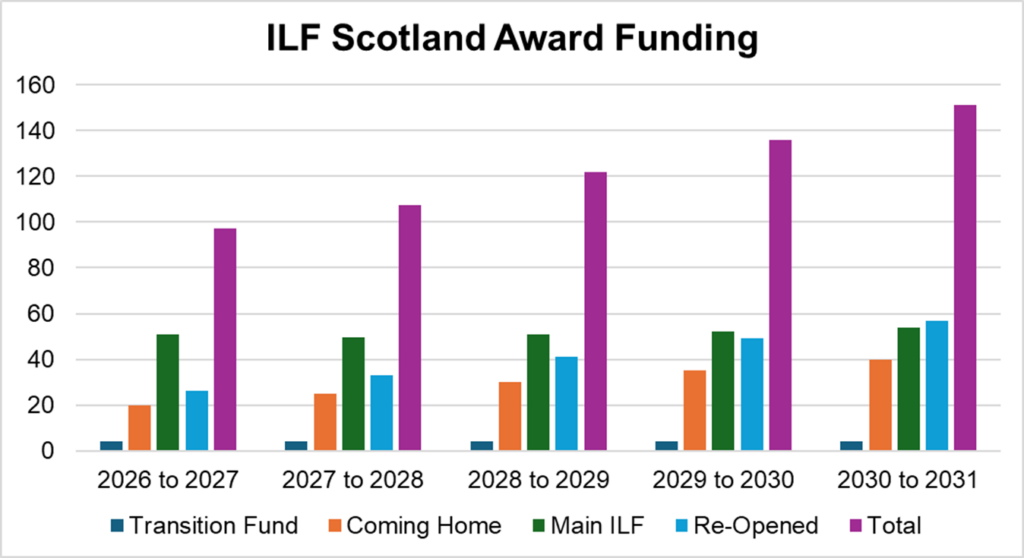
We are projecting a steady and sustainable rise in our funding over the next 2 years. In addition, we may be provided with a significant portion of the Scottish Government’s £20 million budget to support the Coming Home Project. We manage finances carefully and have strong governance arrangements in place and before we commit to any future awards and projects, we assess them to make sure they are affordable and can be sustained. As well as having an award-winning financial team, we have had clean sets of Annual Reports approved by external auditors for 11 years in a row.
Our internal auditors also report that proper arrangements are in place to represent value for money in the services we deliver. We can confidently say that we are managing our funds to the best of our abilities and making sure that as much of these as possible go directly to our Recipients.
We continue to evolve our People Strategy, which sets out our approach to support and develop our employees. We recognise that projects and change programmes are valuable opportunities for our colleagues to build new skills and gain more experience. By making the most of these opportunities, we can create an even more adaptable and confident workforce that can work across different teams. This will support better collaboration and teamwork, help people learn and build a workforce ready and able for the future.
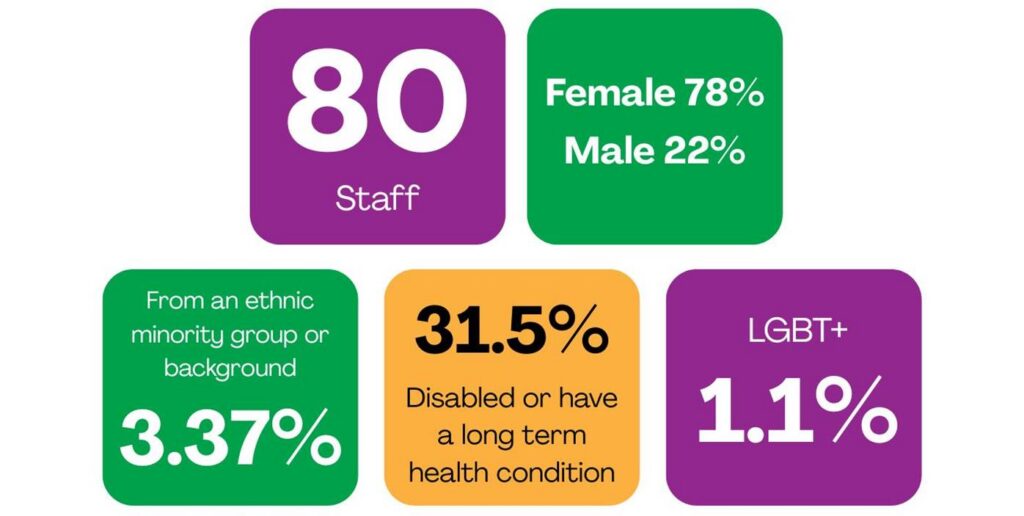
We employ around 80 members of staff who work across a broad range of working patterns. Over half of our workforce operate in frontline roles, directly supporting applicants and Recipients and with our local authority colleagues to develop sustainable support plans for our Recipients. The remainder provide essential support across Finance, People and Culture, Governance, Digital and Information Services, Policy Development and Communications.
Our workforce reflects our commitment to diversity, inclusion and representation. At the start of the 2026 to 2027 financial year, 78% of our employees were female and 22% were male. 31.5% of staff self-identified as disabled or having a long-term health condition, 3.37% are from an ethnic minority background and 1.11% are LGBT+.
While we grow and develop over the next two years, we also aim to make sure we have a stable and capable workforce who have opportunities to be involved in projects across the organisation and who can learn and develop including into future managers and leaders. We indicate below what we think our workforce numbers will look like by the end of 2026 to 2027.
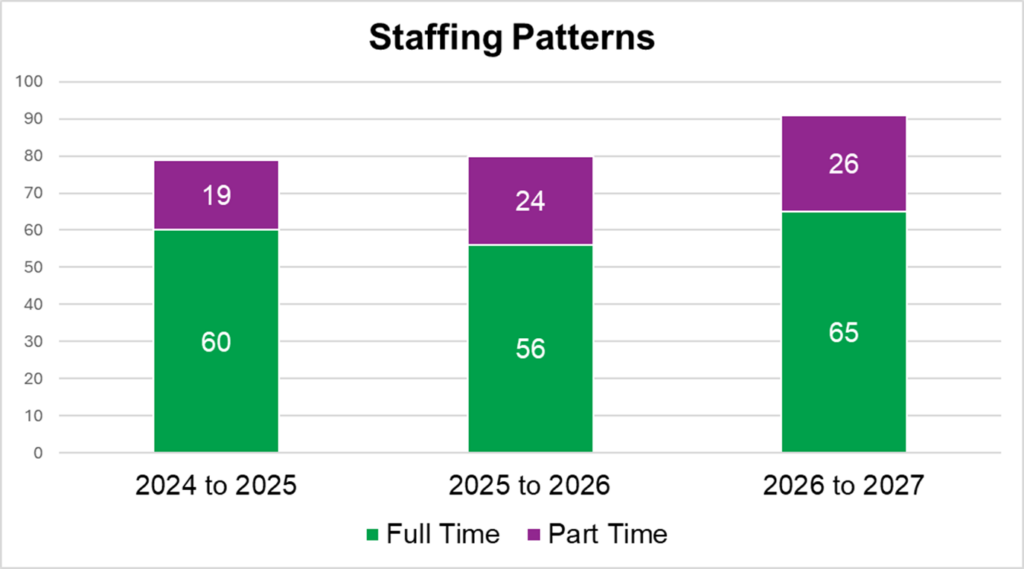
Our strategy confirms that we expect applicant and Recipient numbers to grow over the next few years and there will be a small increase in staff because of this. Our staff are most definitely our greatest asset and through them we strive to deliver our services in the best possible way for those we support and to our professional colleagues.
Nothing in the world of business or public service delivery is risk free and there is always a fine balance between delivering a service and the cost of doing this.
At ILF Scotland, we operate a detailed risk management system. We make sure we understand what risks we might face and manage these appropriately. We also have strong operational resilience and business continuity plans in place. These plans make sure we can act quickly and effectively if things go wrong or there is a crisis we need to respond to.
This year, our principal risks and uncertainties were mainly in connection with:
The Scottish Government elections, the pressures on public finances and the challenges facing health and social care all featured highly on our risk management radar. As a public body, we are directed by Scottish Ministers and funded solely through Scottish Government and may not always be free to operate or deliver the range of services people tell us they want to have. Our policy framework, approved by Scottish Government, sets out who might access our funds and what items and services we can fund.
The Scottish Government has, however, demonstrated a commitment to disabled people in Scotland and confidence in ILF Scotland to deliver services efficiently and effectively, as evidenced by year-on-year increase in funds resulting in growth in the number of people who can access our funds.
During the period of this Business Plan, there will continue to be increasing pressures on health and education, a recruitment crisis in social care and advances in technology that are changing how services are delivered almost daily. However, we are in a strong financial position and we have a good reputation at the highest levels of government for our ability to confidently manager our resources. This is due in part to the now 11 years of unqualified annual accounts and highly accurate financial forecasting. We are fully able to manage effectively with the funding we are allocated on a yearly basis and the confidence in us is reflected in our year-on-year growth in funding.
The period of this Business Plan is going to be a very exciting time for ILF Scotland and for the disabled people we support and who can access our funds. We are in a time of growth with an additional 600 new Recipients to our re-opened Independent Living Fund planned for 2026, at the same time as trialling new routes to applications via our DPO supported application project. Our Transition Fund demand is growing and by undertaking an independent evaluation of it we hope to evidence the life changing difference this grant funding can make to young people and use the findings from the report to inform thinking about the future of the fund.
Internally, we are excited to bring on board new technology to assist with our case management and customer services. In future we will look at potential new routes to applications and a citizen portal so that Recipients and Award Managers might manage their own award or elements of this online if they wish to do so.
At the time of preparing this, we already deliver approximately one quarter of all Direct Payments in Scotland and this is increasing as we complete the third year of the re-opened fund applications. We have a very bright future ahead of us and our business plan for the next two years is to expand our services and support to as many new people as possible!
ILF Scotland
Ground Floor, Denholm House
Almondvale Business Park
Almondvale Way
Livingston
EH54 6GA
Telephone: 0300 200 2022
Email: enquiries@ilf.scot
If you need this document in an alternative format, please contact us.
Follow us:
Facebook: @IndependentLivingFundScotland
X: @ILFScotland
Instagram: @ILFScotland
ILF Scotland Limited is a company limited by guarantee registered in Scotland. Company Number SC5000075. Registered Office Ground Floor, Denholm House, Almondvale Business Park, Almondvale Way, Livingston, EH54 6GA.